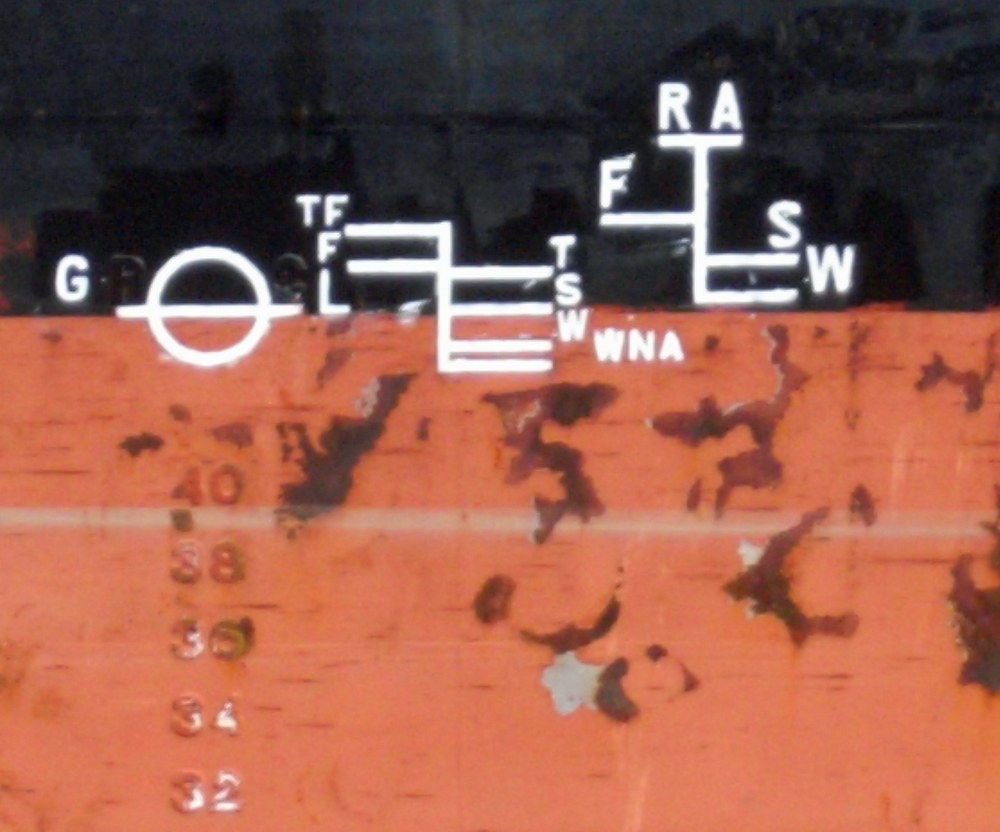


Plimsoll Line
Anweisungen
Load a hull and watch freeboard vanish
Load a hull and watch freeboard vanish
Freeboard is the height from the waterline to the deck. It is what keeps the sea out.
- Float a model hull and mark the waterline.
- Add cargo in measured steps, marking the waterline each time.
- Record freeboard against load.
Materialien für diesen Schritt:
 Balsaholz-Plattensortiment1 Packung
Benötigte Werkzeuge:
 Digitale Küchenwaage
Add waves
Add waves
Static flotation is not the test that matters.
- At high freeboard, make waves in the tank and observe.
- Load the hull heavily and repeat.
- Note when water first comes over the side.
Discover why one line is not enough
Discover why one line is not enough
The same ship floats at different depths in different water.
- Float your loaded hull in fresh water and mark the line.
- Dissolve a lot of salt to make dense water and float it again.
- Compare.
Materialien für diesen Schritt:
 Natriumchlorid (Salz)200 g
Read the real marking
Read the real marking
Learn the letters, which encode water density and season.
- TF Tropical Fresh · F Fresh · T Tropical · S Summer · W Winter · WNA Winter North Atlantic.
- Note that WNA is the LOWEST — the least cargo permitted.
- The circle and bar itself marks the summer load line.
History and context
History and context
Samuel Plimsoll (1824-1898) entered Parliament in 1868 and made overloading his cause, publishing Our Seamen in 1873. The practice he attacked was straightforward: a ship insured for more than her worth, loaded past safety, was a profitable loss if she sank. Crews who refused to sail in a vessel they judged unseaworthy could be — and were — imprisoned for it. In 1873 Plimsoll lost his temper in the Commons, called members villains and shook his fist at the Speaker, and was suspended. The publicity helped.
The Merchant Shipping Act of 1876 made a load line compulsory on British ships. Its serious weakness, which is worth stating, is that it let the SHIPOWNER decide where to paint the line. Owners could and did mark it too high. Government-set positions did not arrive until 1890, and international agreement came with the Load Line Convention of 1930, now maintained by the International Maritime Organization.
The mark carries the assigning authority's initials beside the disc — LR for Lloyd's Register and so on — because a line is only as trustworthy as the body that surveyed it. That is a lesson about standards generally: the number matters less than who is accountable for it.
The name went to a shoe. Plimsoll shoes are said to be named for the band of rubber around the sole, which resembles the ship marking and, like it, indicates the depth at which water gets in.
Materialien
2- 1 PackungPlatzhalter
- Platzhalter
Benötigte Werkzeuge
1- Platzhalter
Verwandte Blueprints
Diese Blueprints teilen Wissen — Techniken, Materialien oder Prinzipien
CC0 Gemeinfrei
Dieser Blueprint ist unter CC0 veröffentlicht. Sie dürfen dieses Werk für jeden Zweck frei kopieren, ändern, verbreiten und verwenden, ohne um Erlaubnis zu fragen.
Unterstützen Sie den Maker, indem Sie Produkte über seinen Blueprint kaufen, wo er eine Maker-Provision von Anbietern festgelegt, verdient. Oder erstellen Sie eine neue Iteration dieses Blueprints und verbinden Sie ihn in Ihrem eigenen Blueprint, um Einnahmen zu teilen.