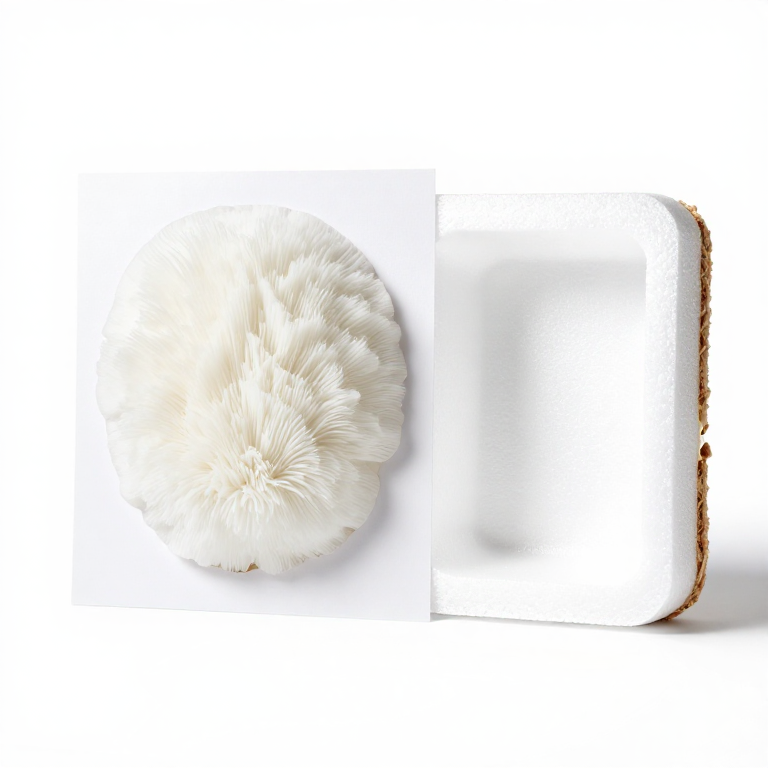


Growing Mycelium Packaging Material — Biodegradable Foam Alternative
Anweisungen
Pasteurize the Substrate
Pasteurize the Substrate
Chop the agricultural waste (hemp hurd, straw, or corn stalks) into pieces approximately 1-3cm long. Submerge in water and heat to 65-80 degrees C for 60-90 minutes. This pasteurization kills competing moulds and bacteria that would outcompete the mycelium, without sterilizing the substrate completely (some beneficial microorganisms survive and actually aid mycelium growth). Drain the substrate thoroughly — it should be damp but not dripping. Squeeze a handful: a few drops of water should emerge, but it should not stream. Excess moisture causes bacterial contamination (anaerobic conditions), while too-dry substrate will not support mycelium growth.
Materialien für diesen Schritt:
 Häckselstroh1-2 kg kg
 Weizenmehl Type 55050g g
Benötigte Werkzeuge:
 Großer Kochtopf
Inoculate and Pack the Mould
Inoculate and Pack the Mould
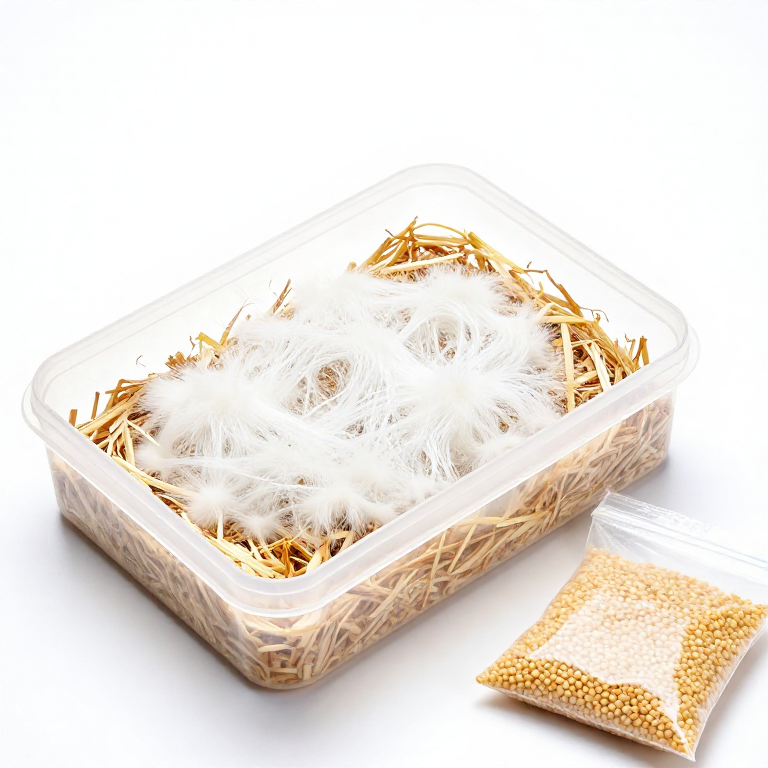
Break the grain spawn into individual grains and mix thoroughly with the cooled, drained substrate at a ratio of 10-15% spawn to substrate by weight. Higher spawn ratios colonize faster and resist contamination better. Pack the inoculated substrate firmly into your mould — the material must be compressed to ensure the mycelium fibers bind the particles into a solid mass. Loose packing produces crumbly, weak material. Wrap the filled mould loosely in plastic to maintain humidity (the mycelium needs high humidity but also some gas exchange). Poke a few small holes in the plastic for air.
Materialien für diesen Schritt:
 Pilzbrut200-300g g
Benötigte Werkzeuge:
 Formwerkzeug für Verpackungen
Incubate for Colonization
Incubate for Colonization
Place the wrapped moulds in a dark, warm location (24-28 degrees C) for 5-7 days. The mycelium grows from each grain spawn point, sending out white hyphae (threadlike filaments) that penetrate and bind the substrate particles together. By day 3-4, white mycelium should be visible on the surface. By day 5-7, the entire surface should be covered with a dense white mat, and the material should hold together as a solid block when the mould is removed. If green or black mould appears instead of white mycelium, the substrate was contaminated — discard it and start over with more thorough pasteurization or a higher spawn ratio.
Benötigte Werkzeuge:
 Frischhaltefolie
Unmould and Skin
Unmould and Skin
Once fully colonized, remove the material from the mould. It should be a solid, self-supporting block that holds its shape. For a smoother, more finished surface, leave the unmoulded piece at room temperature in indirect light for 1-2 additional days. The mycelium will grow a dense outer skin over all exposed surfaces, sealing the material and giving it a smooth, white appearance similar to polystyrene foam. This skinning phase is what gives mycelium packaging its professional appearance and improved water resistance compared to unskinned material.
Dry and Heat-Kill
Dry and Heat-Kill
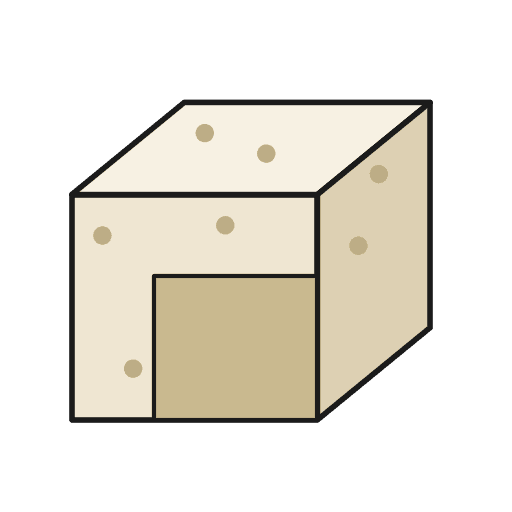
To halt growth and prevent the material from producing mushroom fruiting bodies (which would deform the packaging), heat-kill the mycelium by placing the formed piece in an oven at 80-100 degrees C for 2-4 hours. This dries the material and kills the fungal organism while preserving the structural integrity of the mycelium network. The finished material is lightweight (density approximately 50-100 kg per cubic metre, comparable to expanded polystyrene), insulating, shock-absorbing, fire-resistant (mycelium does not melt or produce toxic fumes like polystyrene), and fully compostable. It decomposes in a home compost or garden soil within 30-90 days, returning nutrients to the soil rather than persisting as plastic waste for centuries.
Benötigte Werkzeuge:
 Backofen
Materialien
5- 1-2 kg kgPlatzhalter
- 50g gPlatzhalter
- 200-300g gPlatzhalter
- 1-2 kg StückPlatzhalter
- 50g StückPlatzhalter
Benötigte Werkzeuge
6- Platzhalter
- Platzhalter
- Platzhalter
- Platzhalter
- Platzhalter
- Platzhalter
Dieser Bauplan stellt her
CC0 Gemeinfrei
Dieser Blueprint ist unter CC0 veröffentlicht. Sie dürfen dieses Werk für jeden Zweck frei kopieren, ändern, verbreiten und verwenden, ohne um Erlaubnis zu fragen.
Unterstützen Sie den Maker, indem Sie Produkte über seinen Blueprint kaufen, wo er eine Maker-Provision von Anbietern festgelegt, verdient. Oder erstellen Sie eine neue Iteration dieses Blueprints und verbinden Sie ihn in Ihrem eigenen Blueprint, um Einnahmen zu teilen.