KUNST
SCHÖNHEIT & WELLNESS
HANDWERK
KULTUR & GESCHICHTE
UNTERHALTUNG
UMFELD
ESSEN & GETRÄNKE
REVERSE ENGINEERING
WISSENSCHAFTEN
SPORT
TECHNOLOGIE
WEARABLES
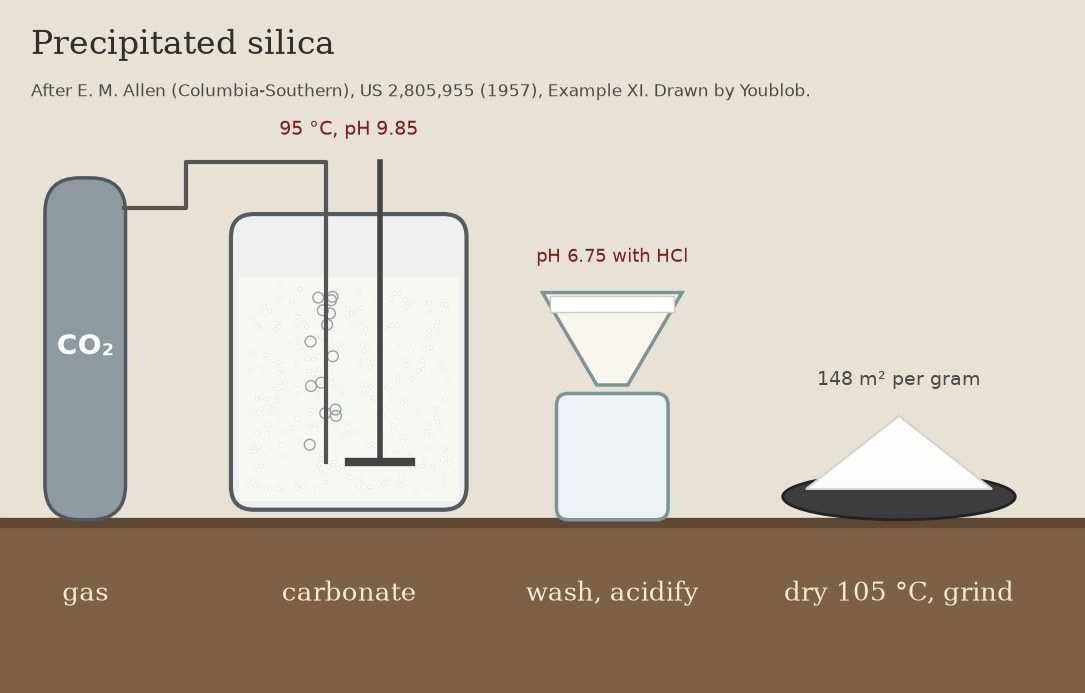
Youblob · CC0


Precipitated Silica: Hot Water Glass Carbonated, Then Acidified to pH 6.75 (Allen 1957)
Bubble carbon dioxide through hot dilute water glass and the silica comes down as an extremely fine white powder rather than a gel. Edward Allen of Columbia-Southern made it this way as a white reinforcing filler for rubber; this follows his Example XI, which gave a powder of 148 m² per gram.
Source: E. M. Allen (Columbia-Southern), US 2,805,955 (1957), Example XI. The percentages are our arithmetic; the filter, mill and indicator are ours. Picture drawn by Youblob.
Fortgeschritten
2 days
Anweisungen
1
1
Dilute the water glass
Dilute the water glass
Take 12,850 g of sodium silicate solution holding 976 g Na2O and 3115 g SiO2 (7.6 % and 24.2 %, a silica to soda ratio of 3.19 by weight; our arithmetic). Dilute it with water to 48 litres in a stirred kettle with a heating coil and thermometer, and heat to 95 °C.
Materialien für diesen Schritt:
 Wasserglas (Natriumsilikatlösung)12850 g
 Wasser1 as required
Benötigte Werkzeuge:
 Druckreaktor
 Rührer
 Thermometer
 Balkenwaage
2
2
Carbonate for an hour
Carbonate for an hour
Bubble in pure carbon dioxide fast enough to add the theoretical amount in about 30 minutes, and keep going at that rate for about 1 hour. The slurry ends at pH 9.85.
Benötigte Werkzeuge:
 KohlendioxidgasDruckreaktorRührerThermometer
 pH-Indikatorpapier
3
3
Filter and wash
Filter and wash
Filter the slurry and wash the cake twice with hot water.
Materialien für diesen Schritt:
Wasser1 as requiredBenötigte Werkzeuge:
 Büchnertrichter (Porzellan)
 Filterpapier
4
4
Acidify to pH 6.75
Acidify to pH 6.75
Stir the cake back into water and bring it to pH 6.75 with 400 ml of 3.5 N hydrochloric acid.
Materialien für diesen Schritt:
Wasser1 as requiredBenötigte Werkzeuge:
 Salzsäure
 GlasgefäßRührerpH-Indikatorpapier
5
5
Wash out the chloride
Wash out the chloride
Filter again and wash the cake with hot water until it is nearly free of chloride.
Materialien für diesen Schritt:
Wasser1 as requiredBenötigte Werkzeuge:
Büchnertrichter (Porzellan)Filterpapier6
6
Dry at 105 °C and grind
Dry at 105 °C and grind
Dry it at 105 °C in a fan oven and grind it to a fine powder. Allen's had a pH of 8.2, 0.61 % sodium and a surface area of 148 m² per gram.
Benötigte Werkzeuge:
 Trockenofen
 Mörser und Pistill
 Glasgefäße mit Deckel
Materialien
2- Platzhalter
- 4 as requiredPlatzhalter
Benötigte Werkzeuge
13- Platzhalter
- Platzhalter
- Platzhalter
- Platzhalter
- Platzhalter
- Platzhalter
- Platzhalter
- Platzhalter
- Platzhalter
- Platzhalter
- Platzhalter
- Platzhalter
- Platzhalter
Dieser Bauplan stellt her
Verwandte Blueprints
Diese Blueprints teilen Wissen — Techniken, Materialien oder Prinzipien
CC0 Gemeinfrei
Dieser Blueprint ist unter CC0 veröffentlicht. Sie dürfen dieses Werk für jeden Zweck frei kopieren, ändern, verbreiten und verwenden, ohne um Erlaubnis zu fragen.
Unterstützen Sie den Maker, indem Sie Produkte über seinen Blueprint kaufen, wo er eine Maker-Provision von Anbietern festgelegt, verdient. Oder erstellen Sie eine neue Iteration dieses Blueprints und verbinden Sie ihn in Ihrem eigenen Blueprint, um Einnahmen zu teilen.