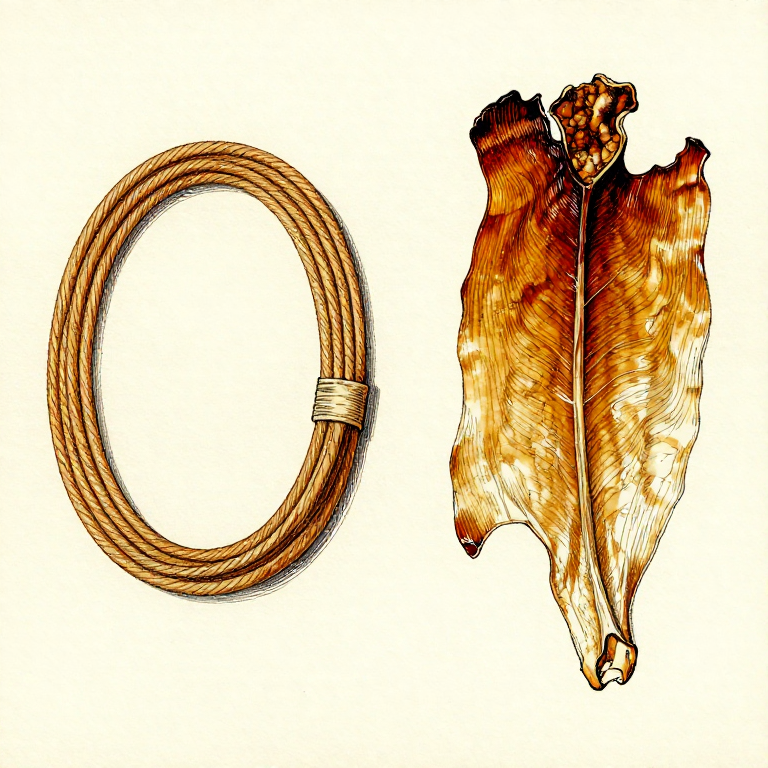


Making Rawhide Cord — Strong Binding from Animal Skin
Anweisungen
Clean and Dehair the Hide
Clean and Dehair the Hide
If using a fresh hide, scrape the flesh side with a flint scraper to remove all fat, meat, and membrane. For dehairing, soak the hide in a wood ash solution (wood ash mixed with water creates a weak alkaline lye, approximately pH 10-12) for 2-3 days. The alkaline solution loosens the hair follicles and swells the collagen fibres, making the hair easy to scrape off. After soaking, drape the hide over a smooth log and scrape the hair side firmly with a blunt flint scraper — the hair should slip off in sheets. Rinse the hide thoroughly in clean water to remove all ash residue. If using a dried hide, simply soak it in plain water for 12-24 hours until pliable.
Materialien für diesen Schritt:
 Hartholzasche500 g g
 Wasserseveral litres for soaking Stück
Benötigte Werkzeuge:
 Feuersteinmesser
 Holzdübelstange
Cut the Hide into Strips
Cut the Hide into Strips
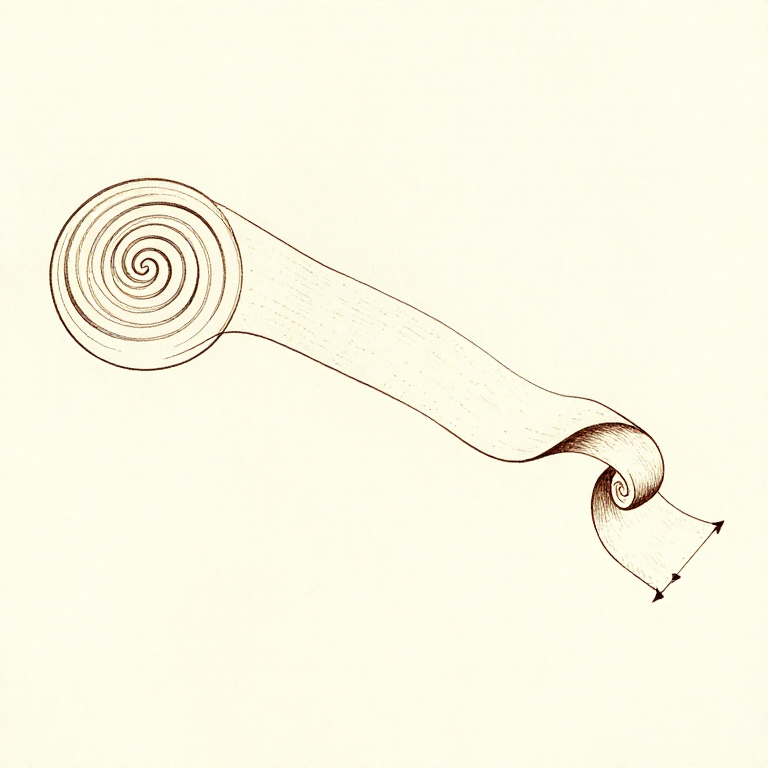
While the hide is still wet and pliable, cut it into long, even strips. The most efficient method for maximising strip length is spiral cutting: start at the outer edge of a roughly circular piece of hide and cut in a continuous spiral toward the centre, producing one very long strip from a single piece. Cut the strips 3-6 mm wide for general-purpose cord, or 10-15 mm wide for heavy lashing. Keep the width as uniform as possible — variations create weak points. A 30 cm square of hide, spiral-cut at 5 mm width, yields approximately 3-4 metres of cord. Cut along the grain of the hide (parallel to the spine) where possible, as this orientation gives the strongest cord.
Stretch and Smooth the Strips
Stretch and Smooth the Strips
While the strips are still damp, pull each one firmly along its length over the edge of a smooth wooden stake or rounded stone. This stretches the collagen fibres into alignment and compresses the cross-section into a roughly round cord profile. Pull the strip through 5-10 times, applying firm pressure against the stake edge. The stretching also removes any residual membrane and evens out thick spots. Twist the strip lightly as you pull to encourage a round profile. The wet strip should feel smooth and slightly slippery — this is the collagen fibres sliding into alignment. A well-stretched strip loses approximately 20% of its original width but gains significantly in tensile strength due to fibre alignment.
Dry Under Tension
Dry Under Tension
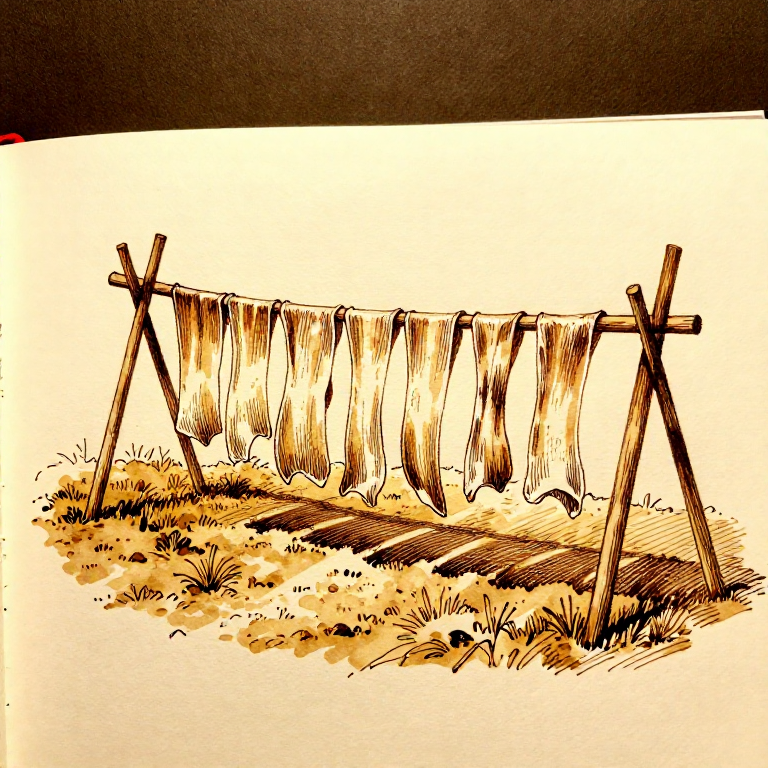
Tie or peg the wet strips between two fixed points (trees, stakes, or a simple drying frame) under moderate tension and allow them to dry completely. Drying takes 12-24 hours depending on humidity and temperature. The critical principle: rawhide shrinks as it dries, and if dried under tension, the collagen fibres lock in their stretched, aligned orientation, producing a cord that is stiff, strong, and resistant to further stretching. If dried without tension, the strips curl and contract unevenly. The dried cord is translucent amber, stiff as wire, and can be stored indefinitely. To use, simply re-wet the cord briefly to make it pliable for wrapping and tying — it shrinks tight again as it dries.
Apply as Shrink-Tight Binding
Apply as Shrink-Tight Binding
To use rawhide cord for hafting or binding, soak a length in water for 10-15 minutes until pliable, then wrap it tightly around the joint — for example, binding a flint blade into a split wooden handle. As the rawhide dries over the following 12-24 hours, it shrinks by 10-15% of its length, compressing the joint with enormous clamping force. This shrink-fit binding is what made rawhide superior to plant-fibre cordage for tool hafting: the joint actually tightens with age rather than loosening. For extra security, apply a coating of pine resin over the dried binding to waterproof it and prevent moisture from re-softening the rawhide. Hafted tools from the Iceman (Oetzi, c. 3300 BCE) found in the Alps used rawhide bindings that were still intact after 5,300 years of burial.
Materialien
4- Fresh or dried animal hide (deer, elk, cow, or goat)1 piece, approximately 30 x 30 cm cm
- 500 g gPlatzhalter
- several litres for soaking StückPlatzhalter
- 1 piece, approximately 30 x 30 cm StückPlatzhalter
Benötigte Werkzeuge
6- Platzhalter
- Sharp flint blade (for cutting strips)
- Platzhalter
- Platzhalter
- Platzhalter
- Platzhalter
CC0 Gemeinfrei
Dieser Blueprint ist unter CC0 veröffentlicht. Sie dürfen dieses Werk für jeden Zweck frei kopieren, ändern, verbreiten und verwenden, ohne um Erlaubnis zu fragen.
Unterstützen Sie den Maker, indem Sie Produkte über seinen Blueprint kaufen, wo er eine Maker-Provision von Anbietern festgelegt, verdient. Oder erstellen Sie eine neue Iteration dieses Blueprints und verbinden Sie ihn in Ihrem eigenen Blueprint, um Einnahmen zu teilen.