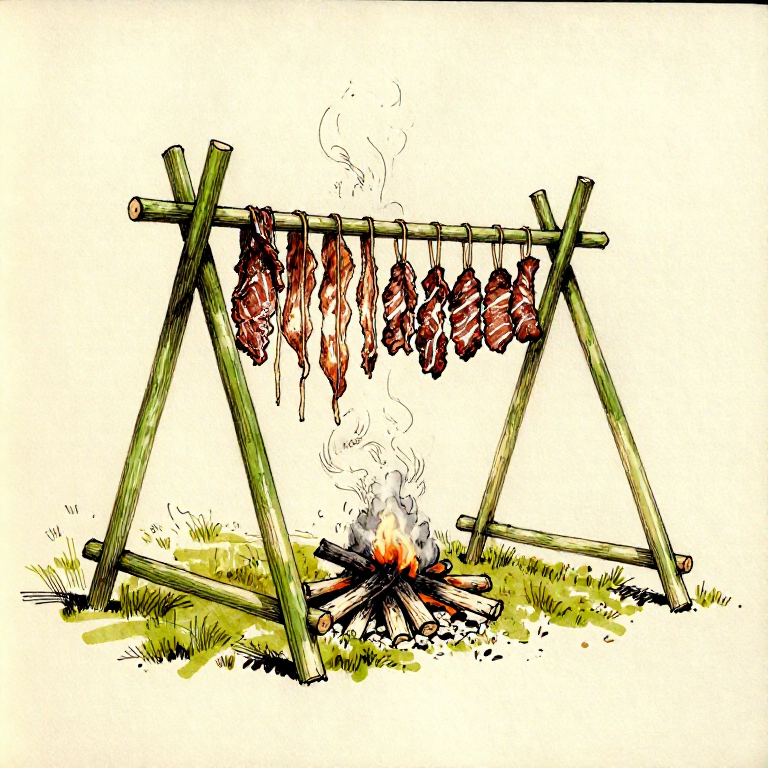


Building a Meat Smoking Rack — Pole Frame for Preservation
Anweisungen
Select the Site and Gather Poles
Select the Site and Gather Poles
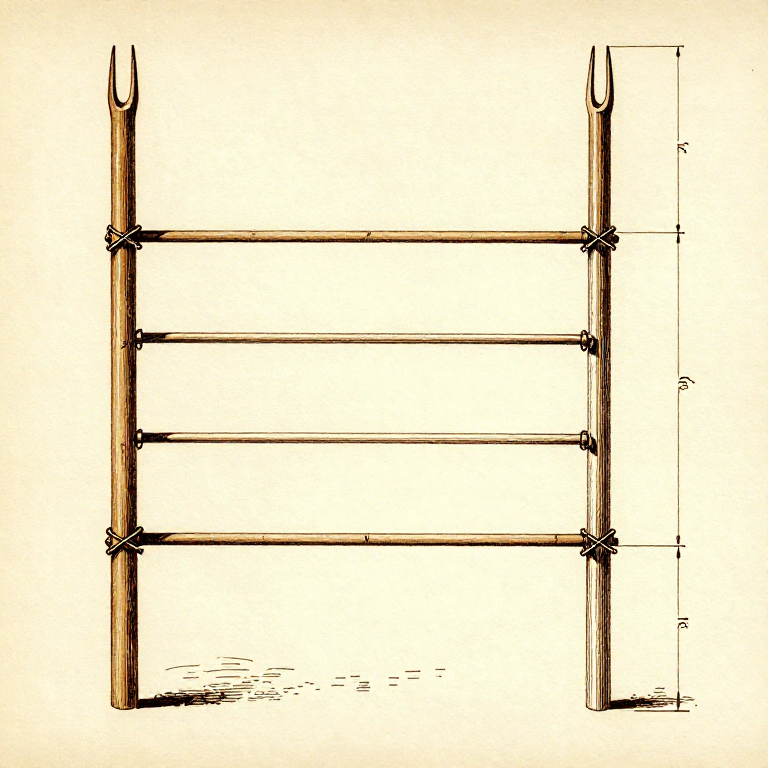
Choose a sheltered location near your fire pit but away from overhanging branches that could catch fire. Gather 8-12 straight green wood poles — willow, hazel, and alder are ideal because green wood resists burning. You need 4 upright poles approximately 1.5-2 m long and 4-8 cross-bars about 1-1.5 m long. Green wood is essential — dry wood placed above a fire will eventually ignite and collapse the entire rack. Cut forked tops on 4 of the poles if possible; the forks cradle the horizontal cross-bars naturally.
Materialien für diesen Schritt:
 Schnur (Kordel)5-8 m m
 Räucherchips aus Hartholz5-10 kg kg
 Lammfleisch5-15 kg, sliced thin kg
Benötigte Werkzeuge:
 Feuersteinmesser
 Brandwachen-Set fürs Schweißen
Build the Frame
Build the Frame
Drive 4 upright poles into the ground in a rectangle approximately 1 m x 0.5 m, with each pole sunk 20-30 cm deep for stability. If the ground is too hard to drive poles, lash pairs of poles together in an X or A-frame configuration and lean them against each other. Lay horizontal cross-bars between the upright forks at 2-3 different heights, starting at about 50-60 cm above the ground for the lowest level. Space the cross-bars 15-20 cm apart at each level. Lash all joints securely with cordage or flexible green withies — the rack must support the weight of several kilograms of meat without sagging or collapsing.
Materialien für diesen Schritt:
Schnur (Kordel)5-8 m mRäucherchips aus Hartholz5-10 kg kgLammfleisch5-15 kg, sliced thin kgPrepare the Meat
Prepare the Meat
Slice the meat into thin strips approximately 5-8 mm thick, cutting across the grain. Thin strips dry and smoke faster and more evenly than thick chunks. Remove as much fat as possible — fat does not dry well and can turn rancid, shortening the storage life of the finished product. If salt is available, rub a light coating onto each strip before smoking. Long, thin strips can be draped directly over the cross-bars. Shorter pieces can be threaded onto thin green sticks and laid across the bars like skewers.
Build and Manage the Smoke Fire
Build and Manage the Smoke Fire
Build a small fire directly beneath the rack. Once you have a coal bed, add green hardwood chips or damp hardwood chunks to produce heavy smoke. Oak, alder, apple, and mesquite produce the best smoke flavour. Avoid resinous softwoods like pine or spruce — they deposit bitter-tasting creosote on the meat. The fire should smoulder and smoke heavily without producing significant flame. If flames appear, dampen them with a sprinkle of water. Maintain this smoky fire for 6-12 hours for hot-smoked meat (cooked and preserved) or 24-48 hours at lower temperatures for cold-smoked meat (more thoroughly preserved for longer storage).
Materialien für diesen Schritt:
Schnur (Kordel)5-8 m mRäucherchips aus Hartholz5-10 kg kgLammfleisch5-15 kg, sliced thin kgCheck Doneness and Store
Check Doneness and Store
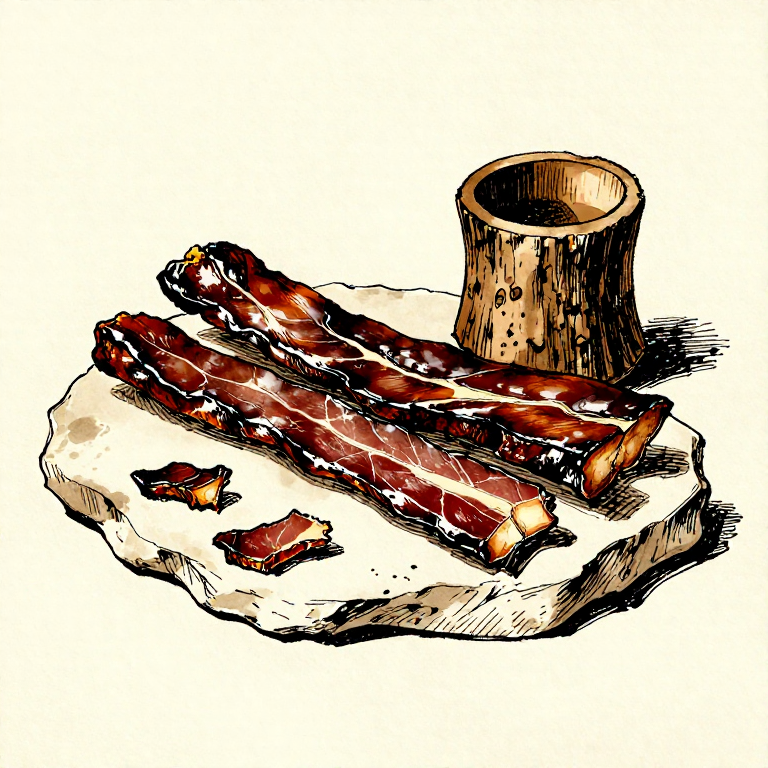
The meat is fully smoked when the strips are dark brown, dry to the touch, firm but still slightly flexible (like leather, not brittle), and have a pleasant smoky aroma. Break a thick piece in half — there should be no pink or moist interior. Well-smoked meat stored in a dry, ventilated container (a bark box or woven basket) keeps for 2-4 weeks at ambient temperature. In cool, dry conditions it lasts even longer. Smoke deposits phenolic compounds and formaldehyde on the meat surface that inhibit bacterial growth, while the heat and dehydration reduce the moisture content below the threshold needed for microbial activity.
Materialien
5- Green wood poles (willow, hazel, or alder)8-12 poles, 1-2 m long m
- 5-8 m mPlatzhalter
- 5-10 kg kgPlatzhalter
- 5-15 kg, sliced thin kgPlatzhalter
- 8-12 poles, 1-2 m long StückPlatzhalter
Benötigte Werkzeuge
2- Platzhalter
- Platzhalter
Verwandte Blueprints
Diese Blueprints teilen Wissen — Techniken, Materialien oder Prinzipien


CC0 Gemeinfrei
Dieser Blueprint ist unter CC0 veröffentlicht. Sie dürfen dieses Werk für jeden Zweck frei kopieren, ändern, verbreiten und verwenden, ohne um Erlaubnis zu fragen.
Unterstützen Sie den Maker, indem Sie Produkte über seinen Blueprint kaufen, wo er eine Maker-Provision von Anbietern festgelegt, verdient. Oder erstellen Sie eine neue Iteration dieses Blueprints und verbinden Sie ihn in Ihrem eigenen Blueprint, um Einnahmen zu teilen.