Zusammenarbeit
KUNST
SCHÖNHEIT & WELLNESS
HANDWERK
KULTUR & GESCHICHTE
UNTERHALTUNG
UMFELD
ESSEN & GETRÄNKE
REVERSE ENGINEERING
WISSENSCHAFTEN
SPORT
TECHNOLOGIE
WEARABLES
Gefährlich

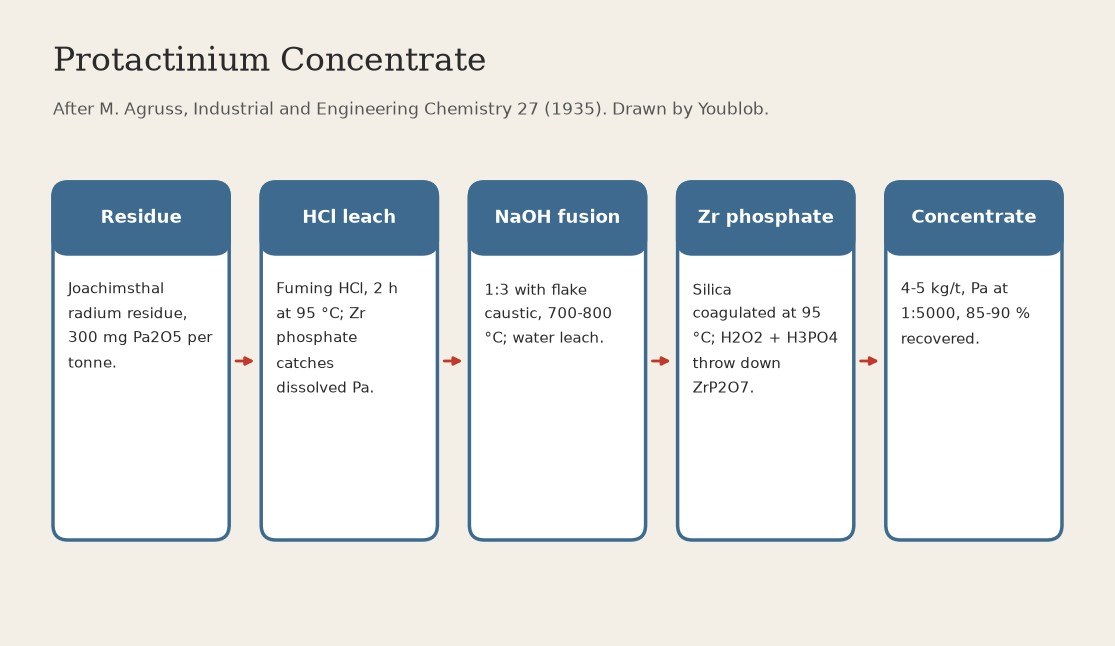
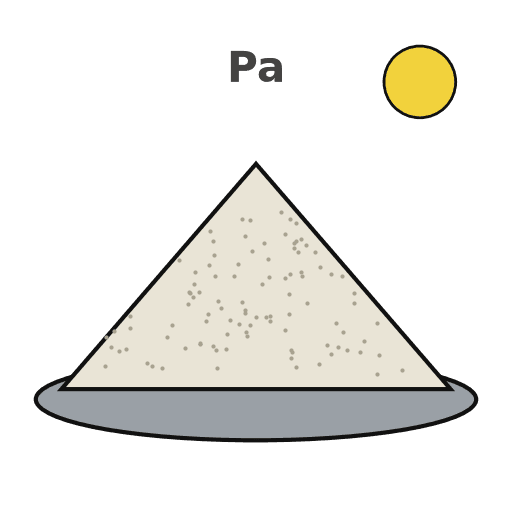
Protactinium Concentrate: Pitchblende Residues Leached, Fused and Carried Down on Zirconium Phosphate (Agruss, 1935)
A works-scale extraction of protactinium, carried on from I. G. Farben's 1928 process. The residue left after radium has been taken from pitchblende still holds about 300 mg of protactinium oxide per tonne. An acid leach, a caustic-soda fusion and a water leach strip away iron, lead and most of the silica; zirconium phosphate and silica then carry the protactinium down.
Result: a concentrate of 4-5 kg per tonne holding 85-90 % of the protactinium at about one part in 5000. In 1935, 1200 kg of residue had given 250 mg of Pa2O5 in this form.
Source: M. Agruss, The Technical Extraction of Element 91 - Protoactinium, Industrial and Engineering Chemistry 27 (1935). Unknown: how the residue and the zirconium oxychloride were made. Not given: the final potash melt. The residue is radioactive. Picture drawn by Youblob.
Erfahren
4 weeks
Gefährlicher Inhalt
Dieser Blueprint enthält gefährliche Verfahren. Melden Sie sich an und aktivieren Sie gefährliche Inhalte in Ihren Kontoeinstellungen, um die Schritt-für-Schritt-Anleitung anzuzeigen.
AnmeldenDieser Bauplan stellt her
Verwandte Blueprints
Diese Blueprints teilen Wissen — Techniken, Materialien oder Prinzipien

Gefährlich
Radium Chloride: Pitchblende Residues Worked Up and the Chlorides Fractionally Crystallised from Hydrochloric Acid (Curie, Debierne, Haitinger and Ulrich, Thorpe 1912)
von Charlie
Anorganisch
8
0
0
0
0
0

Gefährlich
Radium: Chloride Electrolysed onto Mercury, Amalgam Heated to 700 °C in Hydrogen (Curie and Debierne, 1910)
von Charlie
Anorganisch
7
0
0
0
0
0
CC0 Gemeinfrei
Dieser Blueprint ist unter CC0 veröffentlicht. Sie dürfen dieses Werk für jeden Zweck frei kopieren, ändern, verbreiten und verwenden, ohne um Erlaubnis zu fragen.
Unterstützen Sie den Maker, indem Sie Produkte über seinen Blueprint kaufen, wo er eine Maker-Provision von Anbietern festgelegt, verdient. Oder erstellen Sie eine neue Iteration dieses Blueprints und verbinden Sie ihn in Ihrem eigenen Blueprint, um Einnahmen zu teilen.