KUNST
SCHÖNHEIT & WELLNESS
HANDWERK
KULTUR & GESCHICHTE
UNTERHALTUNG
UMFELD
ESSEN & GETRÄNKE
REVERSE ENGINEERING
WISSENSCHAFTEN
SPORT
TECHNOLOGIE
WEARABLES
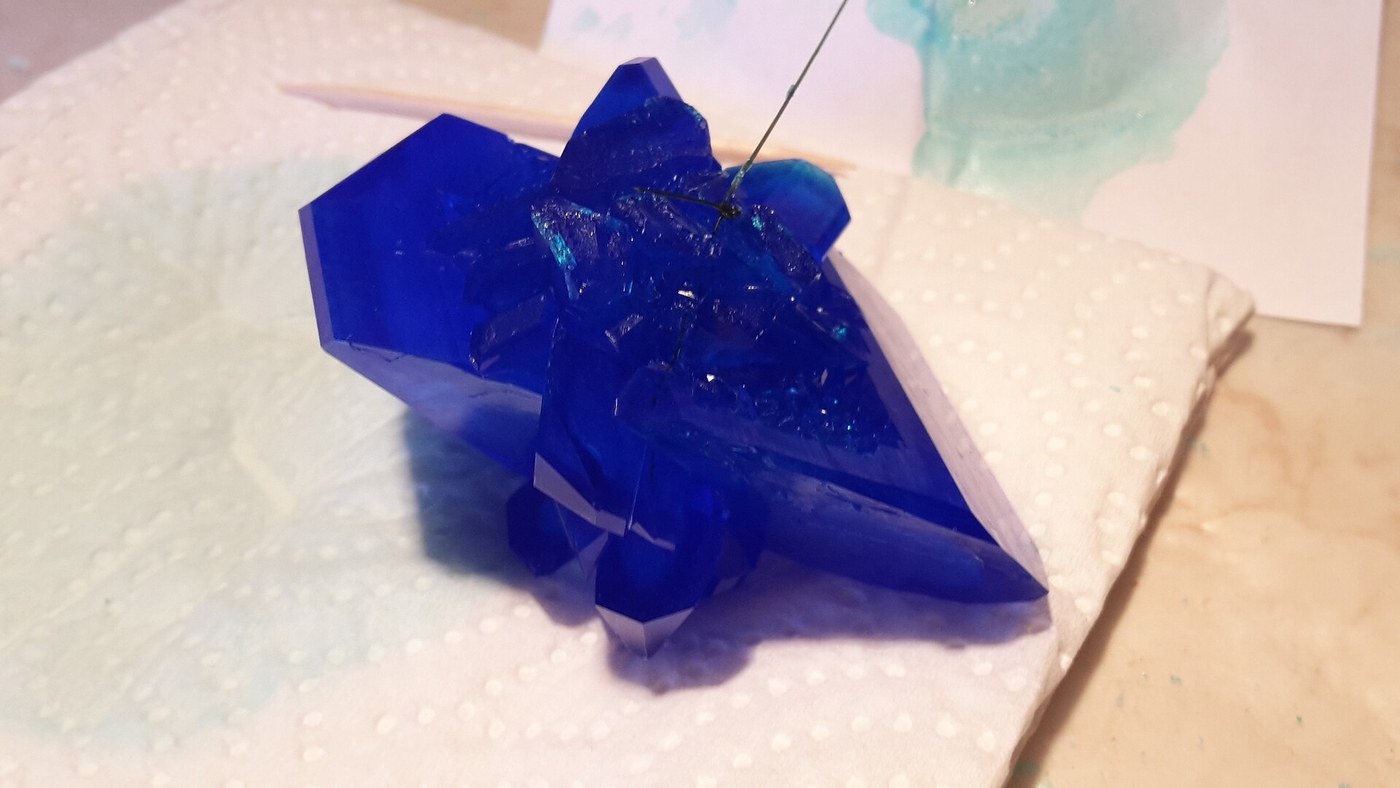


Purified Copper Sulphate: Iron Thrown Down by Fresh Copper Carbonate, Then Recrystallised
Ordinary copper sulphate usually carries a little iron sulphate. The 1907 US Dispensatory gives the cure: add freshly precipitated copper carbonate, which throws the iron down as carbonate, then filter and crystallise. The pharmacopoeia salt had to be at least 99.5 % pure copper sulphate. Making the copper carbonate from part of the same solution, and drying below 30 °C, are our choices. The source gives no quantities, so none are given here.
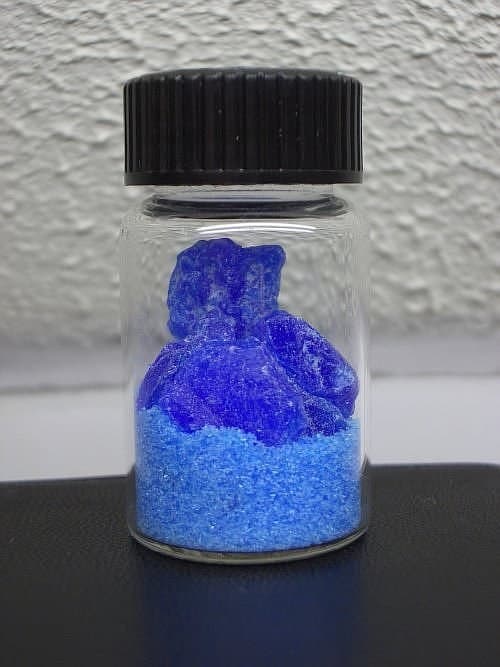
The picture: a copper sulphate crystal (Crystal Titan, Wikimedia Commons, CC BY-SA 4.0).
Fortgeschritten
Two to three days
Anweisungen
1
1
Dissolve in boiling water
Dissolve in boiling water
Dissolve the copper sulphate in boiling distilled water: it takes about half its weight of boiling water (and about 2.2 times its weight of water at 25 °C).
Materialien für diesen Schritt:
 Kupfersulfat-Pentahydrat (CuSO4·5H2O)1 as required
Benötigte Werkzeuge:
 Destilliertes Wasser
 Becherglas aus Borosilikat
 Glasrührstab
 Heizplatte
 Chemikalienschutzbrille
 Gummihandschuhe
2
2
Make fresh copper carbonate
Make fresh copper carbonate
Take a small part of the solution and stir in sodium carbonate solution: alkaline carbonates decompose copper sulphate and copper carbonate falls. Filter it and wash it with distilled water. Use it fresh.
Benötigte Werkzeuge:
 Natriumcarbonat (Soda)Destilliertes WasserBecherglas aus BorosilikatGlasrührstab
 Glastrichter mit Stiel
 FilterpapierChemikalienschutzbrilleGummihandschuhe
3
3
Throw down the iron and filter
Throw down the iron and filter
Stir the fresh copper carbonate into the hot solution, in excess. The iron is deposited as carbonate. Filter the hot solution clear.
Benötigte Werkzeuge:
Becherglas aus BorosilikatGlasrührstabHeizplatteGlastrichter mit StielFilterpapierChemikalienschutzbrilleGummihandschuhe4
4
Crystallise and dry
Crystallise and dry
Evaporate the filtrate in a dish until crystals begin to form, then let it cool. Large, transparent, deep blue crystals grow. Drain them and dry them in the air below 30 °C: at 30 °C the salt starts to lose its water of crystallisation. It slowly loses water in dry air too, so keep it in stoppered bottles.
Benötigte Werkzeuge:
 AbdampfschaleHeizplatte
 Glasflaschen mit StopfenGummihandschuhe
5
5
Test for iron
Test for iron
Dissolve a crystal in water in a test tube and add ammonia water drop by drop. A pale blue precipitate forms and then dissolves in more ammonia to a deep azure-blue solution. Any iron is thrown down with it and does not dissolve again in the excess, so the solution should stay clear. A salt that turns green on the surface in air still contains iron.
Benötigte Werkzeuge:
 ReagenzgläserDestilliertes Wasser
 Ammoniaklösung, verdünntChemikalienschutzbrilleGummihandschuhe
Materialien
1- 1 as requiredPlatzhalter
Benötigte Werkzeuge
13- Platzhalter
- Platzhalter
- Platzhalter
- Platzhalter
- Platzhalter
- Platzhalter
- Platzhalter
- Platzhalter
- Platzhalter
- Platzhalter
- Platzhalter
- Platzhalter
- Platzhalter
Dieser Bauplan stellt her

Verwandte Blueprints
Diese Blueprints teilen Wissen — Techniken, Materialien oder Prinzipien
CC0 Gemeinfrei
Dieser Blueprint ist unter CC0 veröffentlicht. Sie dürfen dieses Werk für jeden Zweck frei kopieren, ändern, verbreiten und verwenden, ohne um Erlaubnis zu fragen.
Unterstützen Sie den Maker, indem Sie Produkte über seinen Blueprint kaufen, wo er eine Maker-Provision von Anbietern festgelegt, verdient. Oder erstellen Sie eine neue Iteration dieses Blueprints und verbinden Sie ihn in Ihrem eigenen Blueprint, um Einnahmen zu teilen.