Zusammenarbeit
KUNST
SCHÖNHEIT & WELLNESS
HANDWERK
KULTUR & GESCHICHTE
UNTERHALTUNG
UMFELD
ESSEN & GETRÄNKE
REVERSE ENGINEERING
WISSENSCHAFTEN
SPORT
TECHNOLOGIE
WEARABLES
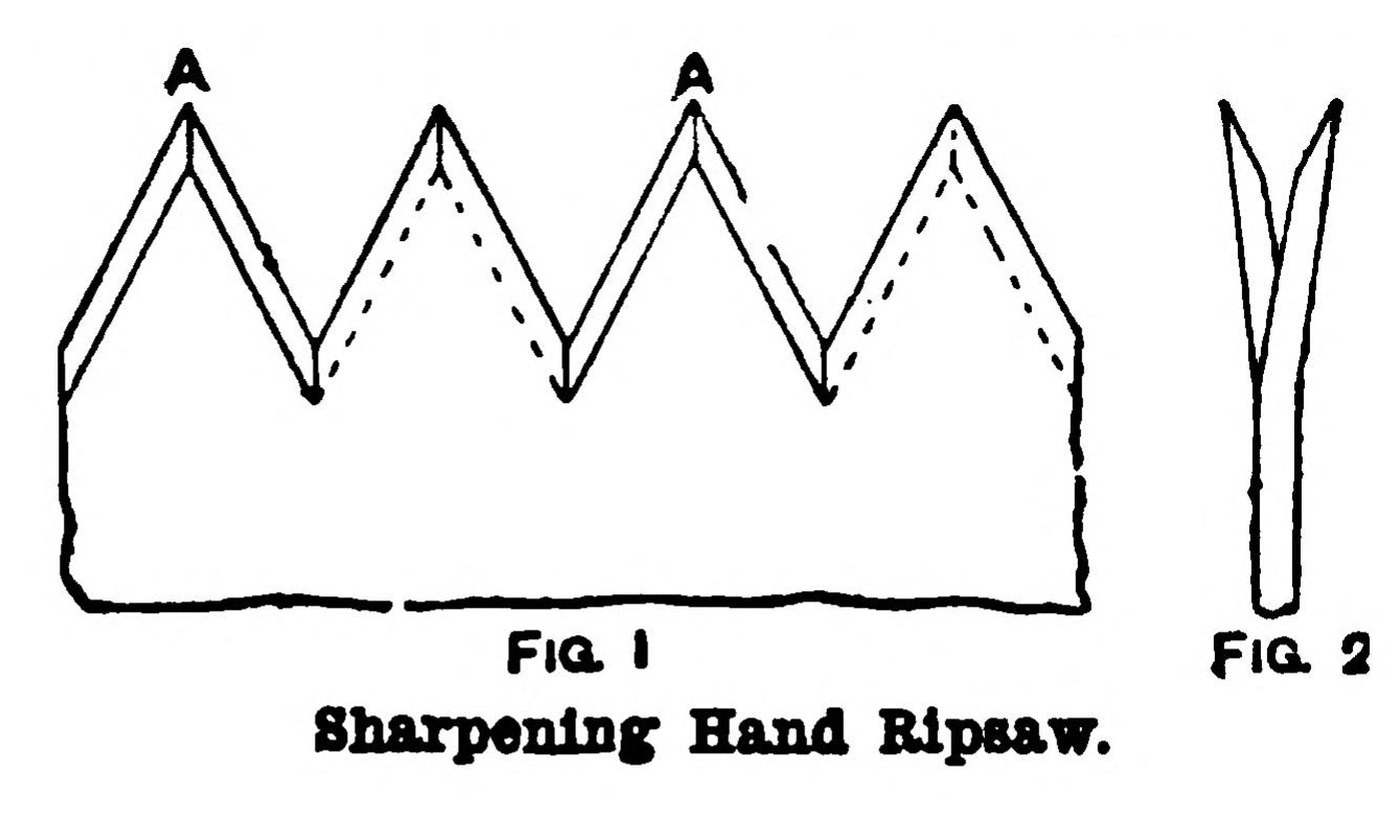


Rip Saw: Diamond-Pointed Teeth Bevelled from One Face (Cassell's Cyclopaedia, 1904)
A less common way to sharpen a hand rip saw, given in Cassell's Cyclopaedia of Mechanics (1904) as one that "answers well in actual practice". Both edges of each tooth are bevelled from the same face, so every tooth comes to a long point like a diamond-pointed wood chisel with a left and a right cutting edge, the teeth alternating from side to side of the blade. Set as usual, with the flat side of each pointed tooth turned outward. Teeth a little longer than an equilateral triangle, with a longer side slope, cut much more sweetly.
Tooth size, bevel angle and amount of set are not given; those are unknown here.
Source: P. N. Hasluck (ed.), Cassell's Cyclopaedia of Mechanics vol. V (1904), p. 122. Picture: its figs. 1 and 2.
Fortgeschritten
An hour
Anweisungen
1
1
Read Cassell's
Read Cassell's
"... both edges of each tooth are bevelled from the same face, to form a long point at A (Fig. 1). In this way each successive tooth resembles a diamond-pointed wood chisel having a left and right cutting edge ..."
2
2
Clamp the saw
Clamp the saw
Clamp the hand saw in the vice with its teeth just above the jaws.
Materialien für diesen Schritt:
 Tischlersäge1 hand saw
Benötigte Werkzeuge:
 Schraubstock
3
3
File the long points
File the long points
File alternate teeth from one side of the blade, bevelling BOTH edges of each tooth from that same face so the tooth ends in a long point (A in Fig. 1). Turn the saw and file the other teeth the same way from the other face. Make the teeth slightly longer than an equilateral triangle and the side slope a little longer than usual, for a keener edge. The bevel angle and tooth size are not given (unknown).
Benötigte Werkzeuge:
 Sägefeile
 Unbekannte Maße
4
4
Set the teeth
Set the teeth
Give the usual set: turn the flat side of each pointed tooth outward, alternately left and right (Fig. 2), the same amount on each side. The amount is not given (unknown).
Benötigte Werkzeuge:
 SägeschränkzangeUnbekannte Maße
5
5
History and honest limits
History and honest limits
Cassell's notes this method was "not generally adopted"; the usual rip saw has upright fronts filed with a small bevel (p. 73, the other Rip Saw blueprint).
Tooth size, bevel angle and amount of set are not given; the saw is a hand saw refiled for ripping.
Materialien
1- 1 hand sawPlatzhalter
Benötigte Werkzeuge
4- Platzhalter
- Platzhalter
- Platzhalter
- Platzhalter
Dieser Bauplan stellt her

CC0 Gemeinfrei
Dieser Blueprint ist unter CC0 veröffentlicht. Sie dürfen dieses Werk für jeden Zweck frei kopieren, ändern, verbreiten und verwenden, ohne um Erlaubnis zu fragen.
Unterstützen Sie den Maker, indem Sie Produkte über seinen Blueprint kaufen, wo er eine Maker-Provision von Anbietern festgelegt, verdient. Oder erstellen Sie eine neue Iteration dieses Blueprints und verbinden Sie ihn in Ihrem eigenen Blueprint, um Einnahmen zu teilen.