Zusammenarbeit
KUNST
SCHÖNHEIT & WELLNESS
HANDWERK
KULTUR & GESCHICHTE
UNTERHALTUNG
UMFELD
ESSEN & GETRÄNKE
REVERSE ENGINEERING
WISSENSCHAFTEN
SPORT
TECHNOLOGIE
WEARABLES
Atmospheric Barrel Churn: Reversed Concave Dashers Close to the Staves, Fresh or Warmed Air Piped to the Middle
Buttercup

Erstellt von

Buttercup

11. November 2026IE
0
0
0
0
0

Atmospheric Barrel Churn: Reversed Concave Dashers Close to the Staves, Fresh or Warmed Air Piped to the Middle

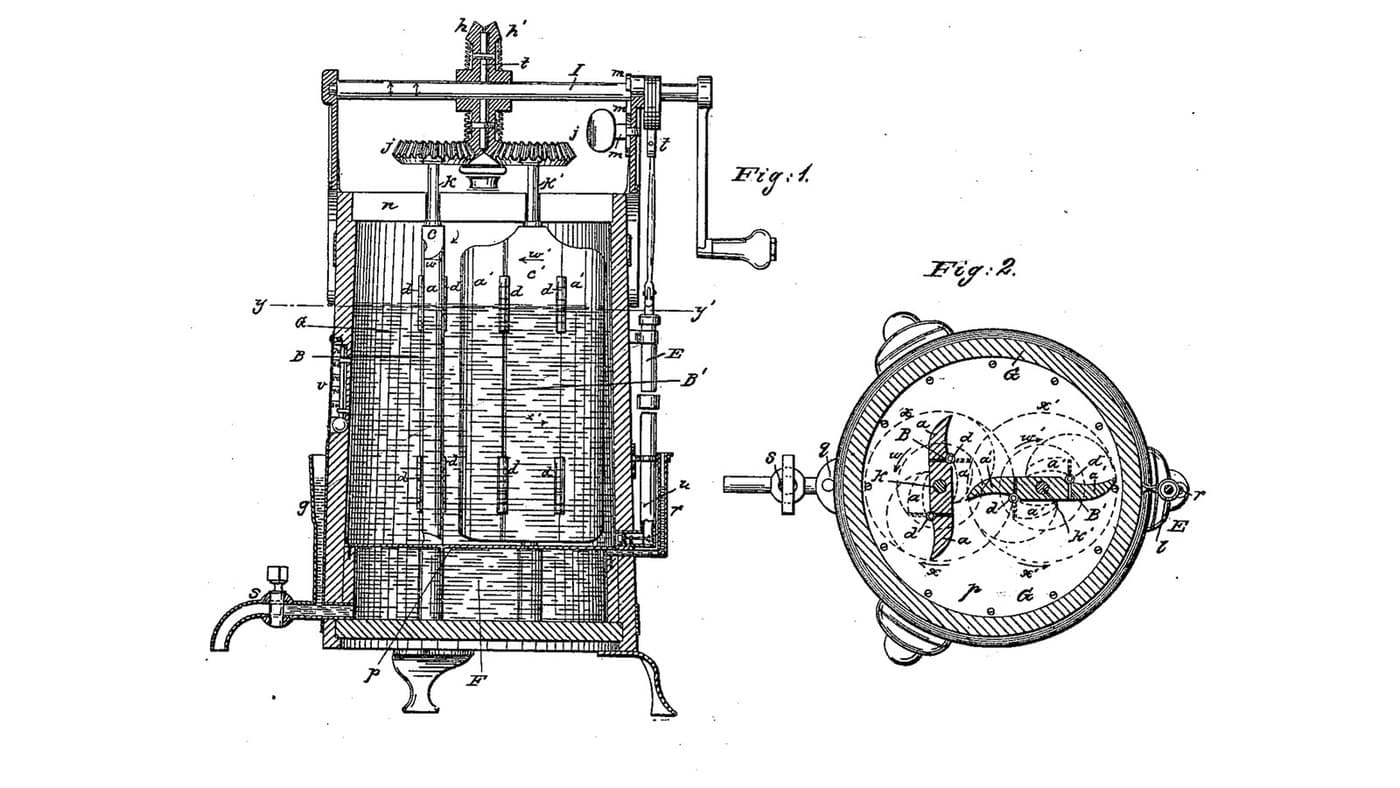
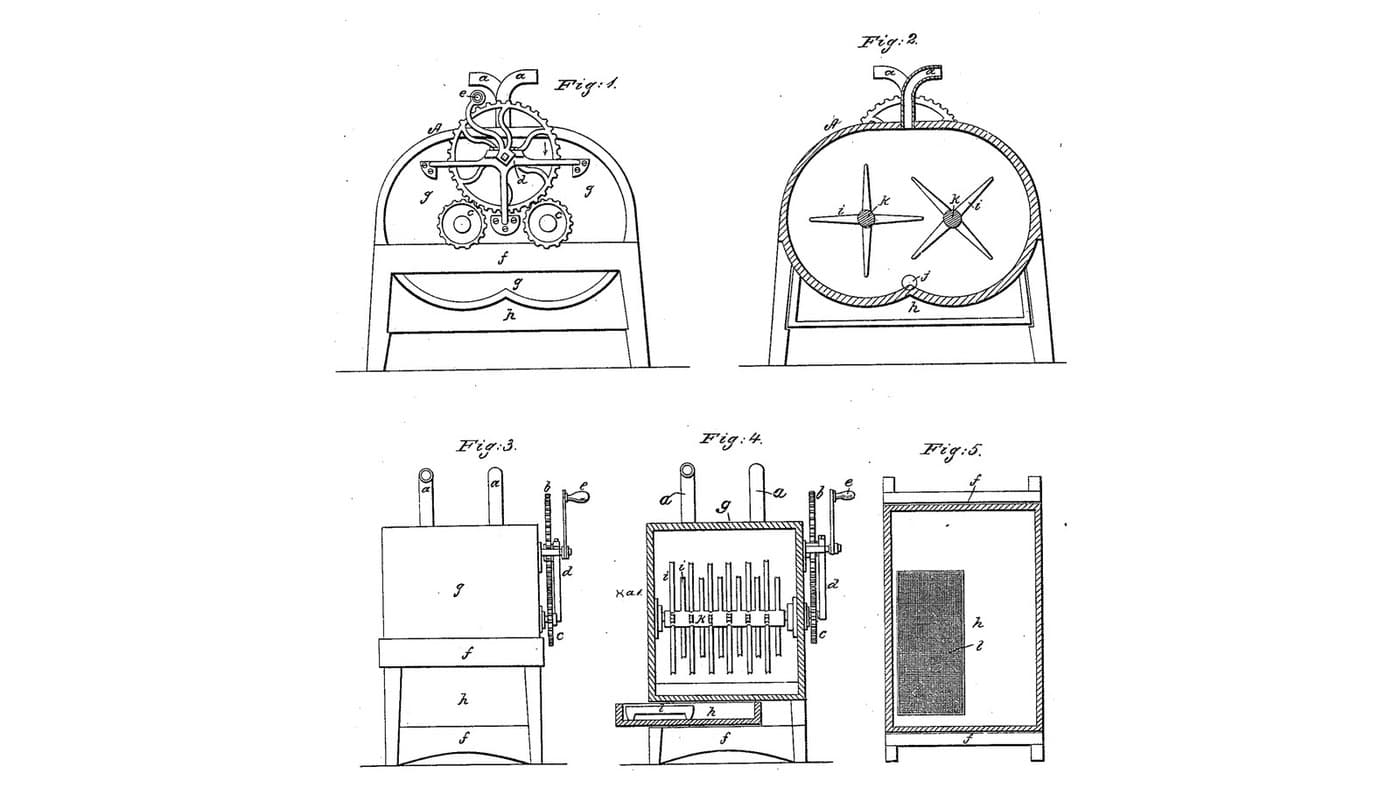
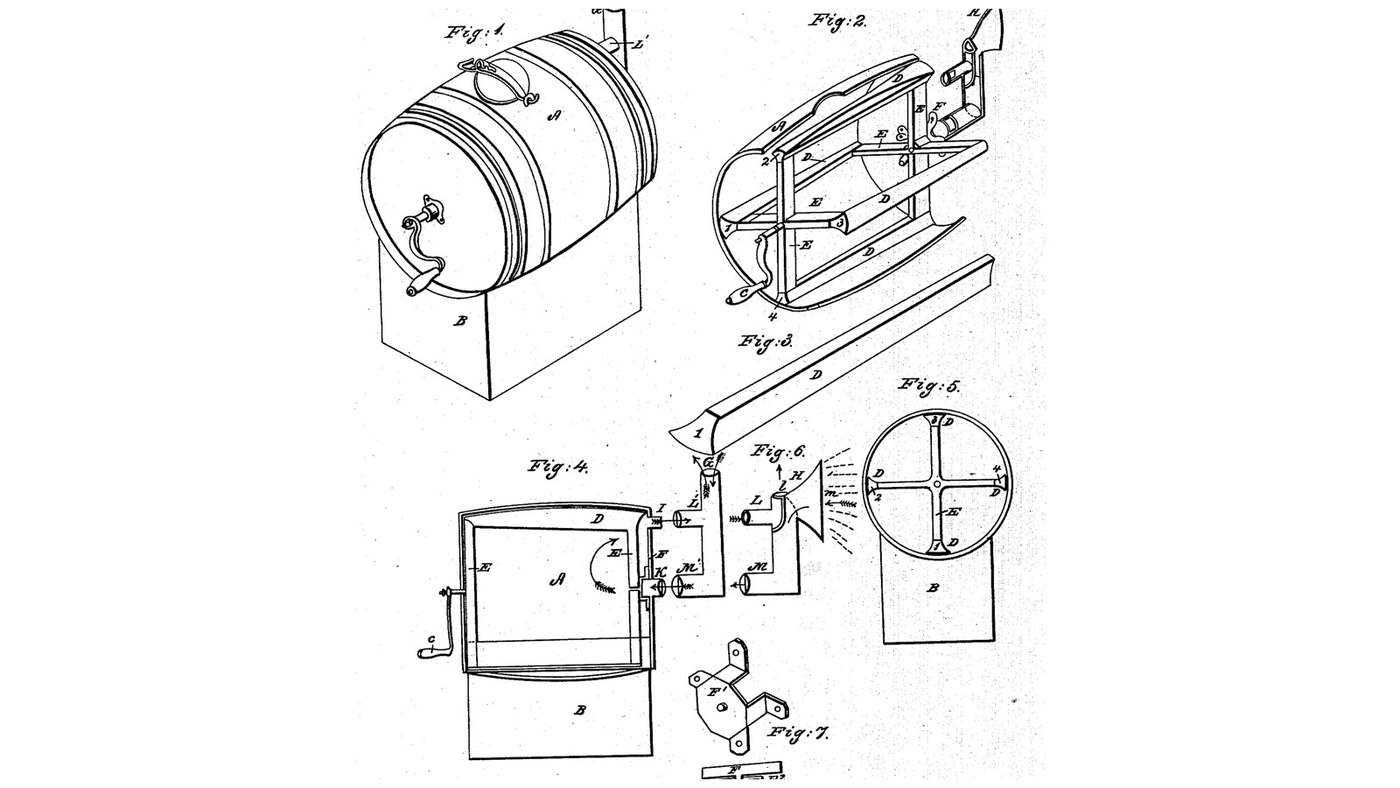
Henry Rohrer of Strasburg township, Pennsylvania, received US 26,377, dated 6 December 1859, for improvements to the common barrel churn, which he named the "Champion atmospheric churn". Four concave, tapering dashers run close to the staves with their wide and narrow ends alternating, so they rub as well as beat. Two tubes through the rear head let fresh air into the middle and steam and musty air out; in winter a funnel-mouthed pipe set near a hot stove brings warm air instead. The patent gives no sizes; every size here is ours.
Fortgeschritten
About 2 days, plus printing

Anweisungen

1

Rohrer's temperatures, and the dashers' sweep

Jupyter-Notebook wird geladen …
2

Air into the cream, three weeks before

Clow pumped air in at the bottom. Rohrer lets it in by pipes alone, warmed from the stove when needed.
3

Read US 26,377

"The concaved, tapering sides of the dashers with the wide end of the one followed by the narrow end of the other in its revolutions, produces side eddies as well as being beaten and partially retained by the concaved side; thus a thorough mixing is produced, while a constant supply of fresh air is admitted through the pipe G to the center of the churn"
4

Print the step F

A raised open step 80 x 80 mm and 55 mm deep, open at the sides, with a 17 mm socket for the rear pivot. PETG, 0.2 mm layers, 40 % infill, 4 walls.
DesigndateiSTLCC0 - Free
5

Barrel A, base B and hatch

Use a wooden barrel about 450 mm long inside, 320 mm across at the heads. Cut a 120 mm hatch in the bilge with a hardwood lid. Bore the front head 17 mm in its centre for the shaft. Bore the rear head 21 mm in its centre for tube K and 21 mm 120 mm above it for tube I. Make a cradle of two shaped hardwood saddles on a base board so the barrel lies level. Fill the barrel with water overnight so it swells tight, then empty it.

Materialien für diesen Schritt:

HolzfassHolzfass1 Stück
HartholzbrettHartholzbrett2 Stück
HolzleimHolzleim1 Stück
HolzschraubenHolzschrauben12 Stück

Benötigte Werkzeuge:

StichsägeStichsäge
KompassKompass
AkkubohrschrauberAkkubohrschrauber
Flachfräsbohrer-SatzFlachfräsbohrer-Satz
TischkreissägeTischkreissäge
Schraubzwinge mit SchiebebügelSchraubzwinge mit Schiebebügel
Bandmaß (Rollmeter)Bandmaß (Rollmeter)
WasserWasser
6

Dashers D and crosses E

Shave four hardwood dashers 400 mm long, tapering from 70 to 35 mm wide, with a 20 mm deep concave face on the inner side and the outer edge left straight. Make two crosses of hardwood 15 x 24 mm, 290 mm across, and screw the dashers to their ends, outer edges 150 mm from the centre, the wide ends alternately at the front and the rear. Fix the front cross on a 16 mm stainless shaft through the front head with a crank C outside, and a 16 mm pivot on the rear cross's centre.

Materialien für diesen Schritt:

HartholzbrettHartholzbrett2 Stück
HolzschraubenHolzschrauben16 Stück
EdelstahlstabEdelstahlstab1 Stück
Shaft CollarShaft Collar2 Stück
HartholzdübelHartholzdübel1 Stück
HolzleimHolzleim1 Stück

Benötigte Werkzeuge:

SchweifhobelSchweifhobel
TischkreissägeTischkreissäge
AkkubohrschrauberAkkubohrschrauber
BohrersatzBohrersatz
Bügelsäge (Metallsäge)Bügelsäge (Metallsäge)
Feilen (Handfeile)Feilen (Handfeile)
Schraubendreher-SatzSchraubendreher-Satz
SchleifpapierSchleifpapier
Bandmaß (Rollmeter)Bandmaß (Rollmeter)
7

Step F, tubes I and K, pipes G and H

Screw the printed step over the rear head's centre hole, its socket on the axis. Seal two 20 mm stainless tubes, 70 mm long, through the rear head: K in the centre under the step, I above it. Make the atmospheric pipe G: an upright stainless tube open at its top, joined to I and K by short tubes and elbows. For winter make pipe H: a stainless funnel, mouth m, on a tube to K, with a tee on the tube from I open as the vent l; set the funnel near a warm stove, never on it, and use silicone tube for the joints.

Materialien für diesen Schritt:

EdelstahlrohrEdelstahlrohr2 Stück
SilikonschlauchSilikonschlauch1 Stück
EdelstahltrichterEdelstahltrichter1 Stück
SilikondichtmasseSilikondichtmasse1 Stück
HolzschraubenHolzschrauben4 Stück
PETG-FilamentPETG-Filament1 Stück

Benötigte Werkzeuge:

FDM-3D-DruckerFDM-3D-Drucker
Bügelsäge (Metallsäge)Bügelsäge (Metallsäge)
Feilen (Handfeile)Feilen (Handfeile)
PropanbrennerPropanbrenner
SchraubstockSchraubstock
Hitzebeständige HandschuheHitzebeständige Handschuhe
Schraubendreher-SatzSchraubendreher-Satz
8

The build in 3D

FreeCAD model of this build, the barrel, heads and cradle cut through the middle: the four alternately reversed dashers on their two crosses, the shaft and crank, the step F on the rear head over tube K, tube I, and the atmospheric pipe G outside. The frame was turned through a quarter turn.
DesigndateiBLENDCC0 - Free
9

Churn

Fill the barrel about half full with heavy cream, about 15 litres. Bring it to 15-18 °C, checked with the thermometer; in winter put pipe H on with its funnel near the warm stove, otherwise pipe G. Close the hatch and turn the crank steadily, timing it. When the butter comes, open the hatch, take out the butter, drain the buttermilk, wash the butter in cold water until it runs clear, salt and weigh it.

Materialien für diesen Schritt:

SchlagsahneSchlagsahne15 l
Grobes MeersalzGrobes Meersalz1 Stück
WasserWasser1 Stück

Benötigte Werkzeuge:

Einsteck-FühlerthermometerEinsteck-Fühlerthermometer
StoppuhrStoppuhr
Digitale KüchenwaageDigitale Küchenwaage
Große Rührschüssel aus EdelstahlGroße Rührschüssel aus Edelstahl
10

Troubleshooting

Atmospheric barrel churn troubleshooting.

Flow

Loading...
11

History and honest limits

**Henry Rohrer** of Strasburg township, Lancaster County, Pennsylvania, US 26,377, 6 December 1859, "Churn". He knew of other ways of bringing air to cream, and claimed the tubes I, K in the rear head with the pipes G and H, mouth m, partition l and tubes L, M, with the dashers D on an open step F. He says he "tested in my own buttery to my entire satisfaction". The patent gives no sizes; every size here is ours. His temperatures, 60 to 65 °F, are 15.6 to 18.3 °C.

Materialien

15

Benötigte Werkzeuge

22

Designdateien

2

CC0 Gemeinfrei

Dieser Blueprint ist unter CC0 veröffentlicht. Sie dürfen dieses Werk für jeden Zweck frei kopieren, ändern, verbreiten und verwenden, ohne um Erlaubnis zu fragen.

Unterstützen Sie den Maker, indem Sie Produkte über seinen Blueprint kaufen, wo er eine Maker-Provision von Anbietern festgelegt, verdient. Oder erstellen Sie eine neue Iteration dieses Blueprints und verbinden Sie ihn in Ihrem eigenen Blueprint, um Einnahmen zu teilen.

Diskussion

(0)

Anmelden um an der Diskussion teilzunehmen

Kommentare werden geladen...