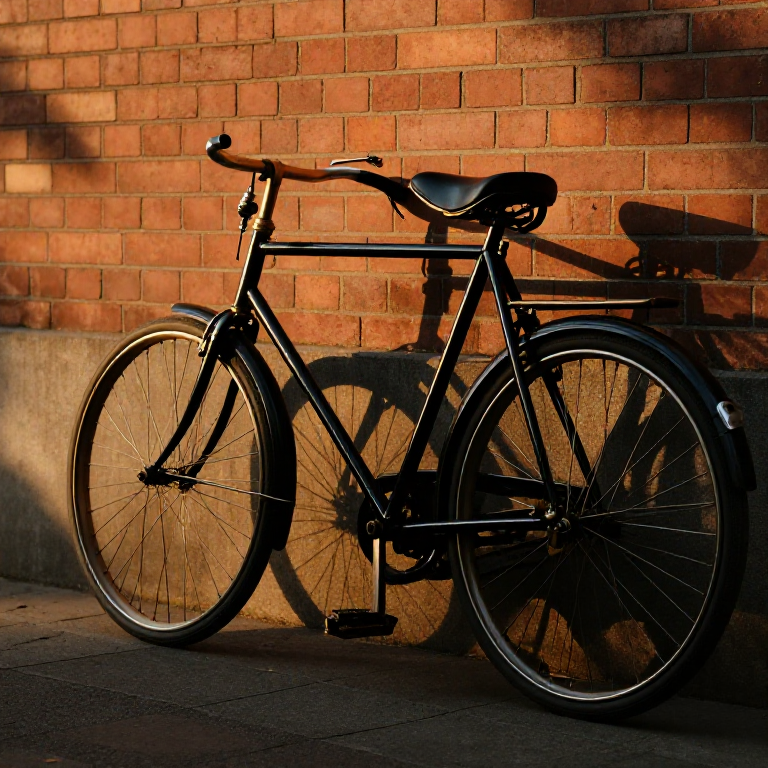


Building a Safety Bicycle — Chain Drive, Equal Wheels, and Personal Freedom
The bicycle that everyone rides today was settled in the 1880s and is still called, in the trade, the safety bicycle — to distinguish it from the terrifying high penny-farthing it replaced. Two equal wheels, a diamond frame, a chain driving the rear wheel, and soon air-filled tyres made cycling safe, fast, and available to ordinary people.
Each feature solves a problem. Equal wheels and a low frame mean you can put a foot down and cannot be pitched over the handlebars. The chain and gearing let a small wheel travel fast without the giant front wheel of the penny-farthing. The diamond frame, built of brazed steel tubes, is astonishingly light and strong for its weight. And Dunlop's pneumatic rubber tyres turned a bone-shaking ride into a smooth one.
The safety bicycle was more than transport. Cheap, simple, and needing no horse or fuel, it gave working people and especially women a freedom of movement they had never had — which is why it is often credited with as much social change as mechanical.
Anweisungen
Understand the safety design
Understand the safety design
Braze the diamond frame
Braze the diamond frame
Materialien für diesen Schritt:
 Stahlrohr (Konstruktionsrohr)4 Meter
Benötigte Werkzeuge:
 Hartlötbrenner
Build the wheels
Build the wheels
Materialien für diesen Schritt:
 Stahlspeichen72 Stück
 Fahrradfelge (Aluminium)2 Stück
Benötigte Werkzeuge:
 Speichenschlüssel
Fit pneumatic tyres
Fit pneumatic tyres
Materialien für diesen Schritt:
 Gummireifen2 Stück
Build the chain drive
Build the chain drive
Materialien für diesen Schritt:
 Rollenkette1 Stück
 Kettenblatt1 Set
 Kettenrad1 Set
Fit the bottom bracket and cranks
Fit the bottom bracket and cranks
Materialien für diesen Schritt:
 Kugellager1 Set
Set up the steering
Set up the steering
Materialien für diesen Schritt:
 Lenker1 Stück
Fit brakes
Fit brakes
Materialien für diesen Schritt:
 Bremssattel2 Stück
Fit the saddle
Fit the saddle
Materialien für diesen Schritt:
 Ledersattel1 Stück
Assemble and true
Assemble and true
Benötigte Werkzeuge:
 Rohrzange
Test and tune
Test and tune
Benötigte Werkzeuge:
RohrzangeAppreciate the freedom it gave
Appreciate the freedom it gave
Materialien
11- Platzhalter
- 72 StückPlatzhalter
- 2 StückPlatzhalter
- 2 StückPlatzhalter
- 1 StückPlatzhalter
- 1 SetPlatzhalter
- 1 SetPlatzhalter
- 1 SetPlatzhalter
- 1 StückPlatzhalter
- 2 StückPlatzhalter
- 1 StückPlatzhalter
Dieser Bauplan stellt her

Verwandte Blueprints
Diese Blueprints teilen Wissen — Techniken, Materialien oder Prinzipien

CC0 Gemeinfrei
Dieser Blueprint ist unter CC0 veröffentlicht. Sie dürfen dieses Werk für jeden Zweck frei kopieren, ändern, verbreiten und verwenden, ohne um Erlaubnis zu fragen.
Unterstützen Sie den Maker, indem Sie Produkte über seinen Blueprint kaufen, wo er eine Maker-Provision von Anbietern festgelegt, verdient. Oder erstellen Sie eine neue Iteration dieses Blueprints und verbinden Sie ihn in Ihrem eigenen Blueprint, um Einnahmen zu teilen.