KUNST
SCHÖNHEIT & WELLNESS
HANDWERK
KULTUR & GESCHICHTE
UNTERHALTUNG
UMFELD
ESSEN & GETRÄNKE
REVERSE ENGINEERING
WISSENSCHAFTEN
SPORT
TECHNOLOGIE
WEARABLES
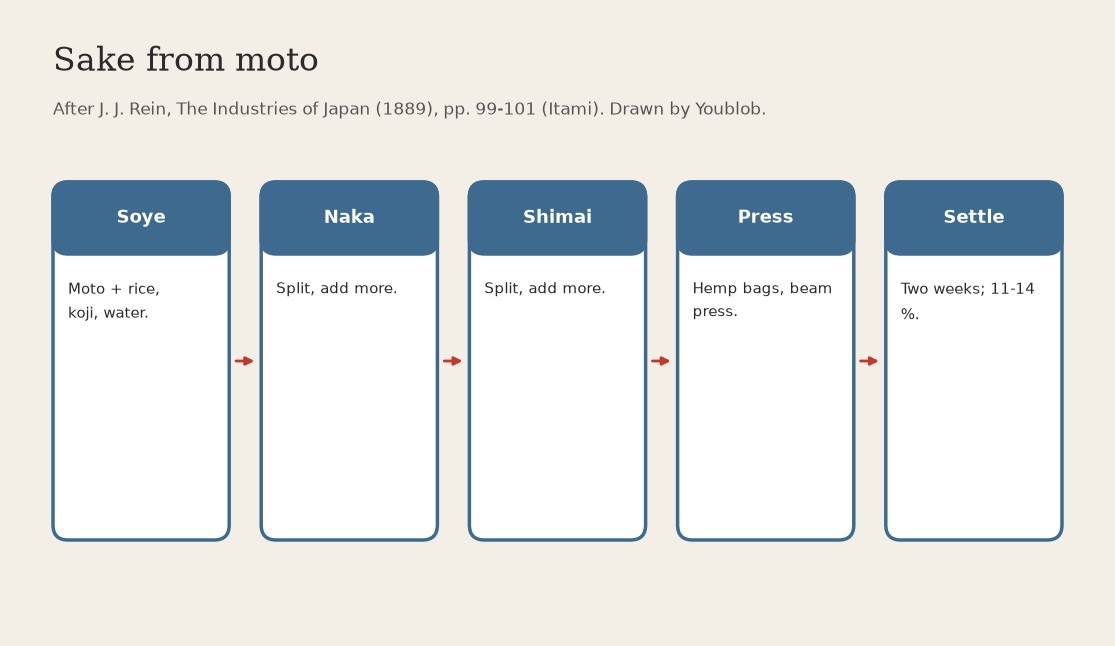


Sake from Moto: the Mash Built Up in Three Additions, Soye, Naka and Shimai, Pressed and Settled (Itami, after Rein 1889)
The brewers of Itami never put all the rice in at once. They fed the moto in three steps, roughly doubling the mash each time, so the yeast always stayed ahead of the sugar the koji made. Then they pressed the mash in a beam press and let the sake settle clear.
Result: sake of 11 to 14 % alcohol.
Source: J. J. Rein, The Industries of Japan (1889), pp. 99-101. The beam press is replaced by any press. Picture drawn by Youblob.
Erfahren
4 weeks
Anweisungen
1
1
Soye: first addition
Soye: first addition
In a three-foot tub mix 1.30 koku steamed rice, 1.30 koku moto, 0.35 koku koji and 1.30 koku water (4.25 koku). Stir thoroughly every two hours for two or three days; it warms to about 20 C and smells pleasant and pungent. Ours: steam the rice over a pot.
Materialien für diesen Schritt:
 Japanischer Rundkornreis1.3 koku
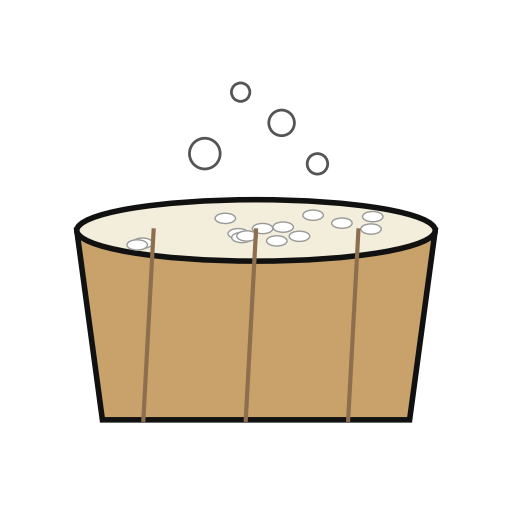 Moto (Sake-Ansatzmaische)1.3 koku
 Koji-Reis (Aspergillus oryzae)0.35 koku
 Wasser1.3 koku
Benötigte Werkzeuge:
 Holzbottich
 Langes hölzernes Rührscheit
 Großer Kochtopf
 Thermometer
2
2
Naka: second addition
Naka: second addition
Split the soye between two tubs and add 2.00 koku steamed rice, 0.65 koku koji and 2.90 koku water (9.80 koku, 4.90 per tub). Stir vigorously every other hour for one day.
Materialien für diesen Schritt:
Japanischer Rundkornreis2 kokuKoji-Reis (Aspergillus oryzae)0.65 kokuWasser2.9 kokuBenötigte Werkzeuge:
HolzbottichLanges hölzernes RührscheitGroßer Kochtopf3
3
Shimai: last addition
Shimai: last addition
Split again into four tubs and add 3.30 koku steamed rice, 1.00 koku koji and 4.20 koku water (Rein prints the naka here as 9.90; total 18.40 koku). Treat as before; keep tubs no more than half full.
Materialien für diesen Schritt:
Japanischer Rundkornreis3.3 kokuKoji-Reis (Aspergillus oryzae)1 kokuWasser4.2 kokuBenötigte Werkzeuge:
HolzbottichLanges hölzernes RührscheitGroßer Kochtopf4
4
Main fermentation
Main fermentation
After three days pour all four tubs into one big six-foot tub. A brisk fermentation follows and eases in two or three days; the scum settles and the liquor is strongly alcoholic.
Benötigte Werkzeuge:
Holzbottich5
5
Press
Press
Fill close-woven hemp bags with the mash, lay them crosswise in a strong box and press. Rein's press is a beam lever weighted with 600-900 kg; ours: any wine press. Collect the turbid sake.
Benötigte Werkzeuge:
 Leinenbeutel
 Weinpresse
6
6
Settle and draw off
Settle and draw off
Let the sake stand quiet two weeks in a standing cask with two taps near the bottom, then draw it off clear by the upper tap. Store in barrels or closed tubs; heat it when warm weather comes to keep it.
Benötigte Werkzeuge:
 Holzfass
Materialien
4- 3.3 kokuPlatzhalter
- 1.3 kokuPlatzhalter
- Platzhalter
- 8.4 kokuPlatzhalter
Dieser Bauplan stellt her

Verwandte Blueprints
Diese Blueprints teilen Wissen — Techniken, Materialien oder Prinzipien

CC0 Gemeinfrei
Dieser Blueprint ist unter CC0 veröffentlicht. Sie dürfen dieses Werk für jeden Zweck frei kopieren, ändern, verbreiten und verwenden, ohne um Erlaubnis zu fragen.
Unterstützen Sie den Maker, indem Sie Produkte über seinen Blueprint kaufen, wo er eine Maker-Provision von Anbietern festgelegt, verdient. Oder erstellen Sie eine neue Iteration dieses Blueprints und verbinden Sie ihn in Ihrem eigenen Blueprint, um Einnahmen zu teilen.