Zusammenarbeit
KUNST
SCHÖNHEIT & WELLNESS
HANDWERK
KULTUR & GESCHICHTE
UNTERHALTUNG
UMFELD
ESSEN & GETRÄNKE
REVERSE ENGINEERING
WISSENSCHAFTEN
SPORT
TECHNOLOGIE
WEARABLES
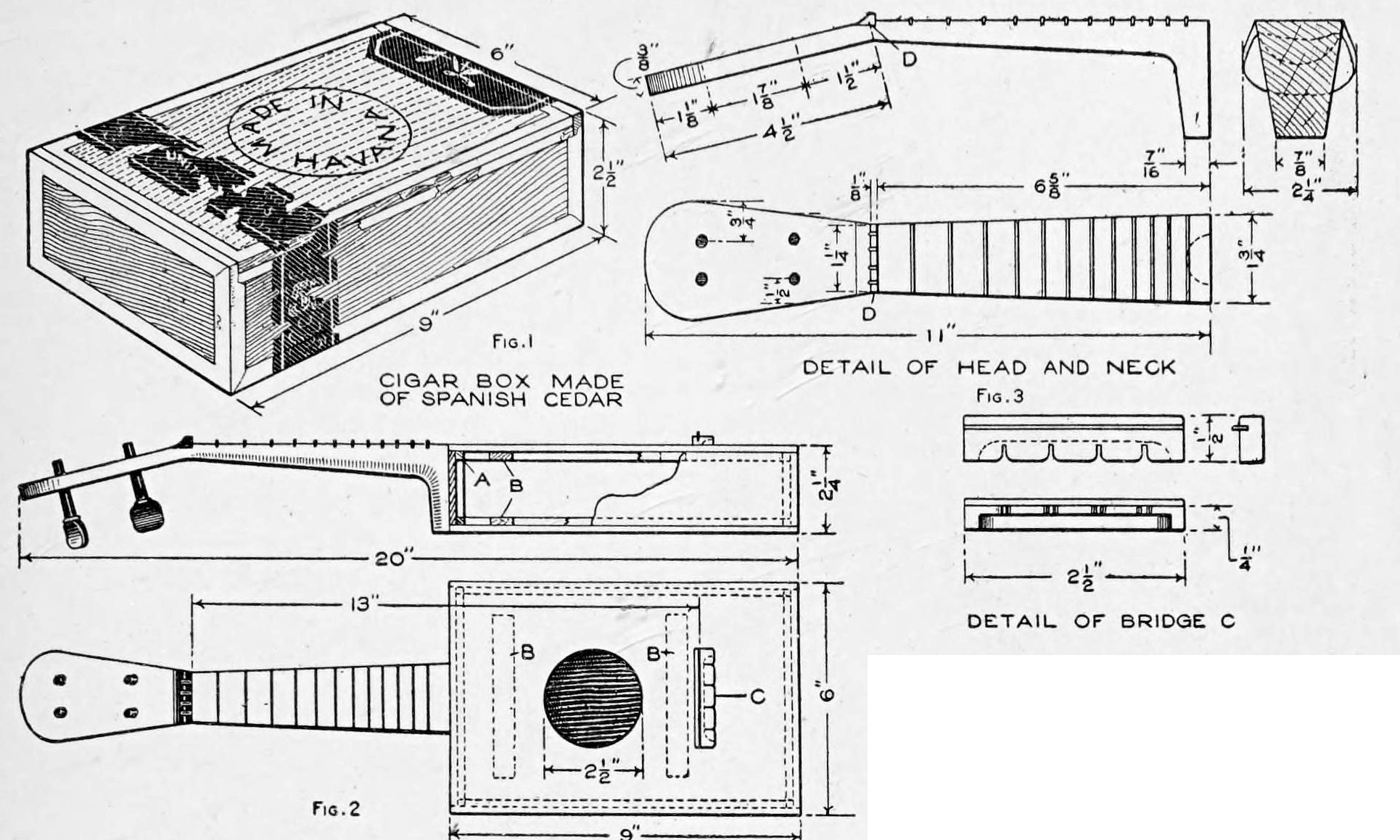


Cigar-Box Hawaiian Ukulele: Spanish-Cedar Body, 11 in Neck and Frets by the Rule of Eighteen (Boy Mechanic, 1919)
S. H. Samuels's ukulele from The Boy Mechanic, Book 3 (1919), made for 30 cents: a Spanish-cedar cigar box rebuilt as a 9 x 6 in body with a 2-1/2 in sound hole, an 11 in cedar or mahogany neck, a notched hardwood bridge, and aluminium frets set by the old rule of 1/18 on a 13 in string length.
Fortgeschritten
About 2 days
Anweisungen
1
1
Fret table
Fret table
Jupyter-Notebook wird geladen …
2
2
Read The Boy Mechanic, Book 3
Read The Boy Mechanic, Book 3
"The size of this instrument makes it especially suited to the cigar-box type of body construction."
3
3
Rebuild the box as the body
Rebuild the box as the body
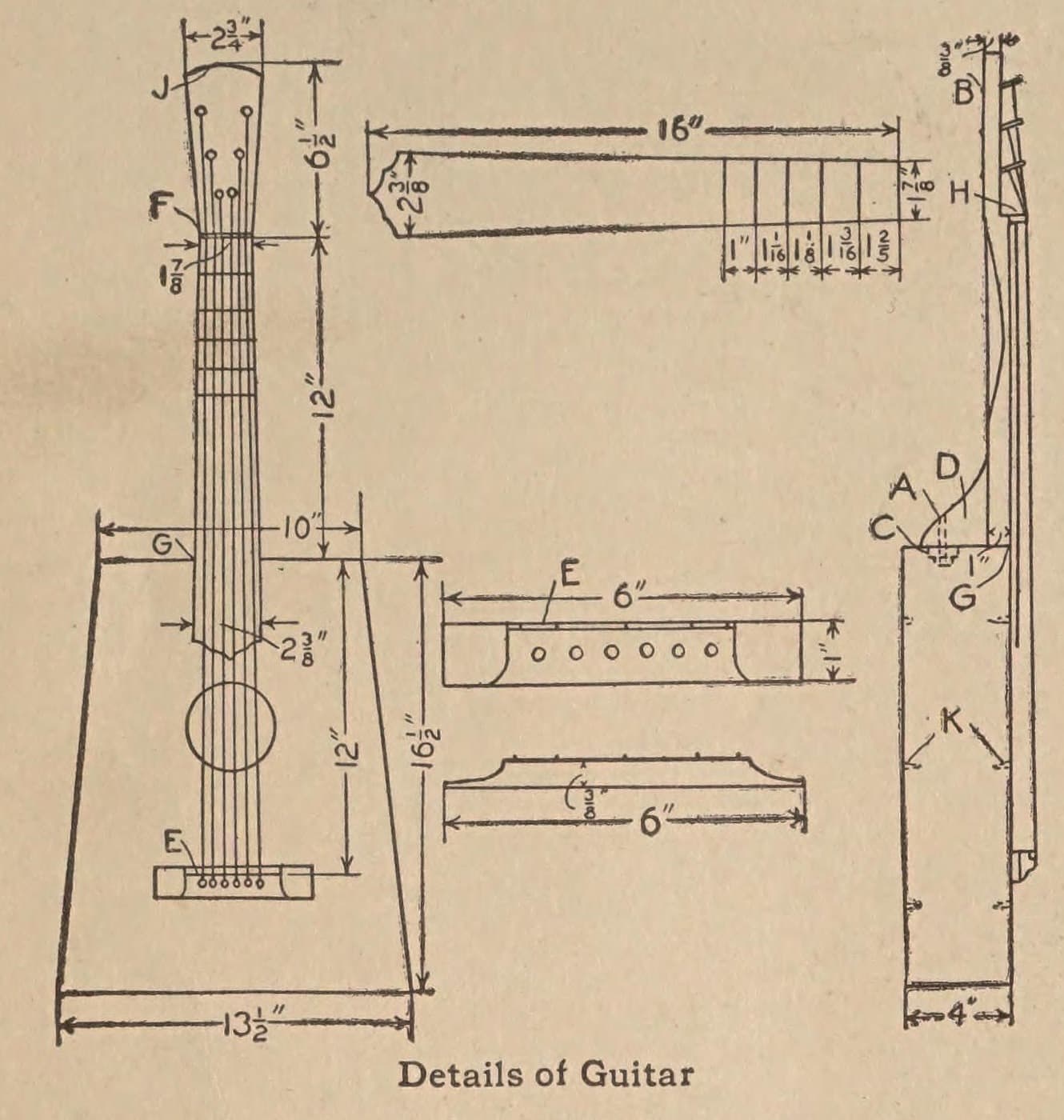
Take a good Spanish-cedar cigar box about 2-1/2 by 6 by 9 in, soak off the paper without marring the wood, take it apart and trim edges with too many or broken nail holes. Fit the parts so top and bottom rest against the sides and ends, the ends between the sides (Fig. 2; drawn 9 by 6 by 2-1/4 in). Cut a 2-1/2 in hole in the top 3-3/4 in from the neck end. Make corner strips A 1/4 in square and strips B 1/4 by 5/8 by 4-1/2 in for under the top and on the bottom.
Materialien für diesen Schritt:
 Zedernholzbrett1 Stück
Benötigte Werkzeuge:
 Laubsäge (Schweifsäge)
 Ledermesser
 Handhobel
 Kompass
 Lineal
4
4
Make the neck, nut and bridge
Make the neck, nut and bridge
Cut the neck from Spanish cedar or mahogany, 11 in long, best in one piece (or with the peg extension and the wide body end glued on and doweled): head 4-1/2 in, fingerboard 6-5/8 in from the 1/8 in nut, 1-1/4 in wide at the nut and 1-3/4 in at the body, heel 7/16 in, section 7/8 by 2-1/4 in as drawn (Fig. 3). Make the nut D of mahogany or walnut with the grain lengthwise, notched for the strings as spaced. Make the bridge C of hard wood, 2-1/2 in long and 1/2 in high, hollowed under the notched edge, with a metal string contact.
Materialien für diesen Schritt:
 Hartholzbrett1 Stück
 Holzdübelstange1 Stück
 Tierleim1 Stück
 Messingband1 Stück
Benötigte Werkzeuge:
 HandsägeLaubsäge (Schweifsäge)Ledermesser
 Feilen (Handfeile)
 Handbohrer
5
5
Fret the fingerboard
Fret the fingerboard
Measure the string length from the bridge contact to the nut (13 in here). Set the first fret 1/18 of that distance from the nut, the second 1/18 of the distance from the first fret to the bridge, and so on (notebook). Cut grooves 1/8 in deep and drive in frets of aluminium (or brass) 1/16 by 3/16 in, tight enough to need no fastening.
Materialien für diesen Schritt:
Messingband1 StückBenötigte Werkzeuge:
Handsäge Bügelsäge (Metallsäge)Feilen (Handfeile)Lineal
 Bleistift
 Hammer
6
6
Assemble and finish
Assemble and finish
Glue the body's end to the neck with animal glue, reinforced by screws, its upper edge parallel with the fingerboard and the fingerboard flush with the top. Glue the body (without the top) to that end; when dry, glue in the strips, bridge and finally the top. Clean, sandpaper, stain and shellac or varnish. Fit tuning pegs (bought or made) and a set of strings.
Materialien für diesen Schritt:
Tierleim1 Stück Holzschrauben1 Stück
 Schleifpapier1 Stück
 Schellackfirnis1 Stück
 Wirbel4 Stück
 Ukulelesaiten1 Stück
Benötigte Werkzeuge:
 Schraubzwinge mit Schiebebügel
 Schlitzschraubendreher
 Breiter Pinsel
7
7
Troubleshooting
Troubleshooting
Ukulele troubleshooting.
Flow
Loading...
8
8
History and honest limits
History and honest limits
From "A Homemade Hawaiian Ukulele" by S. H. Samuels, in **The Boy Mechanic, Book 3**, Popular Mechanics, 1919 (Project Gutenberg 71856; checked on the archive.org scan boymechanic0003unse, pp. 358-359). He gives the box as about 2-1/2 in deep; his drawing shows 2-1/4 in. He names no stain and no string type. The fret table, its equal-temperament comparison and the metric figures are ours.
Materialien
10- 1 StückPlatzhalter
- 1 StückPlatzhalter
- 1 StückPlatzhalter
- 1 StückPlatzhalter
- 1 StückPlatzhalter
- 1 StückPlatzhalter
- 1 StückPlatzhalter
- 1 StückPlatzhalter
- 4 StückPlatzhalter
- 1 StückPlatzhalter
Benötigte Werkzeuge
14- Platzhalter
- Platzhalter
- Platzhalter
- Platzhalter
- Platzhalter
- Platzhalter
- Platzhalter
- Platzhalter
- Platzhalter
- 1 vendor sell this, none ship to you yetPlatzhalter
- Platzhalter
- Platzhalter
- Platzhalter
- Platzhalter
Dieser Bauplan stellt her

Verwandte Blueprints
Diese Blueprints teilen Wissen — Techniken, Materialien oder Prinzipien
CC0 Gemeinfrei
Dieser Blueprint ist unter CC0 veröffentlicht. Sie dürfen dieses Werk für jeden Zweck frei kopieren, ändern, verbreiten und verwenden, ohne um Erlaubnis zu fragen.
Unterstützen Sie den Maker, indem Sie Produkte über seinen Blueprint kaufen, wo er eine Maker-Provision von Anbietern festgelegt, verdient. Oder erstellen Sie eine neue Iteration dieses Blueprints und verbinden Sie ihn in Ihrem eigenen Blueprint, um Einnahmen zu teilen.