Zusammenarbeit
KUNST
SCHÖNHEIT & WELLNESS
HANDWERK
KULTUR & GESCHICHTE
UNTERHALTUNG
UMFELD
ESSEN & GETRÄNKE
REVERSE ENGINEERING
WISSENSCHAFTEN
SPORT
TECHNOLOGIE
WEARABLES
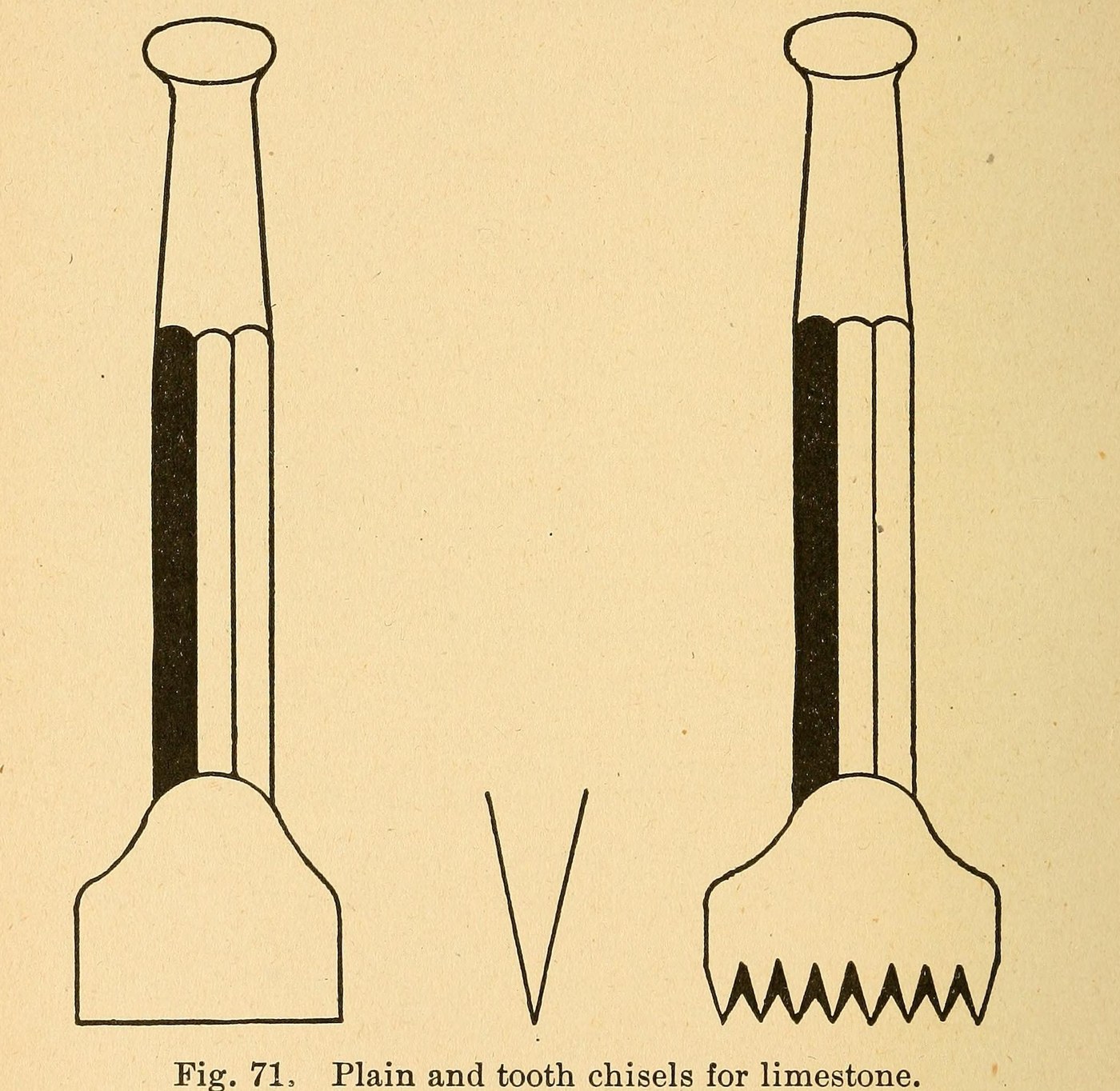


Stone Carving Chisels: Mallet-Headed Plain and Tooth Chisels and Points for Soft Stone (Holford, 1907)
Soft stone such as limestone and sandstone is cut with chisels struck by a wooden mallet, so their heads are broad and a little rounded. H. Holford's 20th Century Toolsmith and Steelworker (1907) shows a set: plain chisels, tooth chisels with a row of sharp teeth, and points, forged from 3/4 inch octagon steel of 75 points carbon and tempered a very pale blue.
He gives no lengths, widths or tooth spacing; those are unknown here. The brine bath is from his chapter on the hardening bath.
Source: H. Holford (1907), pp. 21, 131-133, 140-141. Picture: his Fig. 71.
Fortgeschritten
A day for a set
Anweisungen
1
1
Read Holford
Read Holford
"In cutting soft stone of any description wooden mallets are used, consequently the heads of the tools are made broad and a little rounding, so as not to cut or bruise the mallet."
2
2
Forge the mallet heads
Forge the mallet heads
Use 3/4 inch octagon steel of 75 points carbon. For each tool, upset the head end a little, fuller it in, draw it out, then swage it to its broad, slightly rounded shape between top and bottom swages (Fig. 78). For a narrow chisel, forge the head first; for a wide one, forge the cutting end first. Sizes are not given (unknown).
Materialien für diesen Schritt:
 Werkzeugstahl-Achtkantstab1 3/4 in octagon
Benötigte Werkzeuge:
 Esse
 Amboss
 Schmiedehammer
 Schlitten
 Fuller (Ausbreitgesenk)
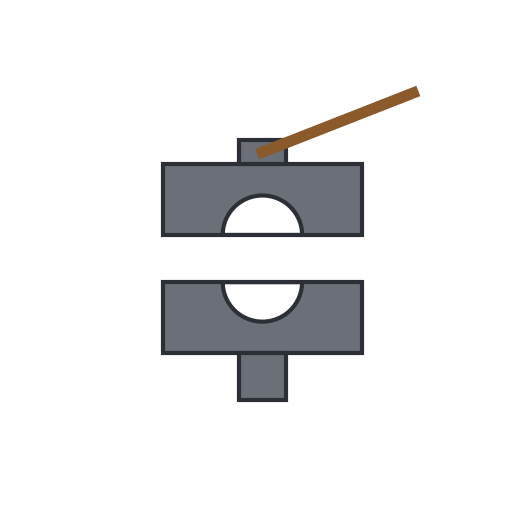 Ober- und Untergesenk
 Schmiedezange
 Unbekannte Maße
 Schutzbrille
 Hitzebeständige Handschuhe
3
3
Forge the chisels and points
Forge the chisels and points
For a wide chisel, upset the end to the width of the chisel before drawing it down to a thin cutting edge. Hammer the flat surfaces. Draw the points down to almost a square point (Fig. 72). For tooth chisels, punch the teeth into the edge in a punch machine after the flat surfaces have been hammered, then file each tooth to an extremely sharp point.
Benötigte Werkzeuge:
EsseAmbossSchmiedehammerSchmiedezange Stanzpresse
 Feine Feile
4
4
Harden the chisels
Harden the chisels
Heat the cutting edge very evenly along its whole length and dip it at least one inch into the hardening bath (clean water, best as a strong brine, kept large and cold). Polish it bright by rubbing it across a board spread with fine clean sand near the forge, and draw the temper to a very pale blue, the right temper for all limestone tools.
Benötigte Werkzeuge:
Esse Gesättigte Salzlake
 Brett
 Feiner SandSchmiedezangeHitzebeständige Handschuhe
5
5
Harden the points
Harden the points
Dip the points deep into the bath. Draw the temper so it shows at least 5/8 inch back from the point; if it runs so fast that only the very tip is tempered, the point bends and breaks easily.
Benötigte Werkzeuge:
EsseGesättigte SalzlakeBrettFeiner SandSchmiedezangeHitzebeständige Handschuhe6
6
History and honest limits
History and honest limits
Holford sets the soft-stone tools apart from those for granite and marble: soft stone takes wooden mallets, hence the broad heads, and a very pale blue temper. The finest stone carvers' tools, struck only lightly, he hardens without drawing any temper at all.
He gives no lengths, widths or tooth spacing; the tools used to make them are ours.
Materialien
1- 1 3/4 in octagonPlatzhalter
Benötigte Werkzeuge
15- Platzhalter
- Platzhalter
- Platzhalter
- Platzhalter
- Platzhalter
- Platzhalter
- Platzhalter
- Platzhalter
- Platzhalter
- Platzhalter
- Platzhalter
- Platzhalter
- Platzhalter
- Platzhalter
- Platzhalter
Dieser Bauplan stellt her
Verwandte Blueprints
Diese Blueprints teilen Wissen — Techniken, Materialien oder Prinzipien
CC0 Gemeinfrei
Dieser Blueprint ist unter CC0 veröffentlicht. Sie dürfen dieses Werk für jeden Zweck frei kopieren, ändern, verbreiten und verwenden, ohne um Erlaubnis zu fragen.
Unterstützen Sie den Maker, indem Sie Produkte über seinen Blueprint kaufen, wo er eine Maker-Provision von Anbietern festgelegt, verdient. Oder erstellen Sie eine neue Iteration dieses Blueprints und verbinden Sie ihn in Ihrem eigenen Blueprint, um Einnahmen zu teilen.