Zusammenarbeit
KUNST
SCHÖNHEIT & WELLNESS
HANDWERK
KULTUR & GESCHICHTE
UNTERHALTUNG
UMFELD
ESSEN & GETRÄNKE
REVERSE ENGINEERING
WISSENSCHAFTEN
SPORT
TECHNOLOGIE
WEARABLES
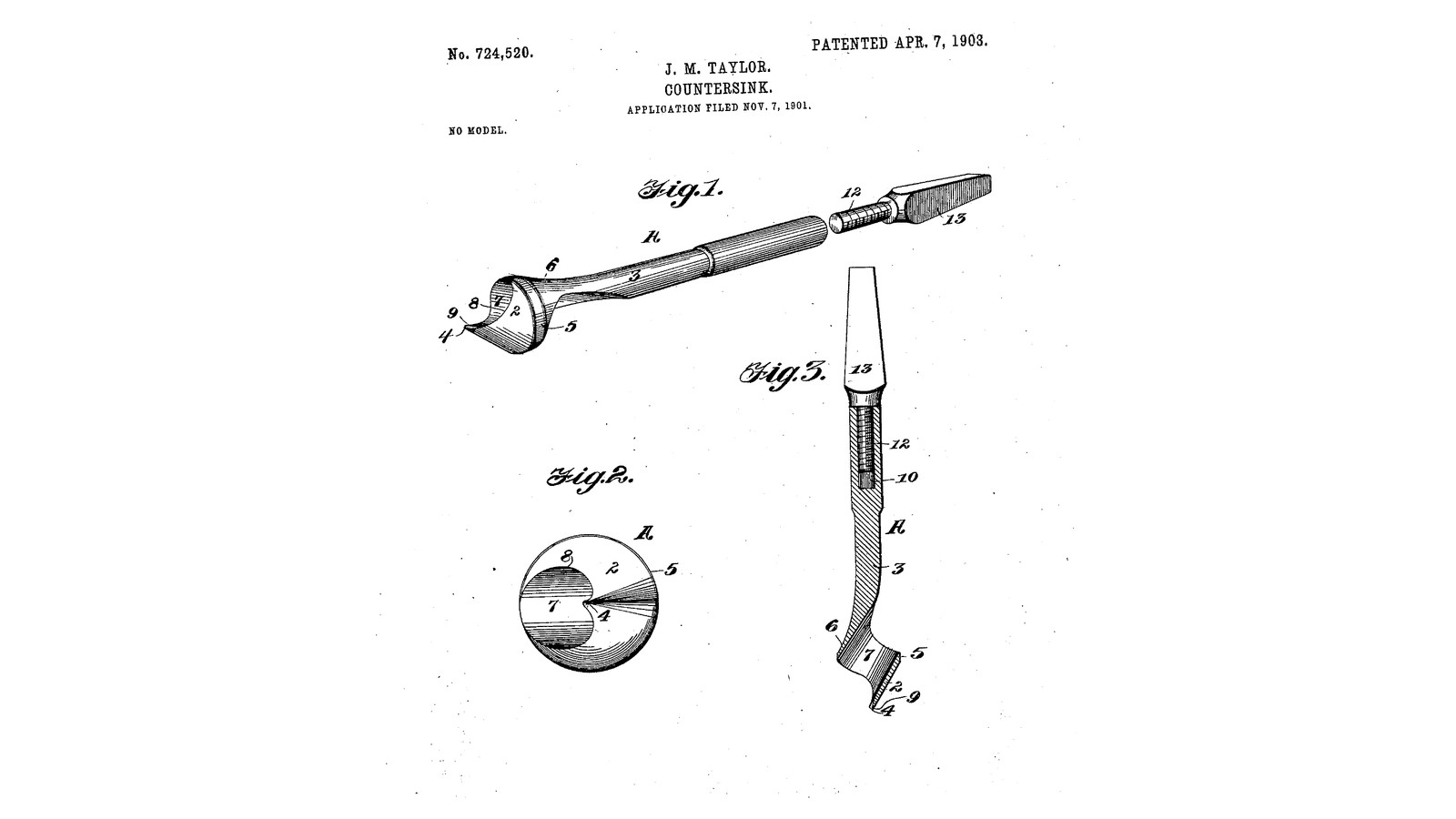


Cross-Hole Countersinks: A Slanting Hole Through the Cone Makes One Spiral Shearing Lip (Taylor, 1903)
John M. Taylor of Hartford, Connecticut, received US 724,520, dated 7 April 1903, for a countersink that shears wood smoothly. Its conical head has a hole drilled through it at a slant that crosses the axis and reaches the point. One edge of that hole is the cutting lip, a spiral curve from the point out to the rim, and the chips go straight out through the hole to the back. A short band behind the cone guides it.
We turn a set of three from tool steel and harden them. The patent gives no sizes; every size here is ours.
Fortgeschritten
About 1 day
Anweisungen
1
1
Where the slanting hole must go
Where the slanting hole must go
Jupyter-Notebook wird geladen …
2
2
Read US 724,520
Read US 724,520
"One of the outer edges of the wall of the opening forms a cutting-lip 8, which is of spiral formation, whereby it is effective to make a shear cut, and terminates in a shoulder 9, forming an entering or cutting point 4 at the apex of the conical head 2."
3
3
Turn the blanks
Turn the blanks
From octagonal tool steel big enough for each head, turn three blanks: a 90 degree cone 2 to a sharp point, 12, 16 and 20 mm across at its base; a band 5 2 mm long at that diameter as the guide; a truncated cone 6 down to an 8 mm shank 50 mm long. File three flats on each shank's end for the chuck. Heat each to a cherry red and let it cool slowly in the air, to soften it for drilling.
Materialien für diesen Schritt:
 Werkzeugstahl-Achtkantstab2 Stück
Benötigte Werkzeuge:
 Metalldrehmaschine
 Dreibackenfutter für die Drehmaschine
 Drehmeißel
 Abstechstahl
 Winkelmesser
 Digitaler Messschieber 6 Zoll
 Feilensatz
 Esse
 Schmiedezange
 Schutzbrille
4
4
Drill the slanting opening 7
Drill the slanting opening 7
Hold a blank in the machine vice tilted so the drill meets the cone's side at 35 degrees to the tool's axis, aimed to cross the axis just behind the point (the notebook gives how far). Drill through with a drill 0.45 of the head across: 5.5, 7 and 9 mm, so the hole breaks out through the point on one side and out of the back cone on the other. Open the back of the hole a little larger, so it tapers towards the shank.
Benötigte Werkzeuge:
 Standbohrmaschine
 MaschinenschraubstockWinkelmesser
 BohrersatzDigitaler Messschieber 6 Zoll
5
5
File the lip 8
File the lip 8
With a round needle file, clean the hole's edge on the side that leads as the countersink turns, leaving it sharp from the point to the band: that is the spiral cutting lip. File a little relief on the cone just behind it, and leave the shoulder 9 at the point.
Benötigte Werkzeuge:
 NadelfeilensatzMaschinenschraubstock
 Doppelschleifer
6
6
Harden and temper
Harden and temper
Heat each head to a cherry red, until a magnet no longer sticks, and quench it point first in water, moving it about. Rub it bright with a stone, heat the shank gently 20 mm behind the head, and quench again as soon as a light straw colour reaches the cutting lip.
Benötigte Werkzeuge:
EsseSchmiedezange Kleiner Magnet
 Abschreckbottich
 Wasser
 Schleifstein
 SchweißerhandschuheSchutzbrille
7
7
Hone and test
Hone and test
Hone the lip lightly with the stone. Drill a few screw holes in hardwood and countersink them in the drill: the cone should cut a smooth bell without chatter and the chips should come out of the hole at the back.
Benötigte Werkzeuge:
Schleifstein AkkubohrschrauberBohrersatz
 HartholzbrettSchutzbrille
8
8
Troubleshooting
Troubleshooting
Countersink troubleshooting.
Flow
Loading...
9
9
History and honest limits
History and honest limits
**John M. Taylor** of Hartford, Connecticut, US 724,520, dated 7 April 1903, filed 7 November 1901. He claimed "a countersink having a cone-shaped head provided with an opening crossing diagonally to the axis within the length of the tool and intersecting the apex of the cone, said opening having a curved edge forming a cutting-lip", and a two-part shank for brace or chuck. We make one-piece shanks for a chuck. He gives no sizes, angle or steel; our 90 degree cones, sizes and the house hardening are ours.
Materialien
1- 2 StückPlatzhalter
Benötigte Werkzeuge
22- Platzhalter
- Platzhalter
- Platzhalter
- Platzhalter
- Platzhalter
- Platzhalter
- Platzhalter
- Platzhalter
- Platzhalter
- Platzhalter
- Platzhalter
- Platzhalter
- Platzhalter
- Platzhalter
- Platzhalter
- Platzhalter
- Platzhalter
- Platzhalter
- Platzhalter
- Platzhalter
- 1 vendor sell this, none ship to you yetPlatzhalter
- Platzhalter
Dieser Bauplan stellt her

Verwandte Blueprints
Diese Blueprints teilen Wissen — Techniken, Materialien oder Prinzipien
CC0 Gemeinfrei
Dieser Blueprint ist unter CC0 veröffentlicht. Sie dürfen dieses Werk für jeden Zweck frei kopieren, ändern, verbreiten und verwenden, ohne um Erlaubnis zu fragen.
Unterstützen Sie den Maker, indem Sie Produkte über seinen Blueprint kaufen, wo er eine Maker-Provision von Anbietern festgelegt, verdient. Oder erstellen Sie eine neue Iteration dieses Blueprints und verbinden Sie ihn in Ihrem eigenen Blueprint, um Einnahmen zu teilen.