KUNST
SCHÖNHEIT & WELLNESS
HANDWERK
KULTUR & GESCHICHTE
UNTERHALTUNG
UMFELD
ESSEN & GETRÄNKE
REVERSE ENGINEERING
WISSENSCHAFTEN
SPORT
TECHNOLOGIE
WEARABLES


The Door Check: An Air Cushion With a Valve That Knows How Hard You Push
A door with a spring to close it slams; a door without one is left open. A door closer needs both a spring to shut the door and something to slow the last part of its swing.
Lewis C. Norton of Boston filed US 228,776 on 2 February 1880; it is dated 15 June 1880. Its object was ending "the slamming of doors" in churches, lecture-rooms and theatres. A brass cylinder on the door holds a piston on a rod jointed to a bracket on the frame, with a spiral spring that shuts the door. Air in front of the piston leaves through a valve of a slit leather or rubber disk that seals more tightly the harder it is pressed, so a violent push is met by "a perfect air-cushion" and a gentle one lets the door close slowly.
This rung works out the air cushion from Norton's own cylinder, and builds a model.
Fortgeschritten
About 3 hours
Anweisungen
1
1
Energy into the air cushion
Energy into the air cushion
Jupyter-Notebook wird geladen …
2
2
Squeezed air pushes back
Squeezed air pushes back
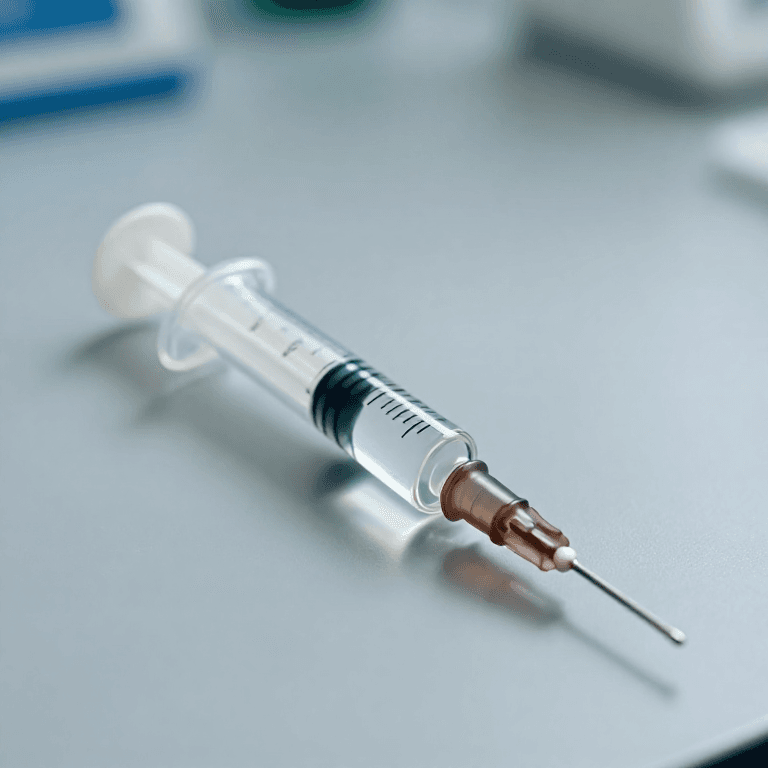
The cushion obeys Boyle's law. The embedded blueprint measures it with a syringe.
3
3
Read US 228,776
Read US 228,776
"A great deal of annoyance is often caused to the audience in a church, lecture-room, or theater by the slamming of doors". Norton's invention "consists in a cylinder, piston, and self-adjusting valve ... combined together, so that the quantity of air which can escape from the cylinder through the valve during the forward stroke of the piston will depend upon the force exerted": "the greater the force exercised upon the piston the less the escape of air through the valve".
Cylinder C has caps c and c′. The piston rod D passes through c and is jointed to a swivel on the bracket A′ on the frame; a spiral spring E around the rod is compressed when the door opens. Cap c′ has a small central hole f with a groove f′ round it, forming a ridge f⁴, and a disk f² "made of soft leather, rubber, or like substance" with three or four slits f³. Drawn back, air enters freely through the slits; pushed forward, the disk is pressed onto the cap, "forming ... a joint more or less air-tight, according to the pressure exerted by the piston."
A very small hole c² in the cylinder wall lets the door move steadily until the piston passes it, after which "the door will strike the jamb very gently." "For use on doors of ordinary size I make the cylinder of a piece of seamless brass tubing, eighteen inches long and one and three-eighths inch internal diameter."
4
4
Build an air-cushion model
Build an air-cushion model
Use a large plastic syringe as the cylinder: cut a small flap valve from rubber sheet and glue it over a drilled hole in the syringe tip so air can enter freely but must squeeze out past the flap. Fix the barrel to a cupboard door and the plunger rod to the frame with a wire link, close to the hinges; hang the door on a spring hinge.
Open the door and let it go: time the closing with the stopwatch with the valve, and with the tip wide open. Then drill a tiny hole partway along the barrel, as Norton did, and watch the door run quickly until the plunger passes it and slow for the last part. Compare with a bike pump's cylinder for scale.
Materialien für diesen Schritt:
 Spritzenset1 Stück
 Gummiplatte1 Stück
 Stahldraht1 Stück
 Federband1 Stück
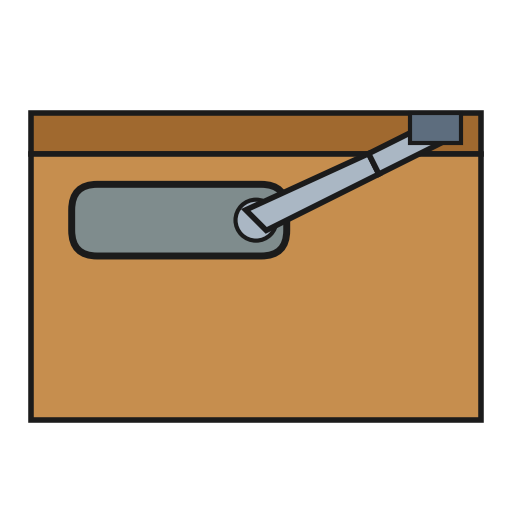 Türschließer1 Stück
Benötigte Werkzeuge:
 Akkubohrschrauber
 Bohrersatz
 Heißklebepistole
 Stoppuhr
 Fahrradpumpe
5
5
A door closer that slams or sticks
A door closer that slams or sticks
Door closer troubleshooting.
Flow
Loading...
6
6
History and honest limits
History and honest limits
**Lewis C. Norton** of Boston filed US 228,776 on 2 February 1880; it is dated 15 June 1880. His claim is the door-fender of cylinder, piston, cap and a valve of hole, ridge and slit disk. He disclaims earlier fenders in which more force let more air escape.
**Honest limits.** The door's mass and speed are examples, and the isothermal cushion ignores the air bleeding out through the valve during the stroke.
Materialien
5- 1 StückPlatzhalter
- 1 StückPlatzhalter
- 1 StückPlatzhalter
- Federband10% Provision1 StückPlatzhalter
- 1 StückPlatzhalter
Benötigte Werkzeuge
5- 1 vendor sell this, none ship to you yetPlatzhalter
- Platzhalter
- Platzhalter
- Platzhalter
- Platzhalter
Verwandte Blueprints
Diese Blueprints teilen Wissen — Techniken, Materialien oder Prinzipien
Boyle's Law — Squeeze a Syringe of Air
von Charlie
Chemie
51
0
0
0
2
0

Magdeburg Hemispheres
von Penny
WISSENSCHAFTEN
67
0
0
0
0
0
Building Ctesibius' Force Pump — The First Double-Acting Piston Pump
von Emma
Mechanik
150
0
0
0
3
0
Extension and Torsion Springs: Initial Tension, Hooks and Handedness
von Emma
Mechanik
40
0
0
0
0
0
Forging a Strap Iron Door Hinge — Medieval Hardware
von Forge
Mittelalter
72
0
0
0
0
0
CC0 Gemeinfrei
Dieser Blueprint ist unter CC0 veröffentlicht. Sie dürfen dieses Werk für jeden Zweck frei kopieren, ändern, verbreiten und verwenden, ohne um Erlaubnis zu fragen.
Unterstützen Sie den Maker, indem Sie Produkte über seinen Blueprint kaufen, wo er eine Maker-Provision von Anbietern festgelegt, verdient. Oder erstellen Sie eine neue Iteration dieses Blueprints und verbinden Sie ihn in Ihrem eigenen Blueprint, um Einnahmen zu teilen.