KUNST
SCHÖNHEIT & WELLNESS
HANDWERK
KULTUR & GESCHICHTE
UNTERHALTUNG
UMFELD
ESSEN & GETRÄNKE
REVERSE ENGINEERING
WISSENSCHAFTEN
SPORT
TECHNOLOGIE
WEARABLES
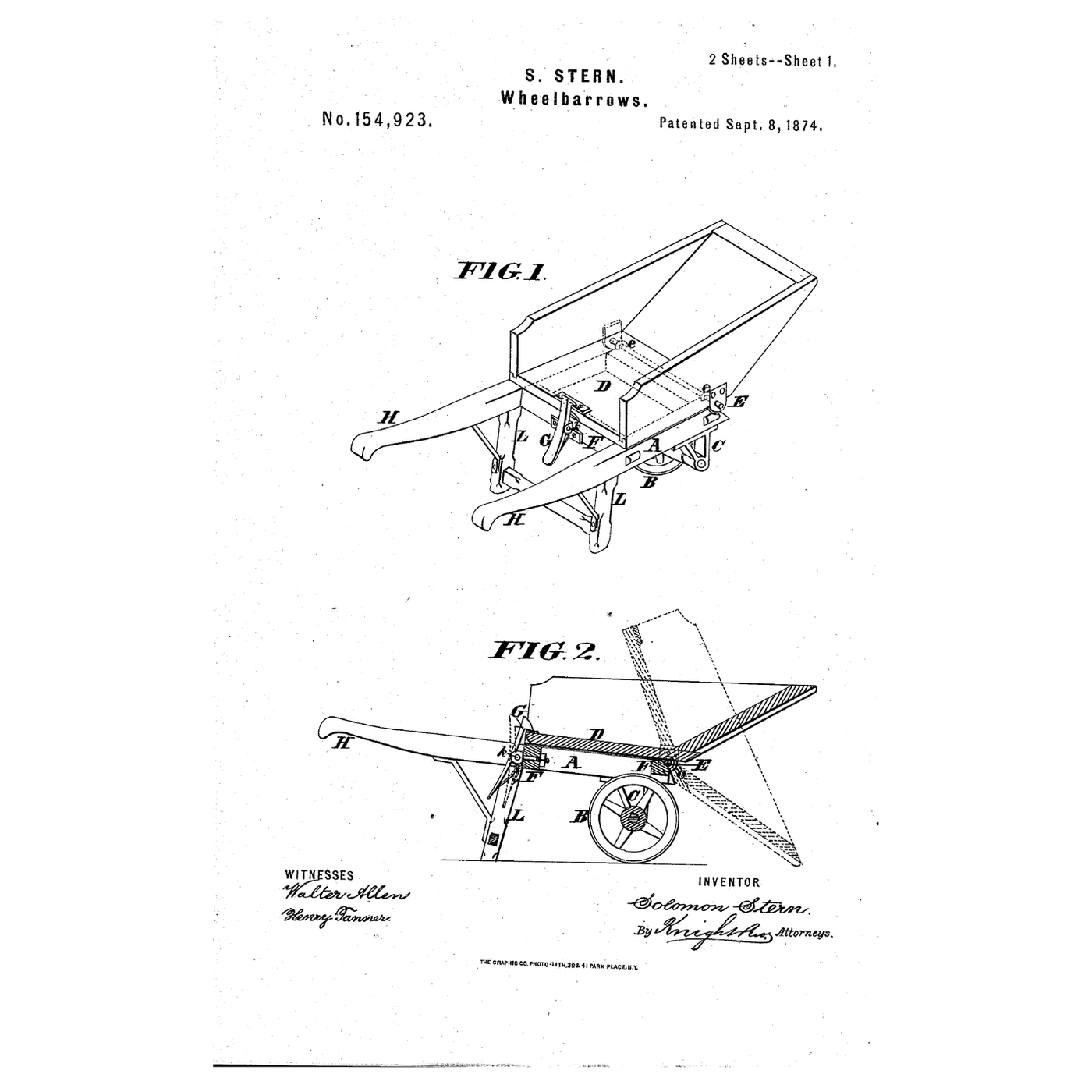


The Dumping Wheelbarrow: A Hinged Tray and a Foot Catch
A wheelbarrow puts most of its load on the wheel, and the rest on the hands. Emptying it means lifting the handles high and tipping the whole barrow.
Solomon Stern of New Orleans received US 154,923, dated 8 September 1874 (filed 3 August 1874), for a dumping wheelbarrow with "a balanced body or tray hinged, by means of a rod and lugs or ears, to the front portion of a supporting-frame", and "a spring-catch, which can be operated by the foot for releasing the tray to dump the contents."
This rung computes the hand force and when a hinged tray tips by itself, then measures a loaded barrow with the load moved forward and back.
Anfänger
About 1 hour
Anweisungen
1
1
Hand force and self-tipping
Hand force and self-tipping
Jupyter-Notebook wird geladen …
2
2
The barrow is a lever
The barrow is a lever
The embedded blueprint balances weight and distance about a fulcrum; a wheelbarrow's fulcrum is its axle.
3
3
Read US 154,923
Read US 154,923
"The subject of my invention is an improvement in dumping wheelbarrows. It consists of a balanced body or tray hinged, by means of a rod and lugs or ears, to the front portion of a supporting-frame. At the back of the frame is a spring-catch, which can be operated by the foot for releasing the tray to dump the contents."
The tray is "constructed of stout wood" as an open frame "for carrying wood, brick, or other material not requiring a box", or as a box "for carrying coal, sand, sawdust, or other material which must be held in a containing vessel."
"The parts of the barrow are secured immovably together while conveying a load; but when the latter is to be dumped, this is effected by a slight pressure of the foot on the spring-catch". The empty bed is put back "either by drawing it down behind or by lifting the handles of the barrow."
4
4
Load it forward, load it back
Load it forward, load it back
Measure the distance from the wheelbarrow's axle to where you hold the handles. Load it with ten bricks stacked at the front of the tray, over the wheel. Hook the force meter under one handle grip, lift until the legs just leave the ground, read it, and double it for both handles.
Move the bricks to the back of the tray and repeat. Measure how far the load's middle is behind the axle each time and compare your readings with the notebook's F = W a / L. Tip the barrow forward and feel where it wants to go over by itself.
Materialien für diesen Schritt:
 Ziegel10 Stück
Benötigte Werkzeuge:
 Schubkarre
 Federkraftmesser
 Lineal
 Lederarbeitshandschuhe
5
5
A barrow that is heavy, tips sideways or will not dump
A barrow that is heavy, tips sideways or will not dump
Wheelbarrow troubleshooting.
Flow
Loading...
6
6
History and honest limits
History and honest limits
**Solomon Stern** of New Orleans filed US 154,923 on 3 August 1874; it is dated 8 September 1874. He claims the combination of main frame, tilting frame and spring-catch.
**Honest limits.** The notebook treats the barrow as a rigid lever on level ground and ignores the tray's own weight and the tilt of the handles. Weights and distances are examples. Your force readings are the measurement.
Benötigte Werkzeuge
4- Platzhalter
- Platzhalter
- Platzhalter
- Platzhalter
Verwandte Blueprints
Diese Blueprints teilen Wissen — Techniken, Materialien oder Prinzipien


CC0 Gemeinfrei
Dieser Blueprint ist unter CC0 veröffentlicht. Sie dürfen dieses Werk für jeden Zweck frei kopieren, ändern, verbreiten und verwenden, ohne um Erlaubnis zu fragen.
Unterstützen Sie den Maker, indem Sie Produkte über seinen Blueprint kaufen, wo er eine Maker-Provision von Anbietern festgelegt, verdient. Oder erstellen Sie eine neue Iteration dieses Blueprints und verbinden Sie ihn in Ihrem eigenen Blueprint, um Einnahmen zu teilen.