KUNST
SCHÖNHEIT & WELLNESS
HANDWERK
KULTUR & GESCHICHTE
UNTERHALTUNG
UMFELD
ESSEN & GETRÄNKE
REVERSE ENGINEERING
WISSENSCHAFTEN
SPORT
TECHNOLOGIE
WEARABLES
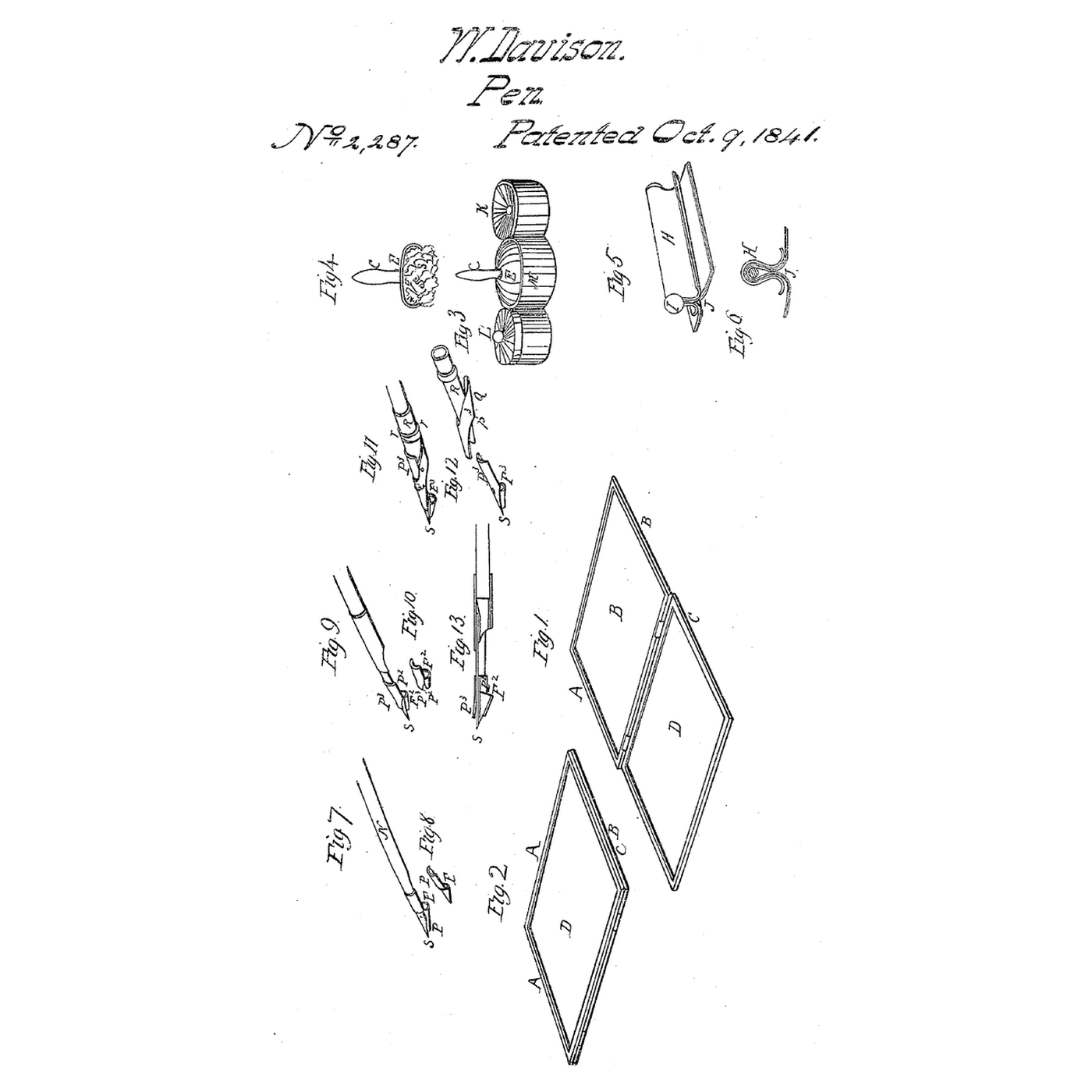


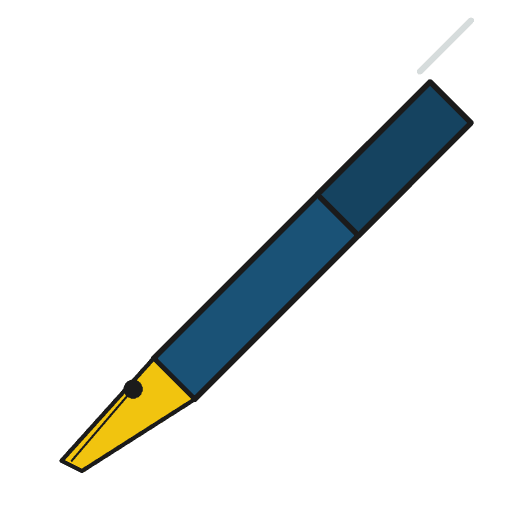
The Fountain-Sheath Pen: A Reservoir Clipped to the Nib, for Writing on Ground Glass
A pupil copying writing exercises dips the pen for every few letters, blots the page, and uses up a copy book.
William Davison of Baltimore, Maryland, received US 2,287, dated 9 October 1841, for teaching writing on "the surface of ground glass with a pen of peculiar construction prepared with fine chalk", over copies laid in a hinged metal frame, "with a pen with which the ink is laid upon the glass being of a new and peculiar construction making the finest hair as well as the boldest line and having attached to it a fountain of ink which fountain being in the form of a funnel, which when filled, is effected at every dip of the pen answers for a page of writing". The fountain's plate lies in the nib's concave side, so the ink runs down the split as the nib writes.
This rung works out how the narrow gap holds the ink, then bends a brass fountain onto a steel dip nib, and writes on chalked ground glass over a copy.
Fortgeschritten
About 4 hours
Anweisungen
1
1
The narrow gap
The narrow gap
Jupyter-Notebook wird geladen …
2
2
The pen before it
The pen before it
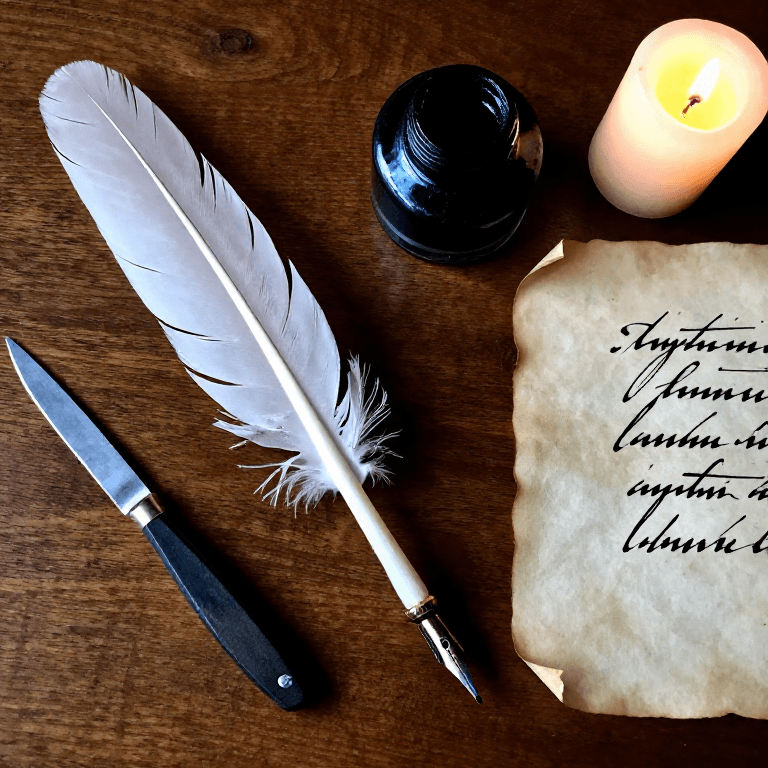
The embedded blueprint cuts a quill pen, dipped every few letters. Davison attaches a fountain to a metallic or quill pen so one dip writes a page.
3
3
Read US 2,287
Read US 2,287
"The fountain pen used upon the guide or upon paper represented by Figs. 7 and 8 is made in the following manner. From a funnel shaped fountain F extends a segment plate P which is folded over on the back on either side so as to form a sheath or socket into which the pen is inserted which is pushed down until the nib comes below the lower end of the fountain and until the latter comes against the split of the pen"
"The ink flows in the act of writing by which it is regulated in its descent, causing it to flow faster or slower according to the movement of the nib."
4
4
Make the fountain and write on glass
Make the fountain and write on glass
**Fountain.** Cut a strip of brass shim 12 × 30 mm. Roll one end round a pencil into a small open funnel, and leave the rest as a flat tongue. Curve the tongue to the concave side of a steel dip nib, and fold its edges over the nib's back as a sheath, so the funnel's lower end sits just above the nib's split and the tongue lies about 0.2 mm from it.
**Guide.** Rub one face of a glass sheet with fine abrasive paper and water until it is evenly frosted. Lay a copy of writing exercises under it on a board. Dampen the frosted face and rub a little fine chalk over it, then rub it dry.
**Test.** Dip the pen once, filling the funnel, and write on the glass, counting the letters before the ink runs out. Do the same with the plain nib. Wash the glass and write again.
Materialien für diesen Schritt:
 Messingblech (für Zungen)1 Stück
 Tusche1 Stück
 Glasscheibe1 Stück
 Markierkreide1 Stück
 Papier1 Stück
Benötigte Werkzeuge:
 Kalligrafie-Federsatz
 Blechschere
 Flachzange
 Rundzange
 Bleistift
 Fühlerlehrensatz
 Lederarbeitshandschuhe
 Schleifpapier
5
5
A fountain that floods, starves or scratches
A fountain that floods, starves or scratches
Fountain-sheath pen troubleshooting.
Flow
Loading...
6
6
History and honest limits
History and honest limits
**William Davison** of Baltimore, Maryland, received US 2,287, dated 9 October 1841. His guide was a thin brass back hinged to a frame holding ground glass about one-fourteenth of an inch thick; he also described a sponge holder, an inkstand with cups for ink, water and sponge, a drier with a roller and cloth, and pens with a second plate forming a sheath. He did not claim reservoirs on metallic pens as such, but combining the reservoir with the pen's concave side in a separate sheath, with the guide, chalk, sponge holder and drier.
**Honest limits.** A brass-shim fountain on a bought dip nib stands in for his brazed plates, and home-frosted glass for his. The notebook uses the ideal parallel-plate rise; its values are examples. Your letters per dip are the result.
Materialien
5- 1 StückPlatzhalter
- 1 StückPlatzhalter
- 1 StückPlatzhalter
- 1 StückPlatzhalter
- 1 StückPlatzhalter
Benötigte Werkzeuge
8- Platzhalter
- Platzhalter
- Platzhalter
- Platzhalter
- 1 vendor sell this, none ship to you yetPlatzhalter
- Platzhalter
- Platzhalter
- Platzhalter
Dieser Bauplan stellt her
Verwandte Blueprints
Diese Blueprints teilen Wissen — Techniken, Materialien oder Prinzipien



CC0 Gemeinfrei
Dieser Blueprint ist unter CC0 veröffentlicht. Sie dürfen dieses Werk für jeden Zweck frei kopieren, ändern, verbreiten und verwenden, ohne um Erlaubnis zu fragen.
Unterstützen Sie den Maker, indem Sie Produkte über seinen Blueprint kaufen, wo er eine Maker-Provision von Anbietern festgelegt, verdient. Oder erstellen Sie eine neue Iteration dieses Blueprints und verbinden Sie ihn in Ihrem eigenen Blueprint, um Einnahmen zu teilen.