KUNST
SCHÖNHEIT & WELLNESS
HANDWERK
KULTUR & GESCHICHTE
UNTERHALTUNG
UMFELD
ESSEN & GETRÄNKE
REVERSE ENGINEERING
WISSENSCHAFTEN
SPORT
TECHNOLOGIE
WEARABLES



The Gripping Shoe Horn: A Jaw That Locks Over Centre
A shoe horn lets the heel slide past the back of the shoe. On a low shoe with no strap, the shoe itself slips away as the foot pushes, so there is nothing to pull against.
Elmer E. Wolf of Springfield, Ohio, received US 466,643, dated 5 January 1892 (filed 17 January 1891), for a shoe-horn with a pivoted clamping-piece "adapted to take hold of or grip a shoe". A cam on the handle gives a "setting action" that "occurs as soon as the point e arrives in line with or passes the pivot F of the handle and clamping-piece".
This rung works out why an over-centre clamp holds itself shut, then builds one in card and puts on a shoe with and without a horn.
Anfänger
About 1 hour
Anweisungen
1
1
Before the line, and past it
Before the line, and past it
Jupyter-Notebook wird geladen …
2
2
The tool for taking the boot off
The tool for taking the boot off
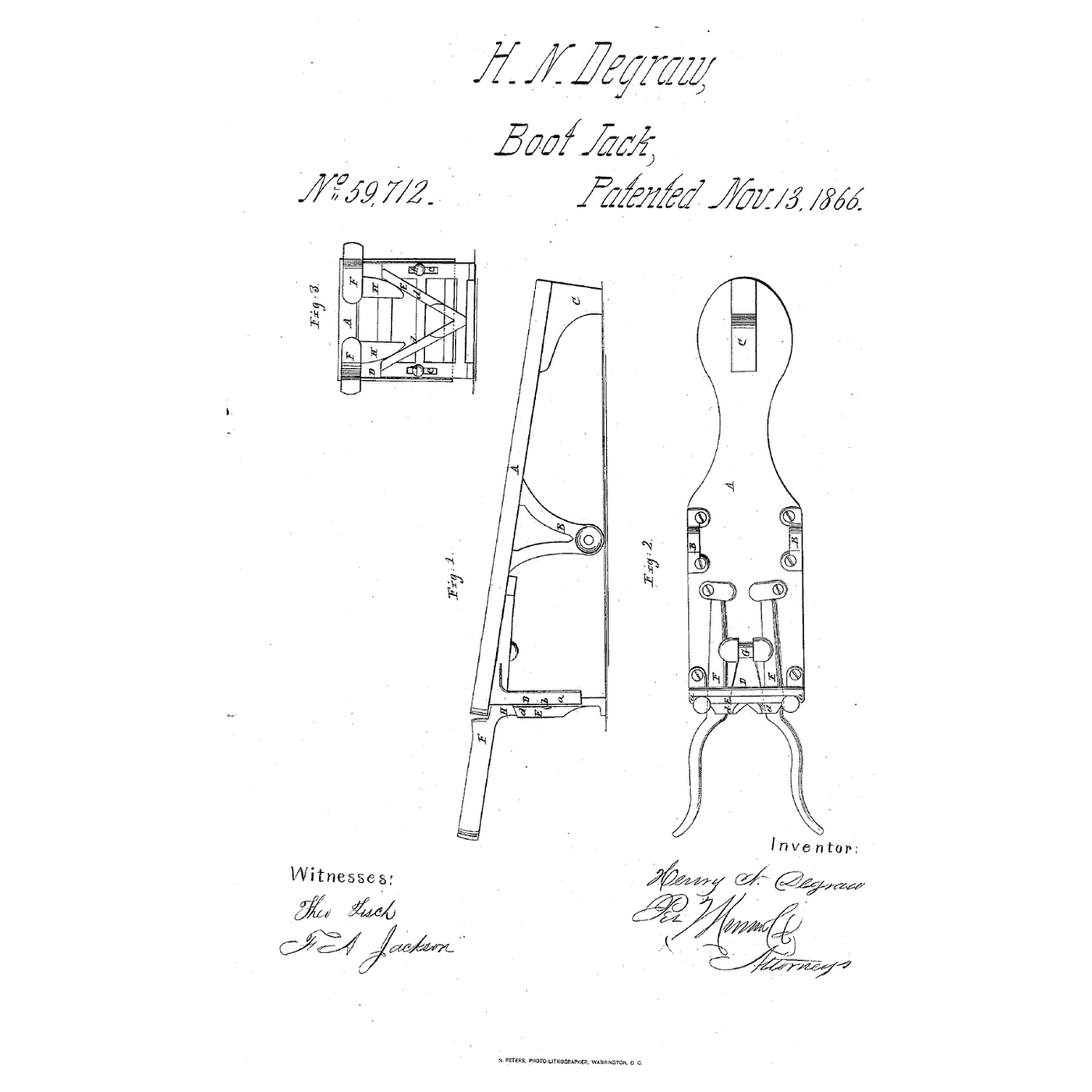
The embedded blueprint is the 1866 boot-jack, which grips the heel to pull a boot off; the shoe horn grips it to get the shoe on.
3
3
Read US 466,643
Read US 466,643
"My invention relates to certain new and useful improvements in shoe-horns; and the object of my improvements is to provide a device adapted to take hold of or grip a shoe and maintain its temporary position thereon by a setting action and allow of yet further gripping action on the said shoe in putting it on the foot."
"As ordinarily formed the shoe-horn has no gripping action on the shoe itself to assist in its adjustment on the foot, and my device is especially adapted for low-cut shoes, or those not provided with a back strap." The clamping-piece has "a rubber lining-surface D, corrugated or otherwise adapted to promote the contact of the clamping device with the leather without marring the same."
"This setting action of the handle and clamping-piece occurs as soon as the point e arrives in line with or passes the pivot F of the handle and clamping-piece. The farther this bearing-point e passes said pivot the greater the setting action, since any pressure on the clamping-piece tending to force it outward or open the jaws will only tend to force this point e still farther past the pivot."
4
4
Putting a shoe on, as a program
Putting a shoe on, as a program
Blockly-Arbeitsbereich
Loading Blockly workspace...
5
5
Build an over-centre lock in card, then time a shoe
Build an over-centre lock in card, then time a shoe
Cut a jaw and a handle from stiff card. Pivot the jaw to a base strip with a nail pushed through an awl hole, and hinge the handle to the jaw so that its end presses on the base. Push the handle down slowly and feel the moment it snaps past the line and holds. Press on the jaw: before the snap it opens, after it stays shut.
Then put on a snug low shoe ten times without a horn and ten times with one, timing each, and hook the force meter into the heel to feel how hard the shoe has to be held.
Materialien für diesen Schritt:
 Schablonen aus Pappe1 Stück
 Eisennägel1 Stück
Benötigte Werkzeuge:
 Schuhlöffel
 Ahle
Ahle Stoppuhr
 Federkraftmesser
 Lineal
6
6
A clamp that will not hold, or will not let go
A clamp that will not hold, or will not let go
Over-centre clamp troubleshooting.
Flow
Loading...
7
7
History and honest limits
History and honest limits
**Elmer E. Wolf** of Springfield, Ohio, filed US 466,643 on 17 January 1891; it is dated 5 January 1892. He writes that a salesman can set the horn on the heel and hand it to the buyer, whose own pull then tightens the grip.
**Honest limits.** The notebook treats the handle as a rigid lever with a point contact and ignores friction at the cam, which in practice makes the lock hold a little before the line. The huge grips near the line are never reached: the jaw lining, the shoe and the card give first. Lengths and forces are examples. Your times and force readings are the measurement.
Materialien
2- 1 StückPlatzhalter
- 1 StückPlatzhalter
Verwandte Blueprints
Diese Blueprints teilen Wissen — Techniken, Materialien oder Prinzipien


CC0 Gemeinfrei
Dieser Blueprint ist unter CC0 veröffentlicht. Sie dürfen dieses Werk für jeden Zweck frei kopieren, ändern, verbreiten und verwenden, ohne um Erlaubnis zu fragen.
Unterstützen Sie den Maker, indem Sie Produkte über seinen Blueprint kaufen, wo er eine Maker-Provision von Anbietern festgelegt, verdient. Oder erstellen Sie eine neue Iteration dieses Blueprints und verbinden Sie ihn in Ihrem eigenen Blueprint, um Einnahmen zu teilen.