KUNST
SCHÖNHEIT & WELLNESS
HANDWERK
KULTUR & GESCHICHTE
UNTERHALTUNG
UMFELD
ESSEN & GETRÄNKE
REVERSE ENGINEERING
WISSENSCHAFTEN
SPORT
TECHNOLOGIE
WEARABLES
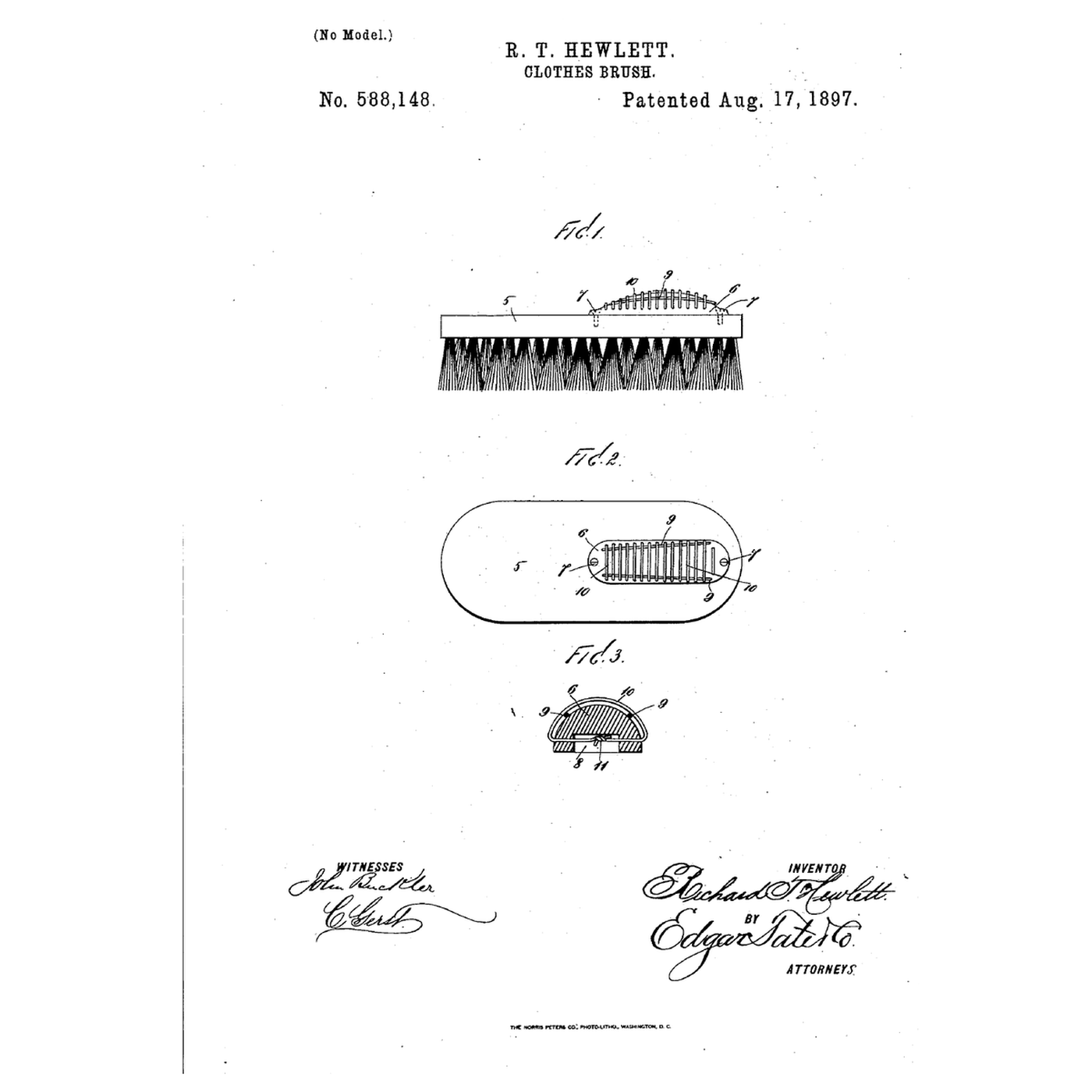


The Mud-Scraper Clothes Brush: Wire on the Back, Bristles on the Front
A clothes brush sweeps loose dust off cloth, but mud that has dried hard needs to be broken up first.
Richard Tanner Hewlett of London received US 588,148, dated 17 August 1897, for a clothes-brush "with an attachment for removing mud and other dirt from clothing after it has become caked or dried thereon": a convex block screwed to the brush's back and wrapped with wire lengthwise and crosswise.
This rung works out how the wires concentrate the push of the hand, then fits a wired block to a clothes brush and tests it on dried mud.
Anfänger
About 2 hours, then a day to dry
Anweisungen
1
1
Pressure under the wires
Pressure under the wires
Jupyter-Notebook wird geladen …
2
2
Ridges loosen dirt
Ridges loosen dirt
The embedded blueprint scrubs cloth over ridges to loosen dirt. Hewlett puts the ridges on the back of the brush and rubs them over the cloth.
3
3
Read US 588,148
Read US 588,148
"This invention relates to brushes for cleaning clothes; and the object thereof is to provide a brush of this class with an attachment for removing mud and other dirt from clothing after it has become caked or dried thereon."
"Whenever it is desired to remove dried mud or other dirt from clothing, the attachment is rubbed thereover, the corrugated surface formed by the wires 9 and 10 operating to loosen and break up the dirt or mud, after which the same may be brushed off in the usual manner."
4
4
Fit a wired block and test it on dried mud
Fit a wired block and test it on dried mud
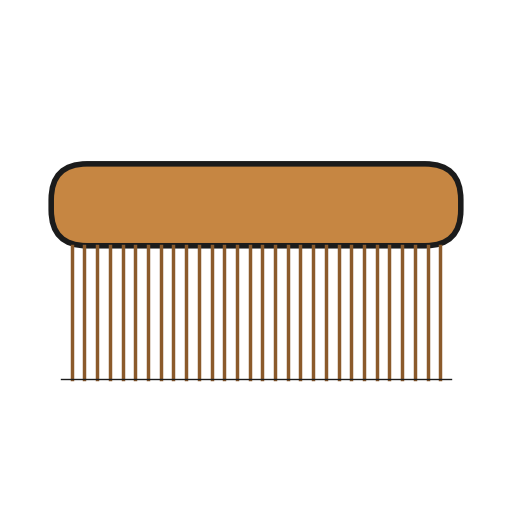
Cut a block of hardwood the length and width of the brush's back. Sand its face into a gentle curve both ways, and cut a groove along the middle of its flat side. Wrap steel wire round it three times lengthwise and eight times crosswise, pulling each turn tight, and twist the ends together in the groove. Screw the block to the brush's back with its flat side down.
Mix garden soil with water to a thick mud. Smear equal patches on two pieces of cotton fabric and let them dry for a day. Clean one with the brush alone and one with the wired block then the brush, counting the strokes until each is clean.
Materialien für diesen Schritt:
 Hartholzbrett1 Stück
 Stahldraht1 Stück
 Holzschrauben2 Stück
 Baumwollgewebe (leicht)1 Stück
 Gartenerde200 g
 Wasser100 ml
Benötigte Werkzeuge:
 Kleiderbürste
 Laubsäge (Schweifsäge)
 Schleifpapier
 Akkubohrschrauber
 Bohrersatz
 Flachrundzange
 Seitenschneider
 Lineal
5
5
A scraper that snags the cloth or leaves the mud
A scraper that snags the cloth or leaves the mud
Clothes-brush scraper troubleshooting.
Flow
Loading...
6
6
History and honest limits
History and honest limits
**Richard Tanner Hewlett** of London filed US 588,148 on 25 February 1897; it is dated 17 August 1897. He noted that "any suitable roughened surface" would serve as well as the wires.
**Honest limits.** The notebook assumes each wire presses an even strip and the wood none; a curved block presses harder at its crown. Sizes and counts are examples. Your stroke counts are the measurement.
Materialien
6- 1 StückPlatzhalter
- 1 StückPlatzhalter
- 2 StückPlatzhalter
- 1 StückPlatzhalter
- 200 gPlatzhalter
- 100 mlPlatzhalter
Benötigte Werkzeuge
8- Platzhalter
- Platzhalter
- Platzhalter
- 1 vendor sell this, none ship to you yetPlatzhalter
- Platzhalter
- Platzhalter
- Platzhalter
- Platzhalter
Verwandte Blueprints
Diese Blueprints teilen Wissen — Techniken, Materialien oder Prinzipien



CC0 Gemeinfrei
Dieser Blueprint ist unter CC0 veröffentlicht. Sie dürfen dieses Werk für jeden Zweck frei kopieren, ändern, verbreiten und verwenden, ohne um Erlaubnis zu fragen.
Unterstützen Sie den Maker, indem Sie Produkte über seinen Blueprint kaufen, wo er eine Maker-Provision von Anbietern festgelegt, verdient. Oder erstellen Sie eine neue Iteration dieses Blueprints und verbinden Sie ihn in Ihrem eigenen Blueprint, um Einnahmen zu teilen.