
The Pneumatic Caisson
To found a bridge pier on rock, you have to reach the rock. If the rock is under thirty metres of river, mud and sand, somebody has to work down there, in the dry, on the riverbed itself.
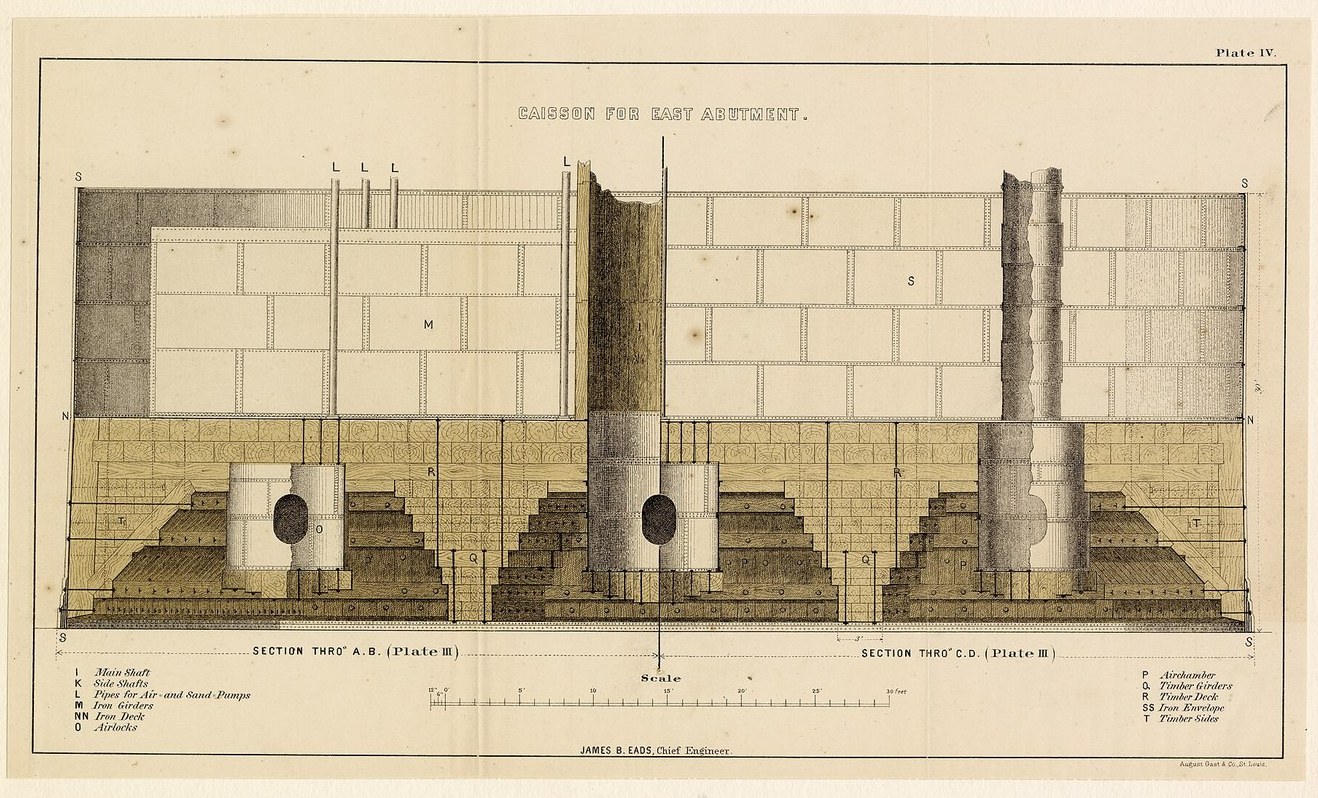
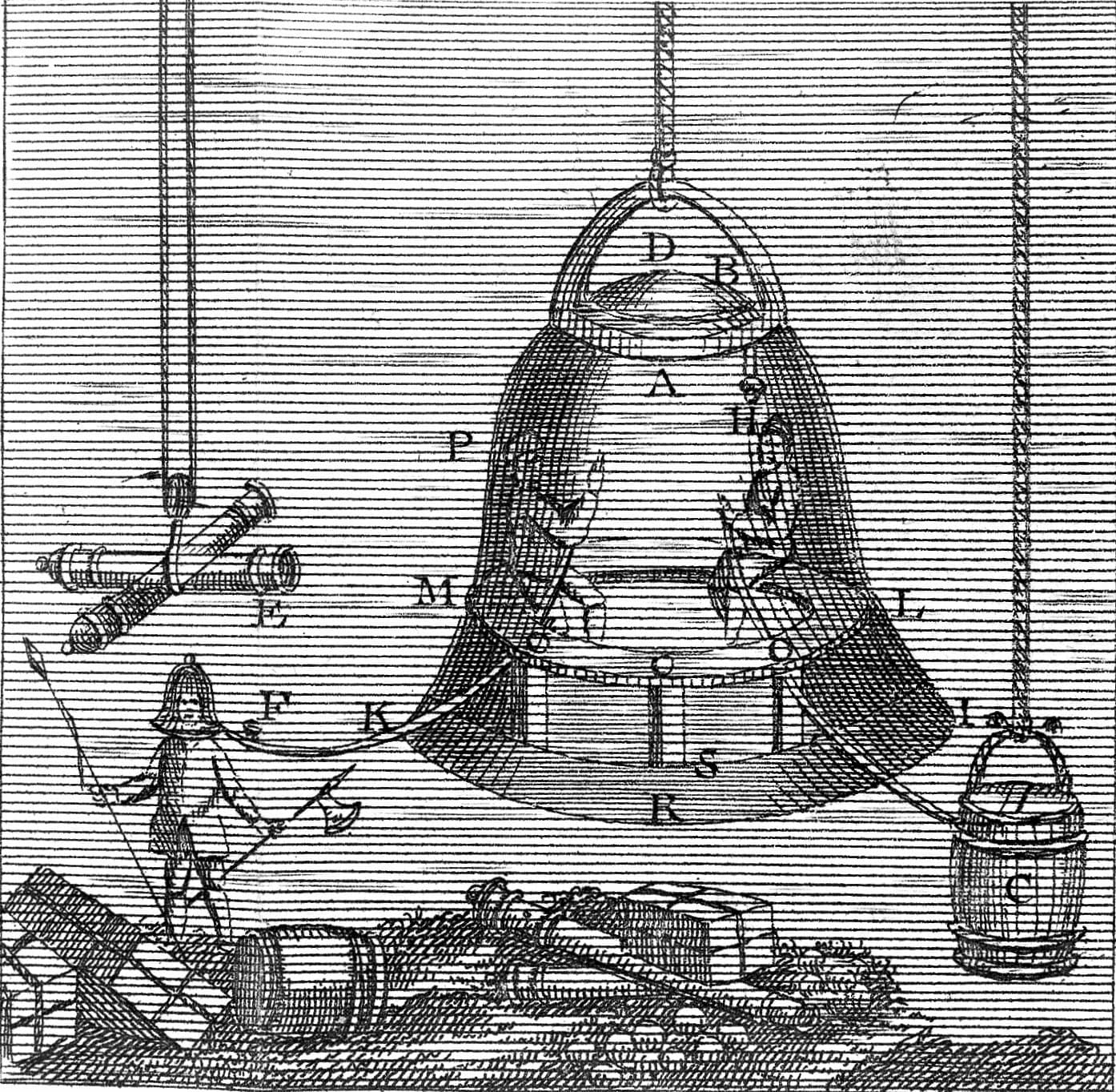
A pneumatic caisson is an upturned box, open at the bottom, sunk to the riverbed and filled with compressed air. The air pushes the water out and holds it out, and men dig inside a bubble held down by the weight of the structure being built on top. Material goes out and men go in and out through air locks. As the digging deepens, the box sinks under its own growing weight.
The pressure required is not a design choice. Water pushes in with a pressure of ρgh, so the air inside must match the pressure at the cutting edge — about one extra atmosphere for every ten metres of depth, and no amount of engineering changes that number.
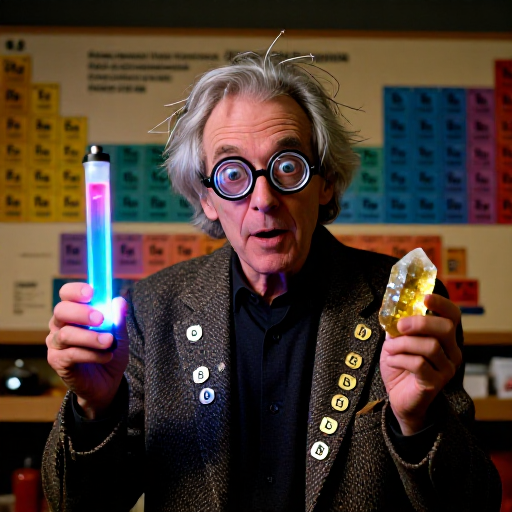
Which is where the physics turns into physiology. Under pressure, Henry's law says more nitrogen dissolves into the blood and tissues of the men breathing it. Bring them up quickly and the dissolved gas comes out of solution inside them, as bubbles. On the Eads and Brooklyn bridges the men worked at pressures up to about 55 psi above atmospheric, and they were crippled and killed by it. Dr Andrew Smith, the Brooklyn Bridge physician, named it caisson disease in 1873. Washington Roebling, the chief engineer, went down in 1871 and was disabled for the rest of his life.
Sink a working caisson in a bucket, measure the pressure it needs, and open a bottle of fizzy water to see the rest.
Anweisungen
Sink a caisson with no air supply at all
Sink a caisson with no air supply at all
Push an inverted clear glass or jar straight down into a deep bucket of water, keeping it level. Mark the water level trapped inside.
Push it deeper and watch the trapped water rise inside the glass.
The air is being compressed, not lost. This is Boyle's law and it is the whole reason a plain diving bell has a working depth limit — go deep enough and the water reaches the roof.
Benötigte Werkzeuge:
 Bandmaß (Rollmeter)
Add the air supply
Add the air supply
Run a tube from a pump up inside the inverted glass. Push the glass down again and pump air in until the water inside is driven back down to the rim.
Hold it there.
You now have a pneumatic caisson: a dry working chamber on the bottom, maintained by continuously replacing the air that escapes under the edge.
Materialien für diesen Schritt:
 Pneumatikschlauch1 Meter
Benötigte Werkzeuge:
 Luftpumpe
Measure the pressure the depth demands
Measure the pressure the depth demands
Fit a gauge in the air line. Record the pressure needed to hold the water at the rim for several different depths of the rim below the surface.
Plot pressure against depth.
Expect a straight line through the origin, at about 1 kPa per 10 cm of water — that is ρgh with ρ = 1000 kg/m³. Real caisson work simply reads further along the same line: 10 m of water is one extra atmosphere, 30 m is three.
Benötigte Werkzeuge:
 Manometer
 Millimeterpapier
Build an air lock
Build an air lock
Fit a second small chamber above the caisson with a valve at each end. Move a marker object in without letting the caisson lose pressure: open the top valve, load, close it, equalise the lock to caisson pressure, then open the bottom valve.
Never both valves at once.
That interlock is the entire invention. Sir Thomas Cochrane patented it in 1830 — not the pressurised chamber, which was older, but the means to get in and out of one without emptying it.
See what pressure does to dissolved gas
See what pressure does to dissolved gas
Take an unopened bottle of carbonated water. Note that it is clear and still — the CO₂ is dissolved, held there by the pressure above the liquid.
Release the cap slowly and watch. Then repeat with a second bottle, opened fast.
Expect the fast release to foam violently and the slow one to settle.
Same liquid, same gas, same starting pressure. The only difference is the rate of decompression, and that is precisely the variable that decides whether a caisson worker walks home.
Model a decompression schedule
Model a decompression schedule
Warm a bottle slightly to raise the pressure, then release it in three stages with a pause at each.
Compare the foam against a single fast release from the same starting condition.
Expect staged release to lose far less liquid, because gas leaves solution steadily instead of nucleating into bubbles all at once.
That is a decompression schedule, and the analogy is close but not perfect — a body has many tissues that load and unload at different rates, which is why real tables are built from tissue models rather than from one number.
Benötigte Werkzeuge:
 Stoppuhr
History & Context
History & Context
The chamber is much older than the way in. Denis Papin proposed keeping water out with pressurised air in 1691, and Coulomb worked on the idea in 1779. What was missing was a way for people and spoil to cross the pressure boundary without letting the pressure go, and that is what Sir Thomas Cochrane patented in 1830: the air lock. Jacques Triger put it to work from 1839 sinking a shaft through waterlogged ground in the Loire coalfield — and his workers reported the symptoms almost immediately, roughly half an hour after coming up.
Henry's law is the whole mechanism. The amount of a gas dissolved in a liquid is proportional to the partial pressure of that gas above it. Air is about 78% nitrogen, and nitrogen is metabolically inert — the body neither uses it nor gets rid of it chemically, it just dissolves. Work for hours at four atmospheres and the tissues load with roughly four times the nitrogen. Come up in minutes and that nitrogen leaves solution wherever it can: in joints, in the spinal cord, in the lungs. The men called it the bends from the posture of those in pain; Andrew Smith called it caisson disease in his 1873 report, describing 110 cases serious enough to demand his attention among about 600 workers.
Two bridges, two physicians, and a lesson learned slowly. Dr Alphonse Jaminet at the Eads Bridge in St Louis published his account in 1871; Dr Andrew Smith at the Brooklyn Bridge published in 1873. Both were describing the same thing, and neither had the mechanism. Slow decompression was tried and helped, but it was resisted as lost working time. Washington Roebling went down into the Brooklyn caisson himself in 1871 and never recovered; he directed the rest of the bridge from his room, with Emily Warren Roebling carrying his instructions to the site and learning enough engineering to answer for them.
What actually solved it was arithmetic, thirty-five years later. J. S. Haldane's work for the Royal Navy, published in 1908, produced the first staged decompression tables built from a model of how different tissues take up and release gas. That is the direct ancestor of every dive table and dive computer in use today. The caisson men were not saved by better machinery; they were saved by somebody modelling the body as several compartments instead of one.
The honest limits. The caisson itself is limited by that same ρgh line — beyond roughly 35 metres the pressure is more than people can safely work in at all, and modern deep foundations use bored piles, slurry walls and diaphragm walls precisely to avoid putting anyone under pressure. Fire in a compressed-air chamber is far worse than at surface pressure, and a caisson fire on the Brooklyn Bridge burned for days inside the timber. And the bench model here is a jar in a bucket at a fraction of an atmosphere. Real compressed-air work is a regulated occupation with medical supervision, and the history above is exactly why.
Materialien
1- 1 MeterPlatzhalter
Materialien verbundener Blueprints
Verwandte Blueprints
Diese Blueprints teilen Wissen — Techniken, Materialien oder Prinzipien



CC0 Gemeinfrei
Dieser Blueprint ist unter CC0 veröffentlicht. Sie dürfen dieses Werk für jeden Zweck frei kopieren, ändern, verbreiten und verwenden, ohne um Erlaubnis zu fragen.
Unterstützen Sie den Maker, indem Sie Produkte über seinen Blueprint kaufen, wo er eine Maker-Provision von Anbietern festgelegt, verdient. Oder erstellen Sie eine neue Iteration dieses Blueprints und verbinden Sie ihn in Ihrem eigenen Blueprint, um Einnahmen zu teilen.