KUNST
SCHÖNHEIT & WELLNESS
HANDWERK
KULTUR & GESCHICHTE
UNTERHALTUNG
UMFELD
ESSEN & GETRÄNKE
REVERSE ENGINEERING
WISSENSCHAFTEN
SPORT
TECHNOLOGIE
WEARABLES
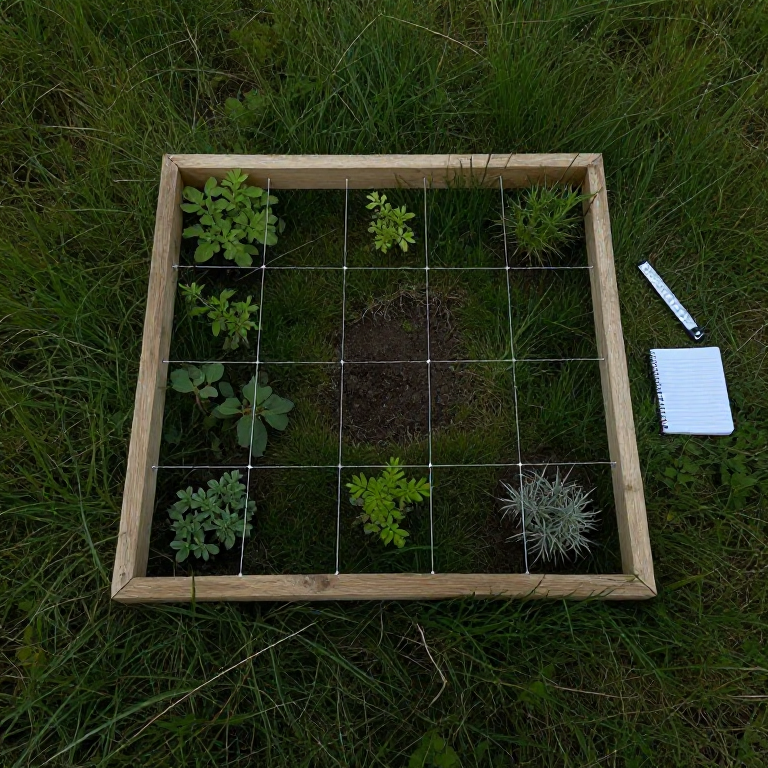


The Quadrat: Counting Plants Without Counting Them All
You cannot count every plant in a field, and you do not need to. Drop a frame of known area on the ground, count what is inside it, repeat enough times in the right places, and arithmetic does the rest.
The quadrat is the oldest and most useful tool in field ecology, and almost everything that goes wrong with it goes wrong before any counting starts — in WHERE the frames are placed. A person choosing spots that 'look representative' produces numbers that describe their own judgement, not the field, and no amount of careful counting afterwards recovers from it.
So this blueprint is mostly about randomisation, replication and honesty about what a sample can support. Those three ideas are the whole of quantitative field biology, and they are worth learning on a lawn before anything depends on them.
Anfänger
1 day
Anweisungen
1
1
Make a frame of a known, stated area
Make a frame of a known, stated area
Build a rigid square frame of a size that suits your subject — 0.25 m by 0.25 m for moss, 0.5 m for grassland, 1 m or more for shrubs — and write its INTERNAL dimensions on it.
Measure and record the inside, not the outside: a frame of 25 mm timber has an outside area 20 per cent larger than its inside, and mixing the two silently inflates or deflates every density you ever calculate. Stringing it into a grid of 25 or 100 small squares makes percentage cover far quicker to estimate.
Materialien für diesen Schritt:
 Holzdübel4 Stück
 Galvanisierte Nägel12 Stück
Benötigte Werkzeuge:
 Handsäge
 Bandmaß (Rollmeter)
 Permanentmarker
 Maurerschnur
2
2
Place it at RANDOM, and mean random
Place it at RANDOM, and mean random
Lay two tapes at right angles along the edges of your area to make a coordinate grid, generate pairs of random numbers, and place the frame where each pair falls — including when that is a bare patch or an awkward corner.
Throwing the quadrat over your shoulder is not random: it lands further on open ground than in a thicket, and people throw harder when they are bored. Moving a frame 'because it landed on the path' biases the result by exactly the amount the path matters. If the path is in your area, it is part of your answer.
Benötigte Werkzeuge:
Bandmaß (Rollmeter) Feldbuch
3
3
Decide your rules before you look
Decide your rules before you look
Write down, in advance: does a plant rooted outside but overhanging count? What about one rooted exactly on the line? Are you recording DENSITY (how many), FREQUENCY (in how many quadrats it appears) or COVER (what fraction of ground)?
Deciding these while looking at a difficult plant is how a result bends toward the answer you expected. The usual conventions are: count it if it is ROOTED inside, and count a plant on the line if it is on the north or east edge only. Any rule works; an unwritten rule does not.
Benötigte Werkzeuge:
Feldbuch Lupe
Lupe4
4
Estimate cover consistently, and check yourself
Estimate cover consistently, and check yourself
For percentage cover, use the strung grid and count squares. Then have a second person estimate the same quadrat independently and compare.
Cover estimates by eye are notoriously variable between observers — differences of twenty percentage points on the same quadrat are common — and the difference between your two estimates IS your measurement error. If you must work alone, re-estimate a few quadrats an hour later without looking at your first answer.
Benötigte Werkzeuge:
Feldbuch5
5
How many quadrats, and what the number means
How many quadrats, and what the number means
Jupyter-Notebook wird geladen …
Benötigte Werkzeuge:
Feldbuch6
6
Record enough that someone else could repeat it
Record enough that someone else could repeat it
Note the date, the site, the grid you used, the quadrat size, the rules from step 3, who recorded, and the weather.
An ecological survey is only worth anything if it can be repeated in five years to see what changed, and that repeat has to use the same method or the comparison is meaningless. Mark at least two corners of your grid permanently so the same area can be found again — that single act turns a survey into a monitoring programme.
Materialien für diesen Schritt:
 Holzpflock4 Stück
Benötigte Werkzeuge:
 Klauenhammer
 KompassFeldbuch
 Set mit Vermessungsfähnchen und -stäben
Materialien
3- 4 StückPlatzhalter
- 12 StückPlatzhalter
- 4 StückPlatzhalter
Benötigte Werkzeuge
9- Platzhalter
- 1 vendor sell this, none ship to you yetPlatzhalter
- Platzhalter
- Platzhalter
- Platzhalter
- Platzhalter
- Platzhalter
- Platzhalter
- Platzhalter
Dieser Bauplan stellt her

Verwandte Blueprints
Diese Blueprints teilen Wissen — Techniken, Materialien oder Prinzipien

CC0 Gemeinfrei
Dieser Blueprint ist unter CC0 veröffentlicht. Sie dürfen dieses Werk für jeden Zweck frei kopieren, ändern, verbreiten und verwenden, ohne um Erlaubnis zu fragen.
Unterstützen Sie den Maker, indem Sie Produkte über seinen Blueprint kaufen, wo er eine Maker-Provision von Anbietern festgelegt, verdient. Oder erstellen Sie eine neue Iteration dieses Blueprints und verbinden Sie ihn in Ihrem eigenen Blueprint, um Einnahmen zu teilen.