KUNST
SCHÖNHEIT & WELLNESS
HANDWERK
KULTUR & GESCHICHTE
UNTERHALTUNG
UMFELD
ESSEN & GETRÄNKE
REVERSE ENGINEERING
WISSENSCHAFTEN
SPORT
TECHNOLOGIE
WEARABLES
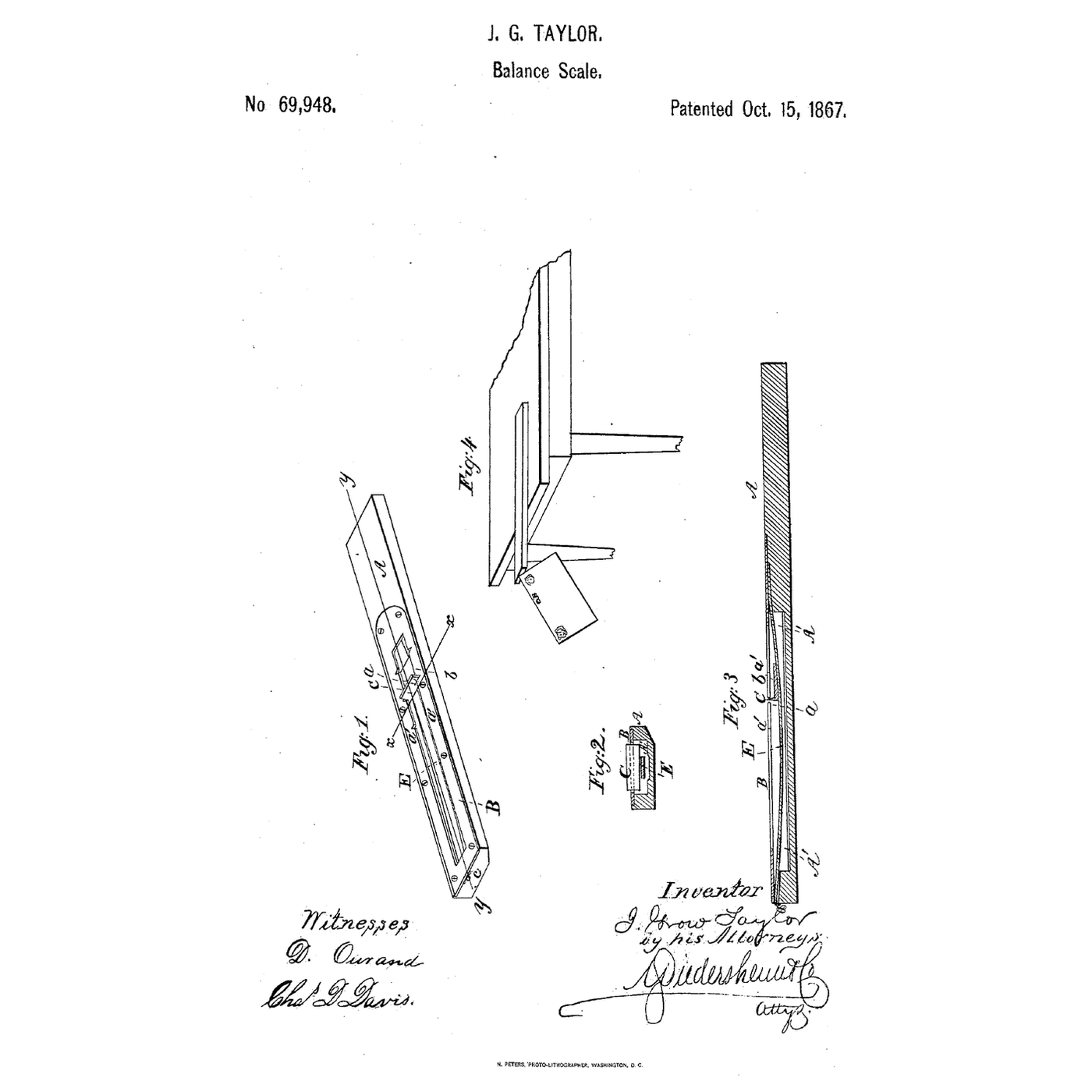


The Ruler Letter Scale: A Ruler That Weighs With Its Own Weight
Every desk has a ruler, but a letter scale is another thing to buy and to find room for.
T. Grow Taylor of Lawrenceville, New York, received US 69,948, dated 15 October 1867, for "adapting an ordinary rule or ruler to be used as a letter-scale by certain appliances whereby the functions of both will be retained, yet both act independently of each other": a notched plate in a channel on top of the ruler, an angular slide whose short arm forms the fulcrum, and a spring with a hook to hold the letter. Laid over the edge of a desk, the ruler balances the letter by its own weight.
This rung works out where the notches go, then fits a slide, notched plate and hook to a ruler and weighs letters with it.
Anfänger
About 2 hours
Anweisungen
1
1
Notches from the ruler's own weight
Notches from the ruler's own weight
Jupyter-Notebook wird geladen …
2
2
The ruler as its own counterweight
The ruler as its own counterweight
The embedded blueprint works out the lever law. Taylor's ruler needs no counterweight: its own weight, at its middle, balances the letter.
3
3
Read US 69,948
Read US 69,948
"C represents a slide, moving in the channel A′, and retained in place by the frame or plate B. The slide consists of an angular block, having its short arm a to protrude beyond the short plate B, and which will form the fulcrum of the scale."
"The rule is to be placed in the position shown in fig. 4, that is, with the slide underneath, and the weighing end to project over the end of a table, desk, or other resting place. The letter may be held by its flap catching in the hook, or may be pierced in one corner by the pin."
4
4
Fit the ruler and weigh letters
Fit the ruler and weigh letters
**Plate.** Weigh the ruler on the kitchen scale and run the notebook with its mass and length. Cut a strip of aluminium sheet 15 × 2 cm and file notches in one edge at the notebook's distances from the letter end.
**Slide.** Cut a small angular block from hardwood block with a short arm that sticks out below the ruler as the fulcrum. Tape the plate along the ruler's top so the slide runs under its notched edge and clicks into each notch.
**Hook.** Screw a strip of spring steel along the ruler's end with its tip bent into a hook, to hold a letter by its flap.
**Test.** Set the slide at the half-ounce notch, lay the ruler over the edge of the table with the slide on the edge, and hang letters weighed on the kitchen scale. Note which tip the ruler and which balance, and compare with their weights.
Materialien für diesen Schritt:
 Aluminiumblech1 Stück
 Hartholzblock1 Stück
 Federstahlband1 Stück
 Holzschrauben2 Stück
Benötigte Werkzeuge:
 Lineal
 Blechschere
 Nadelfeilensatz
 Bügelsäge (Metallsäge)
 Akkubohrschrauber
 Bohrersatz
 Schraubendreher-Satz
 Flachzange
 Digitale Küchenwaage
 Digitaler Messschieber 6 Zoll
 Bleistift
 Malerkrepp
5
5
A ruler scale that reads wrong or will not balance
A ruler scale that reads wrong or will not balance
Ruler letter scale troubleshooting.
Flow
Loading...
6
6
History and honest limits
History and honest limits
**T. Grow Taylor** of Lawrenceville, St. Lawrence County, New York, signed US 69,948 on 13 April 1867; it is dated 15 October 1867 and antedated 17 April 1867. (The specification prints his name as T. Grow Taylor; the drawing sheet's header reads J. G. Taylor. Which initial is right is not settled here.) His inner notch marked half an ounce and the next a full ounce, the notches could be cut in the channel instead of a plate, and he offered gum or a pin in place of the hook.
**Honest limits.** A taped aluminium plate, a hardwood slide and a spring-steel hook stand in for his fitted parts. The notebook ignores the hook's weight; the ruler's mass and length are examples. Your weighings are the result.
Materialien
4- 1 StückPlatzhalter
- 1 StückPlatzhalter
- 1 StückPlatzhalter
- 2 StückPlatzhalter
Benötigte Werkzeuge
12- Platzhalter
- Platzhalter
- Platzhalter
- Platzhalter
- 1 vendor sell this, none ship to you yetPlatzhalter
- Platzhalter
- Platzhalter
- Platzhalter
- Platzhalter
- Platzhalter
- 1 vendor sell this, none ship to you yetPlatzhalter
- Platzhalter
Verwandte Blueprints
Diese Blueprints teilen Wissen — Techniken, Materialien oder Prinzipien



CC0 Gemeinfrei
Dieser Blueprint ist unter CC0 veröffentlicht. Sie dürfen dieses Werk für jeden Zweck frei kopieren, ändern, verbreiten und verwenden, ohne um Erlaubnis zu fragen.
Unterstützen Sie den Maker, indem Sie Produkte über seinen Blueprint kaufen, wo er eine Maker-Provision von Anbietern festgelegt, verdient. Oder erstellen Sie eine neue Iteration dieses Blueprints und verbinden Sie ihn in Ihrem eigenen Blueprint, um Einnahmen zu teilen.