
KUNST
SCHÖNHEIT & WELLNESS
HANDWERK
KULTUR & GESCHICHTE
UNTERHALTUNG
UMFELD
ESSEN & GETRÄNKE
REVERSE ENGINEERING
WISSENSCHAFTEN
SPORT
TECHNOLOGIE
WEARABLES
The Sheet-of-Water Fountain Brush: Tapered Slots Part the Bristles
Woody

Erstellt von

Woody

6. Oktober 2026NO
28
0
0
0
0

The Sheet-of-Water Fountain Brush: Tapered Slots Part the Bristles

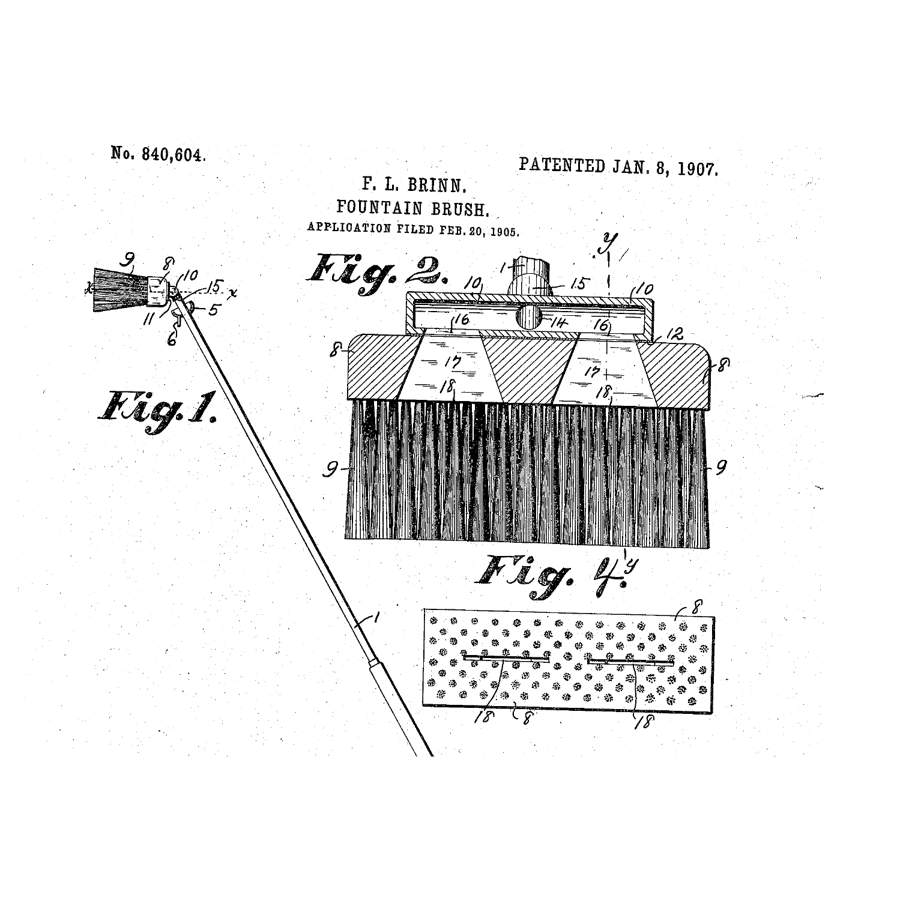
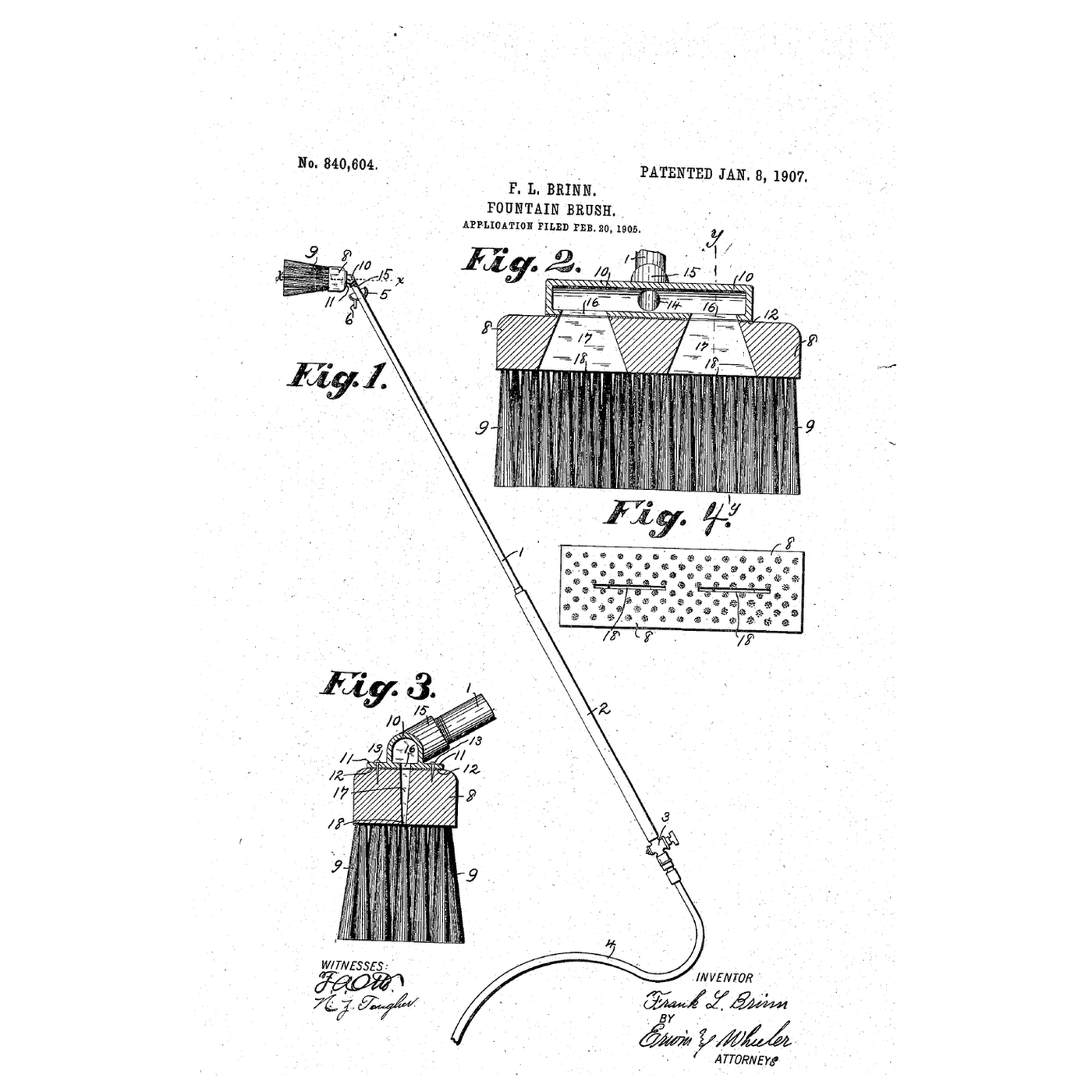
Water dribbled onto the back of a brush stays in the bristles and never reaches the surface being washed. Frank L. Brinn of Milwaukee received US 840,604, patented 8 January 1907, for a fountain brush in which "the fluid may be delivered to the longitudinal central portion of the brush in a sheet, which when the fluid is turned on at full head will serve to separate the bristles and flush the surface to be washed": slots through the block narrow toward the bristles, fed from a cylinder on top through a tubular handle, with a cup on the handle to catch what runs down. This rung works out how the taper speeds the sheet, then cuts the slots in a scrub brush, plumbs it and compares full flow with throttled flow.
Fortgeschritten
About 4 hours

Anweisungen

1

Sheet speed from the slot

Jupyter-Notebook wird geladen …
2

Water through a brush's back before it

The embedded blueprint jets or soaks water through openings in a brush's back. Brinn shapes the openings into tapered slots so the water leaves as a sheet.
3

Read US 840,604

"By opening the valve at 3 to its full capacity a sheet of water will be discharged which will separate the bristles and effectively flush the surface to be washed, whether the bristles are in contact with such surface or not. By partially closing the valve at 3 the sheets of water escaping through the openings 18 are broken up by the bristles, and the water thus becomes distributed throughout the brush."
4

Cut the slots

On the scrub brush's top mark two slots 60 × 8 mm, 90 mm apart on the centre line. Drill a row of holes in each and cut it through with the coping saw.

Materialien für diesen Schritt:

ScheuerbürsteScheuerbürste1 Stück

Benötigte Werkzeuge:

SchraubstockSchraubstock
AkkubohrschrauberAkkubohrschrauber
BohrersatzBohrersatz
Laubsäge (Schweifsäge)Laubsäge (Schweifsäge)
PermanentmarkerPermanentmarker
LinealLineal
5

Taper the slots

Pare each slot with chisels so its long sides close to about 1.5 mm at the bristle face and its ends open out to 70 mm. Trim the bristles along the slot line.

Benötigte Werkzeuge:

Stechbeitelsatz für HolzStechbeitelsatz für Holz
HammerHammer
Digitaler Messschieber 6 ZollDigitaler Messschieber 6 Zoll
BastelmesserBastelmesser
6

Make the manifold

Cut 160 mm of 22 mm copper tube and cap both ends with fittings. File a 4 mm slot along its underside over both brush slots. Fit a tee in its middle for the handle.

Materialien für diesen Schritt:

KupferrohrKupferrohr1 Stück
MessingfittingsMessingfittings1 Stück

Benötigte Werkzeuge:
RohrabschneiderRohrabschneider
Feilen (Handfeile)Feilen (Handfeile)
RollgabelschlüsselRollgabelschlüssel
7

Seat the manifold

Bed the manifold on the brush in silicone over a rubber gasket and strap it down with an aluminium strip and four wood screws.

Materialien für diesen Schritt:

SilikondichtmasseSilikondichtmasse1 Stück
GummiplatteGummiplatte1 Stück
AluminiumblechAluminiumblech1 Stück
Holzschraube #8 x 1"Holzschraube #8 x 1"1 Stück

Benötigte Werkzeuge:

BlechschereBlechschere
Schraubendreher-SatzSchraubendreher-Satz
BastelmesserBastelmesser
8

Handle, valve and drip cup

Fit 1.2 m of 15 mm copper tube to the tee, with a ball valve and hose connector at its top. Slide a small tin can, holed and sealed with silicone, onto the handle as a drip cup, and fit a short copper spout low on its side.

Materialien für diesen Schritt:

KupferrohrKupferrohr1 Stück
KugelhahnKugelhahn1 Stück
MessingfittingsMessingfittings1 Stück
PTFE-GewindedichtbandPTFE-Gewindedichtband1 Stück
BlechdoseBlechdose1 Stück
SilikondichtmasseSilikondichtmasse1 Stück

Benötigte Werkzeuge:

RohrabschneiderRohrabschneider
RollgabelschlüsselRollgabelschlüssel
AkkubohrschrauberAkkubohrschrauber
BohrersatzBohrersatz
9

The patent drawing

US 840,604 drawing sheet, public domain (expired patent).
Schritt 9 - Image 1
10

Full flow against throttled

Connect the garden hose. With the valve fully open, hold the brush 2 cm off a board and watch the sheet part the bristles; then close it half and watch the water spread through them. Time a litre into the jug each way.
Schritt 10 - Image 1

Materialien für diesen Schritt:

WasserWasser1 Stück

Benötigte Werkzeuge:

MesskanneMesskanne
StoppuhrStoppuhr
LinealLineal
GartenschlauchGartenschlauch
11

A sheet that sprays, sputters or leaks

Sheet-of-water fountain brush troubleshooting.

Flow

Loading...
12

History and honest limits

**Frank L. Brinn**, a citizen of Canada residing in Milwaukee, filed US 840,604 on 20 February 1905; it was patented 8 January 1907. His cylinder is held to the block by a plate with packing and screws, its slots feeding the slot-apertures; the handle's end carries a rubber sheath and the valve; the cup, with its spout, collects the water instead of letting it run down the handle when the brush is raised. **Honest limits.** A slotted copper tube stands in for his cylinder, and a tin can for his cup. The notebook treats the sheet as uniform. What you see on the board is the result.

Materialien

11

Benötigte Werkzeuge

18

CC0 Gemeinfrei

Dieser Blueprint ist unter CC0 veröffentlicht. Sie dürfen dieses Werk für jeden Zweck frei kopieren, ändern, verbreiten und verwenden, ohne um Erlaubnis zu fragen.

Unterstützen Sie den Maker, indem Sie Produkte über seinen Blueprint kaufen, wo er eine Maker-Provision von Anbietern festgelegt, verdient. Oder erstellen Sie eine neue Iteration dieses Blueprints und verbinden Sie ihn in Ihrem eigenen Blueprint, um Einnahmen zu teilen.

Diskussion

(0)

Anmelden um an der Diskussion teilzunehmen

Kommentare werden geladen...