KUNST
SCHÖNHEIT & WELLNESS
HANDWERK
KULTUR & GESCHICHTE
UNTERHALTUNG
UMFELD
ESSEN & GETRÄNKE
REVERSE ENGINEERING
WISSENSCHAFTEN
SPORT
TECHNOLOGIE
WEARABLES


The Standing Transplanter: Set Out Plants Without Stooping
Setting out hundreds of young plants by hand means bending to the ground for every one, and the back pays for it.
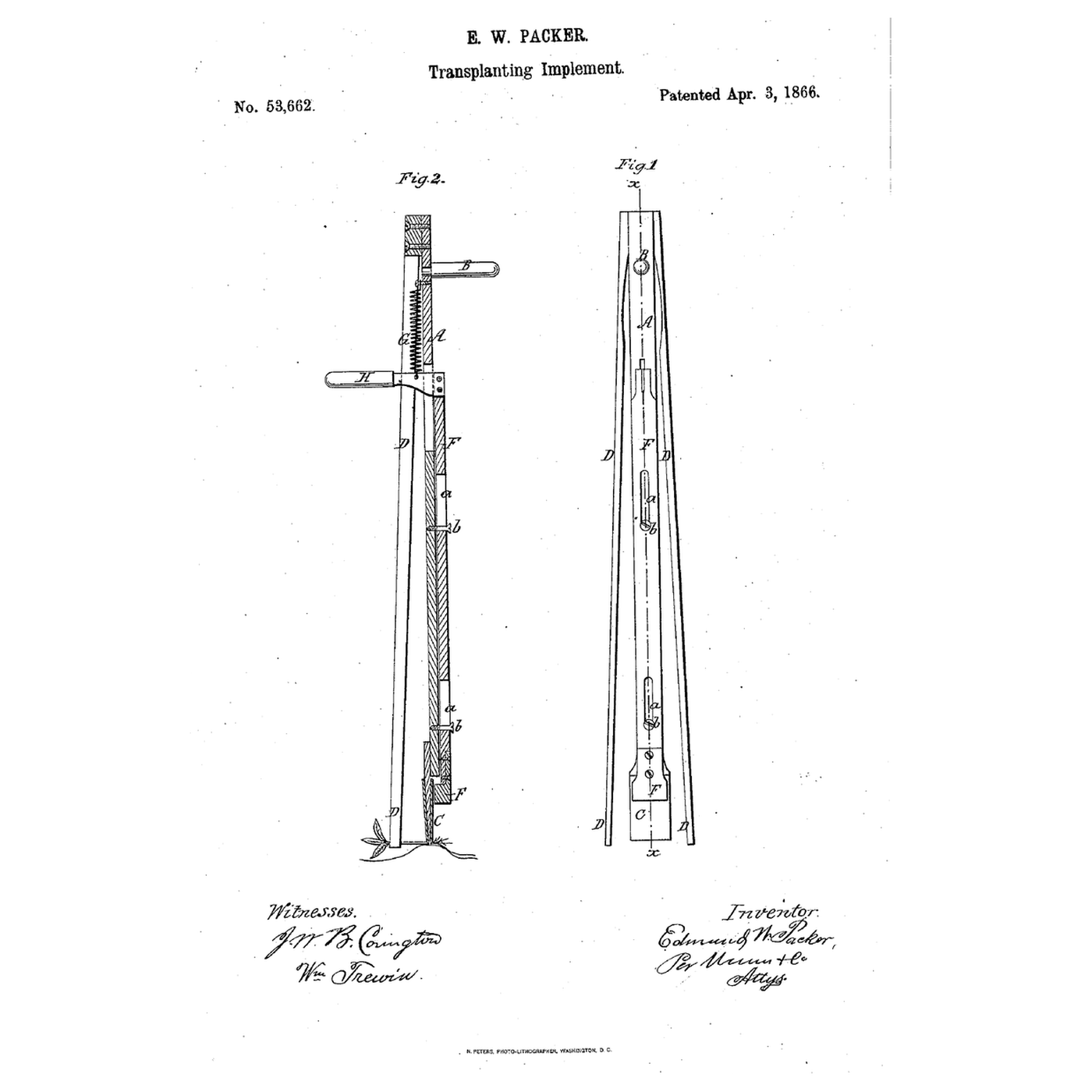
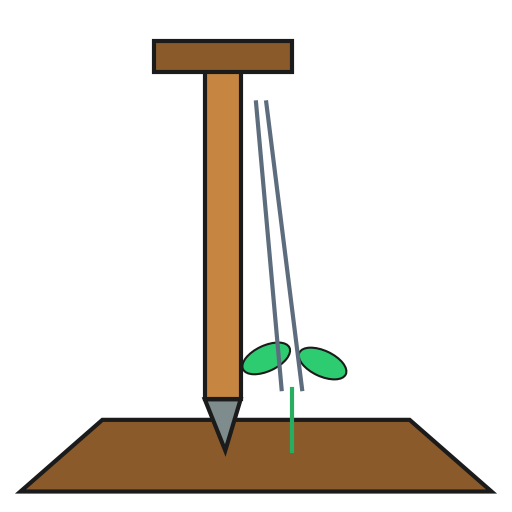
Edmund W. Packer of Paulsborough, New Jersey, received US 53,662, dated 3 April 1866, for an implement for setting out sweet-potato, cabbage and other plants "not requiring the person using it to stoop". A staff with a wedge-shaped foot carries tong-levers that hold the plant, and a spring-returned ram firms the earth around it.
This rung works out the load stooping puts on the lower back, then builds a standing transplanter and sets out a row of seedlings with it.
Anfänger
About 3 hours
Anweisungen
1
1
Back load, upright against stooped
Back load, upright against stooped
Jupyter-Notebook wird geladen …
2
2
Getting the plants ready
Getting the plants ready
The embedded blueprint hardens seedlings and plants them out. Packer's staff sets them out without bending.
3
3
Read US 53,662
Read US 53,662
"The object of this invention is to provide a tool or implement with which sweet-potato, cabbage, and other plants can be expeditiously set out or planted in the ground, and with but very little manual labor, the implement embraced by the present improvements not requiring the person using it to stoop, which by the mode hitherto practiced for the setting out of such plants with the hands occasioned much pain in the person's back".
The plant is "forced into the ground, and to any desired depth, by simply exerting more or less force upon the staff", after which the ram "is forced down, pressing the earth around and about the plant", and "is drawn back by the action of the spiral spring G".
4
4
Build a standing transplanter and plant a row
Build a standing transplanter and plant a row
Raise lettuce seedlings in a seedling tray.
Take a broom handle as the staff and fix a wedge-shaped hardwood foot to its lower end. Screw two long hardwood strips to its sides as tongs, hinged at the top, so their lower ends pinch a seedling's stem when squeezed together. Beside the staff, fit a sliding dowel with a flat foot as the ram, guided by two screw eyes and pulled back up by a spring.
Set out one row with the transplanter and one by hand with the trowel. Time each row, and note how often you had to bend.
Materialien für diesen Schritt:
 Hartholzbrett1 Stück
 Holzdübel1 Stück
 Druckfedern-Sortiment1 Stück
 Holzschrauben8 Stück
 Salatsamen1 Stück
 Blumenerde1 Stück
Benötigte Werkzeuge:
 Pflanzgerät
 Pflanzkelle
 Anzuchtschale
 Gießkanne
 Handsäge
 Akkubohrschrauber
 Stoppuhr
5
5
Transplants that wilt, lean or sit too shallow
Transplants that wilt, lean or sit too shallow
Transplanting troubleshooting.
Flow
Loading...
6
6
History and honest limits
History and honest limits
**Edmund W. Packer** of Paulsborough, Gloucester County, New Jersey, received US 53,662, dated 3 April 1866. The patent prints no filing date.
**Honest limits.** The notebook treats the upper body as one weight at one distance. It is a rough guide to how the back load grows, not a medical figure. The masses and distances are examples. Your timed rows are the measurement.
Materialien
6- 1 StückPlatzhalter
- 1 StückPlatzhalter
- 1 StückPlatzhalter
- 8 StückPlatzhalter
- 1 StückPlatzhalter
- 1 StückPlatzhalter
Verwandte Blueprints
Diese Blueprints teilen Wissen — Techniken, Materialien oder Prinzipien

CC0 Gemeinfrei
Dieser Blueprint ist unter CC0 veröffentlicht. Sie dürfen dieses Werk für jeden Zweck frei kopieren, ändern, verbreiten und verwenden, ohne um Erlaubnis zu fragen.
Unterstützen Sie den Maker, indem Sie Produkte über seinen Blueprint kaufen, wo er eine Maker-Provision von Anbietern festgelegt, verdient. Oder erstellen Sie eine neue Iteration dieses Blueprints und verbinden Sie ihn in Ihrem eigenen Blueprint, um Einnahmen zu teilen.