KUNST
SCHÖNHEIT & WELLNESS
HANDWERK
KULTUR & GESCHICHTE
UNTERHALTUNG
UMFELD
ESSEN & GETRÄNKE
REVERSE ENGINEERING
WISSENSCHAFTEN
SPORT
TECHNOLOGIE
WEARABLES


The Top-Figured Letter-Scale Beam: Read the Weight From Above
A steelyard beam carries its figures on its sides, and on a desk the clerk has to stoop to read them.
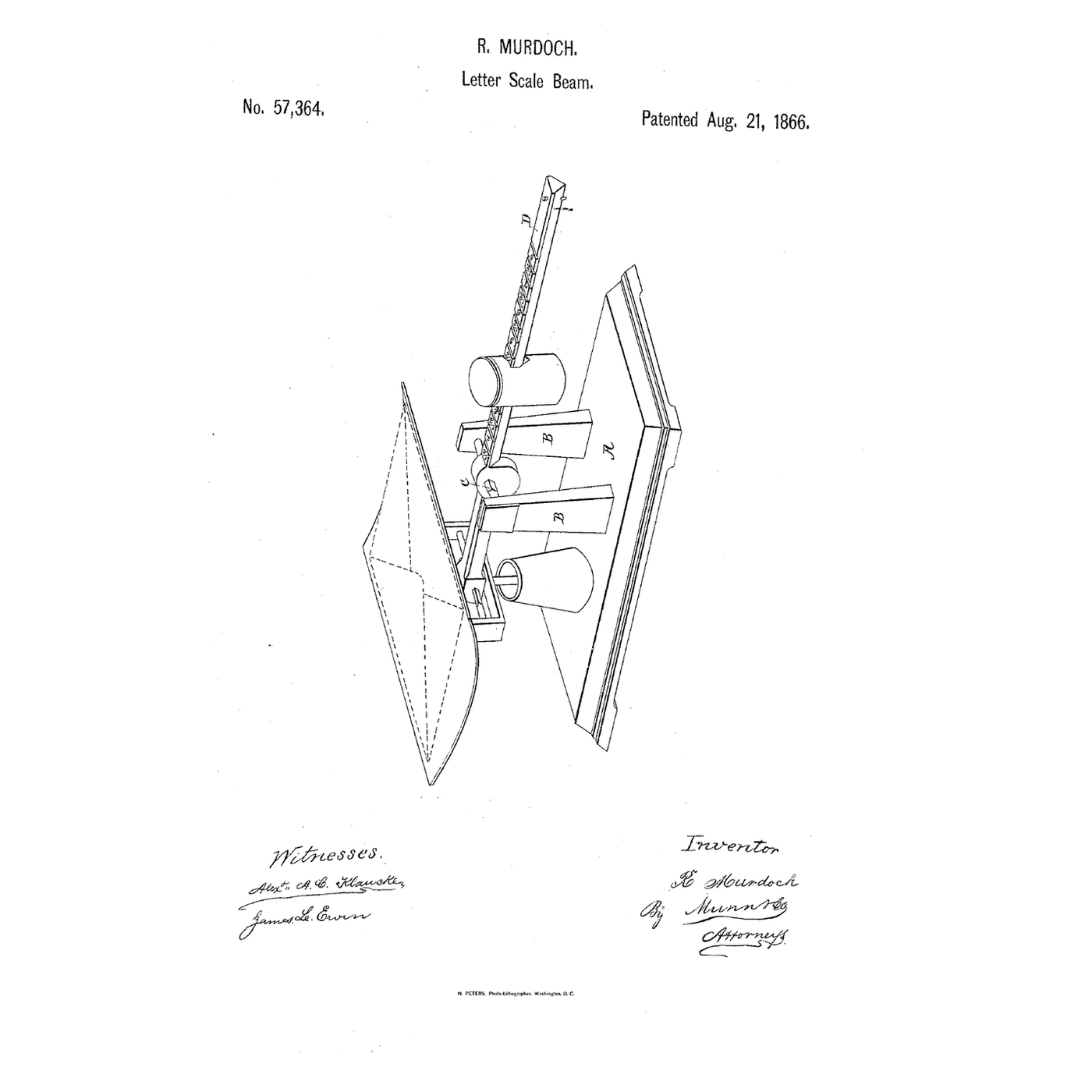
Richard Murdoch of Baltimore received US 57,364, dated 21 August 1866, for "making the beam of the scale, to wit, on the top, so as to make the figures more readily seen and more conveniently read": "in my letter-scales the top of the beam is flat and the figures are placed thereon, which is much more convenient in every respect to the person weighing the letters."
This rung works out how much larger figures on the top look from above, then builds a steelyard letter scale with figures on both the side and the top and has readers compare them.
Anfänger
About 3 hours
Anweisungen
1
1
Side figures against top figures
Side figures against top figures
Jupyter-Notebook wird geladen …
2
2
The beam it improves
The beam it improves
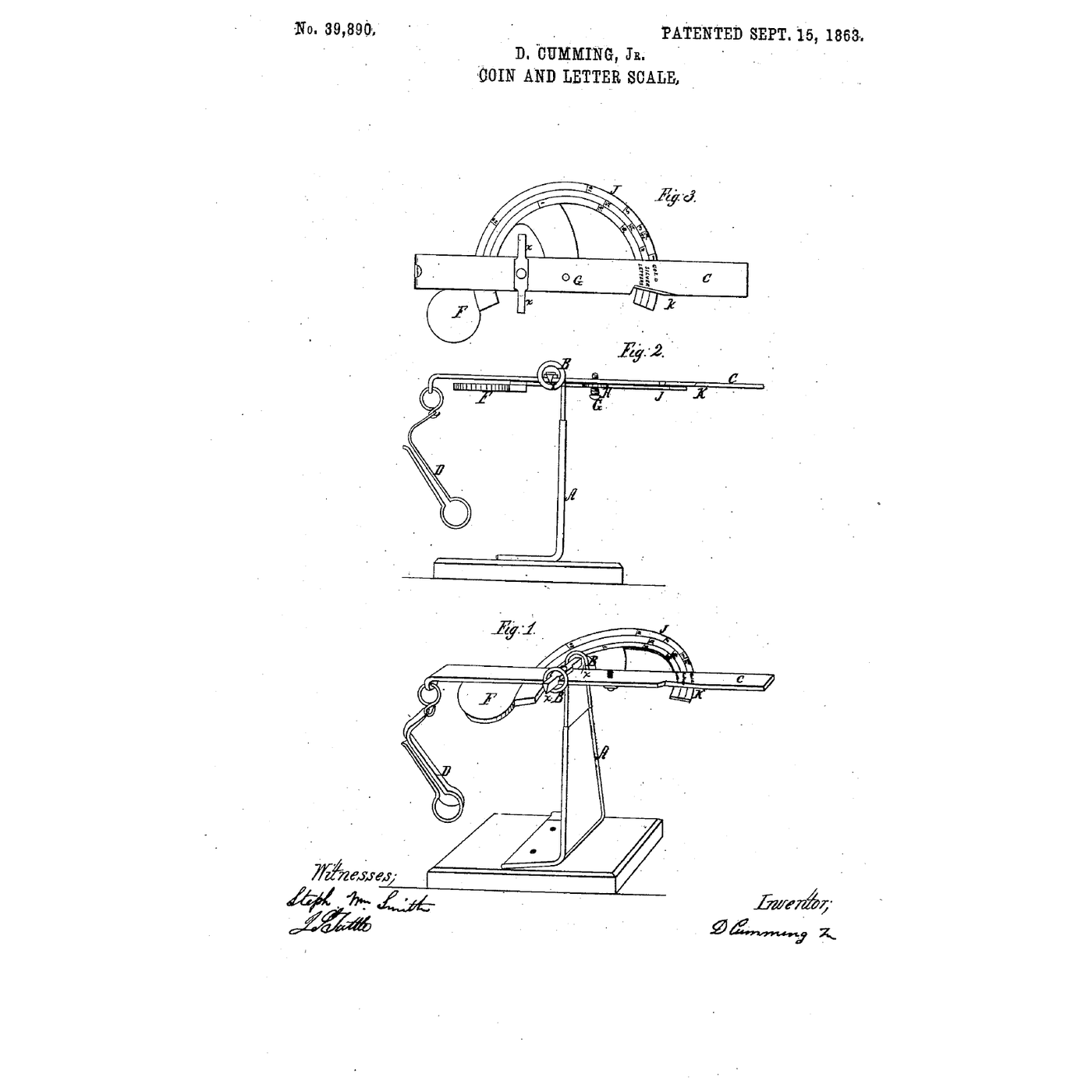
The embedded blueprint builds a steelyard with a sliding weight. Murdoch's beam is the same; only where the figures are cut changes.
3
3
Read US 57,364
Read US 57,364
"In the drawings, A is the base; B, the standard; C, the tray, and D the beam, whose notches are on the upper side, as usual, being engaged by a projection in the slot of the pea or weight."
"It is usual to put the figures denoting weight upon the flat and nearly vertical sides of the beam".
4
4
Build the scale and compare the figures
Build the scale and compare the figures
**Stand.** Screw a hardwood upright 15 cm tall to a plywood base and drill a hole near its top for a nail fulcrum.
**Beam.** Saw a beam 30 × 2 × 1.5 cm from hardwood board, flat on top. Drill it for the nail 7 cm from one end. Hang a small plywood tray from that end on wire.
**Pea.** Bend a wire saddle that sits on the beam, hang washers and a nut from it as the pea, and file small notches across the top of the beam where it will sit.
**Figures.** Balance the empty scale by filing the heavier end. Put objects weighed on the kitchen scale in the tray, slide the pea until level, and mark each notch. Write each weight twice, the same size: once on the beam's side and once on its top.
**Test.** Put the scale on a table. Have five people read a weight from where they would stand to weigh a letter, first from the side figures and then from the top; time each reading and note mistakes.
Materialien für diesen Schritt:
 Sperrholzplatte1 Stück
 Hartholzbrett1 Stück
 Nägel1 Stück
 Verzinkter Stahldraht0.5 Meter
 Unterlegscheibe8 Stück
 Sechskantmutter1 Stück
 Holzschrauben2 Stück
Benötigte Werkzeuge:
 Handsäge
 Akkubohrschrauber
 Bohrersatz
 Feilen (Handfeile)
 Rundzange
 Schraubendreher-Satz
 Digitale Küchenwaage
 Stoppuhr
 Lineal
 Permanentmarker
5
5
A scale that reads badly or sticks
A scale that reads badly or sticks
Top-figured letter scale troubleshooting.
Flow
Loading...
6
6
History and honest limits
History and honest limits
**Richard Murdoch** of Baltimore signed US 57,364 on 22 March 1866; it is dated 21 August 1866. His claim is letter scales "provided with a graduated beam having the figures upon its flat upper side".
**Honest limits.** A hardwood beam, wire pea and nail fulcrum stand in for his metal scale. The notebook treats the eye as far from the scale compared with its size; its angles are examples. Your reading times are the result.
Materialien
7- 1 StückPlatzhalter
- 1 StückPlatzhalter
- 1 StückPlatzhalter
- 0.5 MeterPlatzhalter
- 8 StückPlatzhalter
- 1 StückPlatzhalter
- 2 StückPlatzhalter
Benötigte Werkzeuge
10- Platzhalter
- 1 vendor sell this, none ship to you yetPlatzhalter
- Platzhalter
- Platzhalter
- Platzhalter
- Platzhalter
- Platzhalter
- Platzhalter
- Platzhalter
- Platzhalter
Verwandte Blueprints
Diese Blueprints teilen Wissen — Techniken, Materialien oder Prinzipien
CC0 Gemeinfrei
Dieser Blueprint ist unter CC0 veröffentlicht. Sie dürfen dieses Werk für jeden Zweck frei kopieren, ändern, verbreiten und verwenden, ohne um Erlaubnis zu fragen.
Unterstützen Sie den Maker, indem Sie Produkte über seinen Blueprint kaufen, wo er eine Maker-Provision von Anbietern festgelegt, verdient. Oder erstellen Sie eine neue Iteration dieses Blueprints und verbinden Sie ihn in Ihrem eigenen Blueprint, um Einnahmen zu teilen.