KUNST
SCHÖNHEIT & WELLNESS
HANDWERK
KULTUR & GESCHICHTE
UNTERHALTUNG
UMFELD
ESSEN & GETRÄNKE
REVERSE ENGINEERING
WISSENSCHAFTEN
SPORT
TECHNOLOGIE
WEARABLES
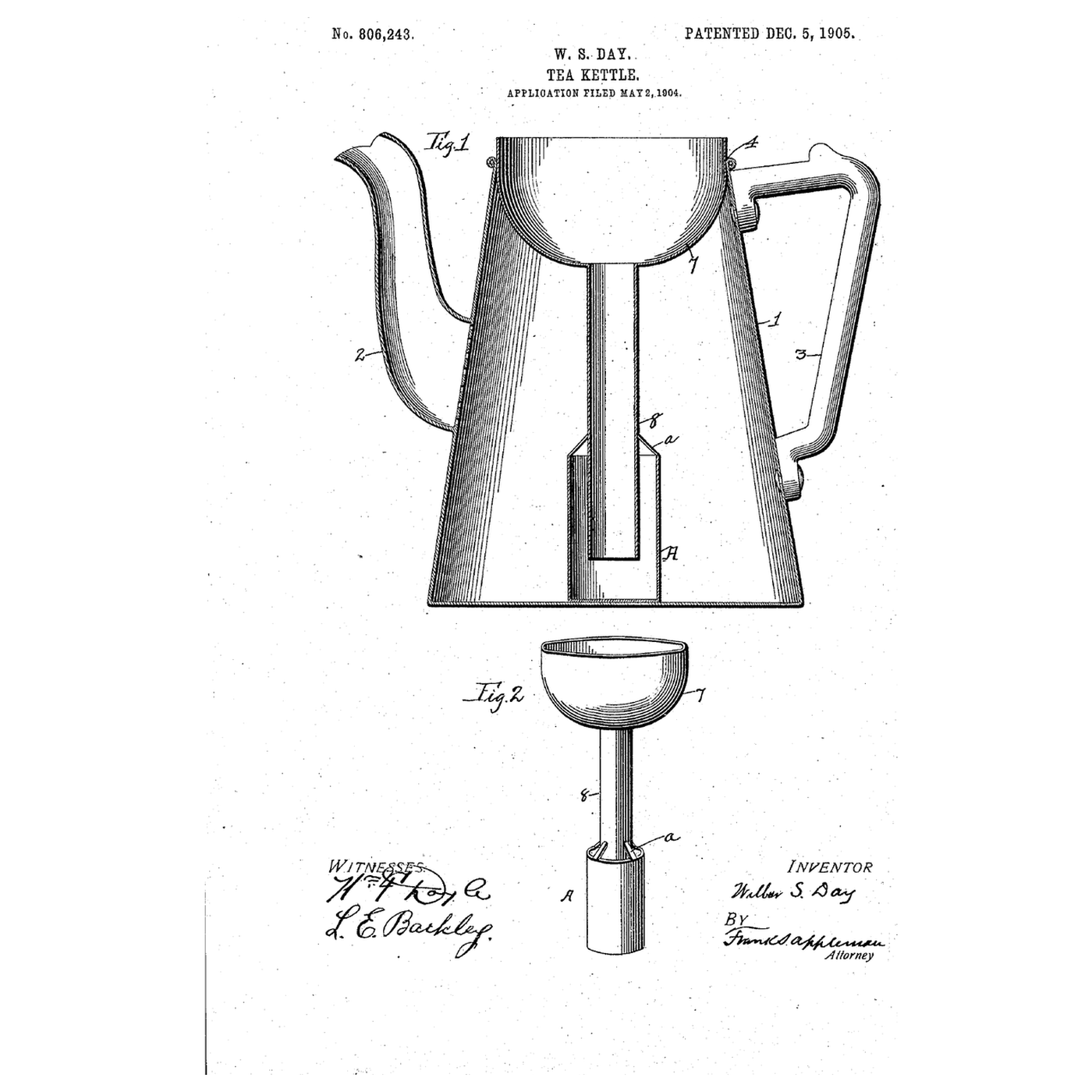


The Trap-Sealed Funnel Cover: The Kettle's Own Water Keeps the Steam In
Pouring from a boiling kettle sends steam out of the fill opening in its top, over the hand on the handle.
Wilbur S. Day of Warren, Minnesota, received US 806,243, patented 5 December 1905, for a cover "with a depending portion reaching into and sealed by the contents of the kettle, whereby the discharge of steam through the top opening of said kettle is prevented": a funnel pressed into the opening, its tube dipping into a trap that rests on the kettle's bottom and is held to the tube by springy arms; lifted out, it serves as a funnel.
This rung works out how much pressure the trap's water holds back, then makes the funnel, tube and trap for a stovetop kettle and looks for steam at the top and at the spout.
Fortgeschritten
About 3 hours
Anweisungen
1
1
Pressure the seal holds
Pressure the seal holds
Jupyter-Notebook wird geladen …
2
2
A kettle guarded from its steam before it
A kettle guarded from its steam before it
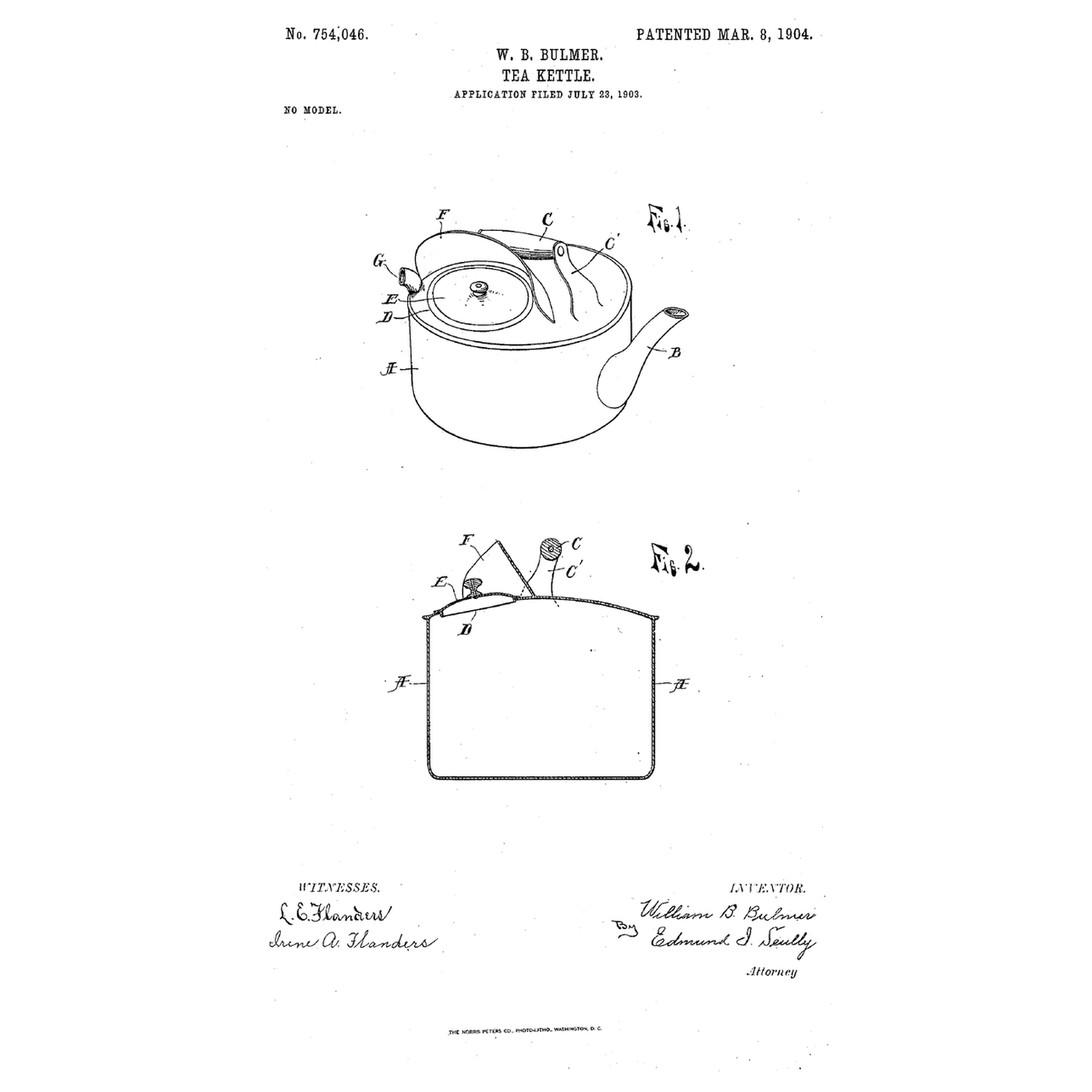
The embedded blueprint shields the hand from steam leaving the opening. Day stops the steam leaving the top at all, by sealing the opening's funnel in a trap of the kettle's own water.
3
3
Read US 806,243
Read US 806,243
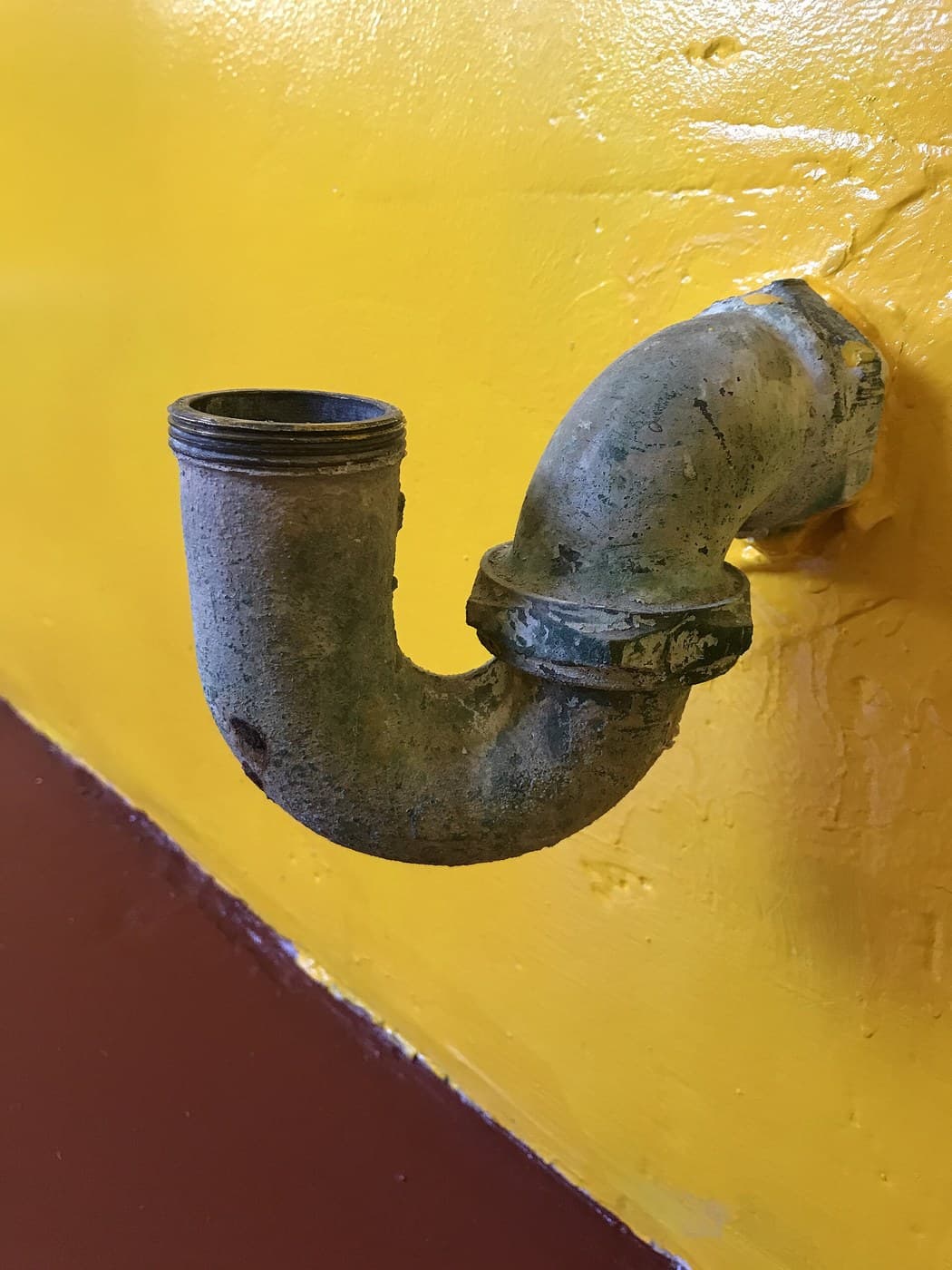
"To prevent the escape of steam through the tube 8, a trap A is applied to the free or lower end of the tube 8. This trap rests on the bottom of the kettle and has formed on its upper edge the resilient arms a, which engage the tube 8 and retain the trap A in its operative relation to the free end of the tube 8 no matter what position the kettle may attain."
"In practice it is to be understood that the trap is filled by the liquid poured into the kettle, and thereby forming a perfect seal for the tube."
4
4
Make the cover and look for steam
Make the cover and look for steam
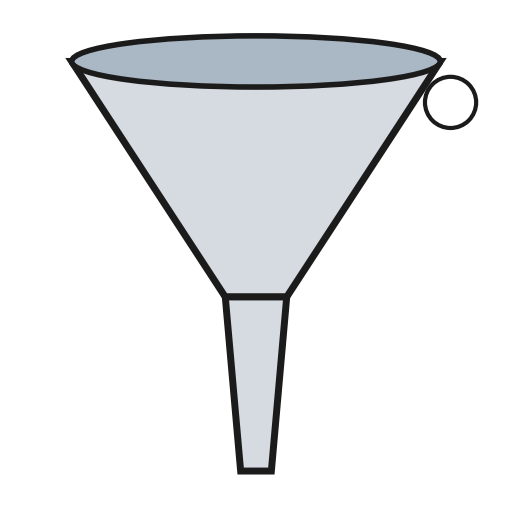
**Funnel.** Choose a stainless steel kitchen funnel whose cone presses snugly into the kettle's fill opening in place of its lid. Measure from the funnel's seat to the kettle's floor.
**Tube.** Cut copper tube that slips over the funnel's spout, long enough to end 1.5 cm above the floor. Wrap the spout with PTFE tape and push the tube on tightly.
**Trap.** Choose a small, clean tin can that passes through the fill opening. With tin snips cut three tabs 1.5 cm deep into its rim and bend them inward so they spring against the tube and hold it central, with its end 1 cm above the can's floor. File every cut edge smooth.
**Test.** Fill the kettle through the funnel until the trap is covered, and bring it to the boil. Hold a cold spoon over the funnel and another over the spout and see which one mists; then lift the funnel out and hold the spoon over the open fill hole.
Materialien für diesen Schritt:
 Kupferrohr1 Stück
 PTFE-Gewindedichtband1 Stück
 Blechdose1 Stück
Benötigte Werkzeuge:
 Wasserkessel
 Rohrabschneider
 Blechschere
 Flachzange
 Feilen (Handfeile)
 Lineal
 Hitzebeständige Handschuhe
 Küchentrichter
5
5
A cover that lets steam through or falls apart
A cover that lets steam through or falls apart
Trap-sealed funnel cover troubleshooting.
Flow
Loading...
6
6
History and honest limits
History and honest limits
**Wilbur S. Day** of Warren, Marshall County, Minnesota, filed US 806,243 on 2 May 1904; it was patented 5 December 1905. The funnel's body 7 is preferably bowl-shaped, its walls flaring slightly toward the top so it can be pressed into the edge of the opening 4 for a tight joint; the arms a hold the tube 8 central in the trap, and the trap is easily removed so the funnel can be used alone. His claim covers a receptacle with a top opening, a cover with a body fitting tightly in it and a depending tube, and a trap on the bottom with arms on its upper edge binding against the tube.
**Honest limits.** A bought funnel, a copper tube taped to its spout and a tin can stand in for his one-piece cover and trap. The notebook treats the seal as a still column of water; its depths are examples. What your spoons show is the result.
Materialien
3- 1 StückPlatzhalter
- 1 StückPlatzhalter
- 1 StückPlatzhalter
Benötigte Werkzeuge
8- Platzhalter
- Platzhalter
- Platzhalter
- Platzhalter
- Platzhalter
- Platzhalter
- Platzhalter
- Platzhalter
Verwandte Blueprints
Diese Blueprints teilen Wissen — Techniken, Materialien oder Prinzipien




CC0 Gemeinfrei
Dieser Blueprint ist unter CC0 veröffentlicht. Sie dürfen dieses Werk für jeden Zweck frei kopieren, ändern, verbreiten und verwenden, ohne um Erlaubnis zu fragen.
Unterstützen Sie den Maker, indem Sie Produkte über seinen Blueprint kaufen, wo er eine Maker-Provision von Anbietern festgelegt, verdient. Oder erstellen Sie eine neue Iteration dieses Blueprints und verbinden Sie ihn in Ihrem eigenen Blueprint, um Einnahmen zu teilen.