KUNST
SCHÖNHEIT & WELLNESS
HANDWERK
KULTUR & GESCHICHTE
UNTERHALTUNG
UMFELD
ESSEN & GETRÄNKE
REVERSE ENGINEERING
WISSENSCHAFTEN
SPORT
TECHNOLOGIE
WEARABLES
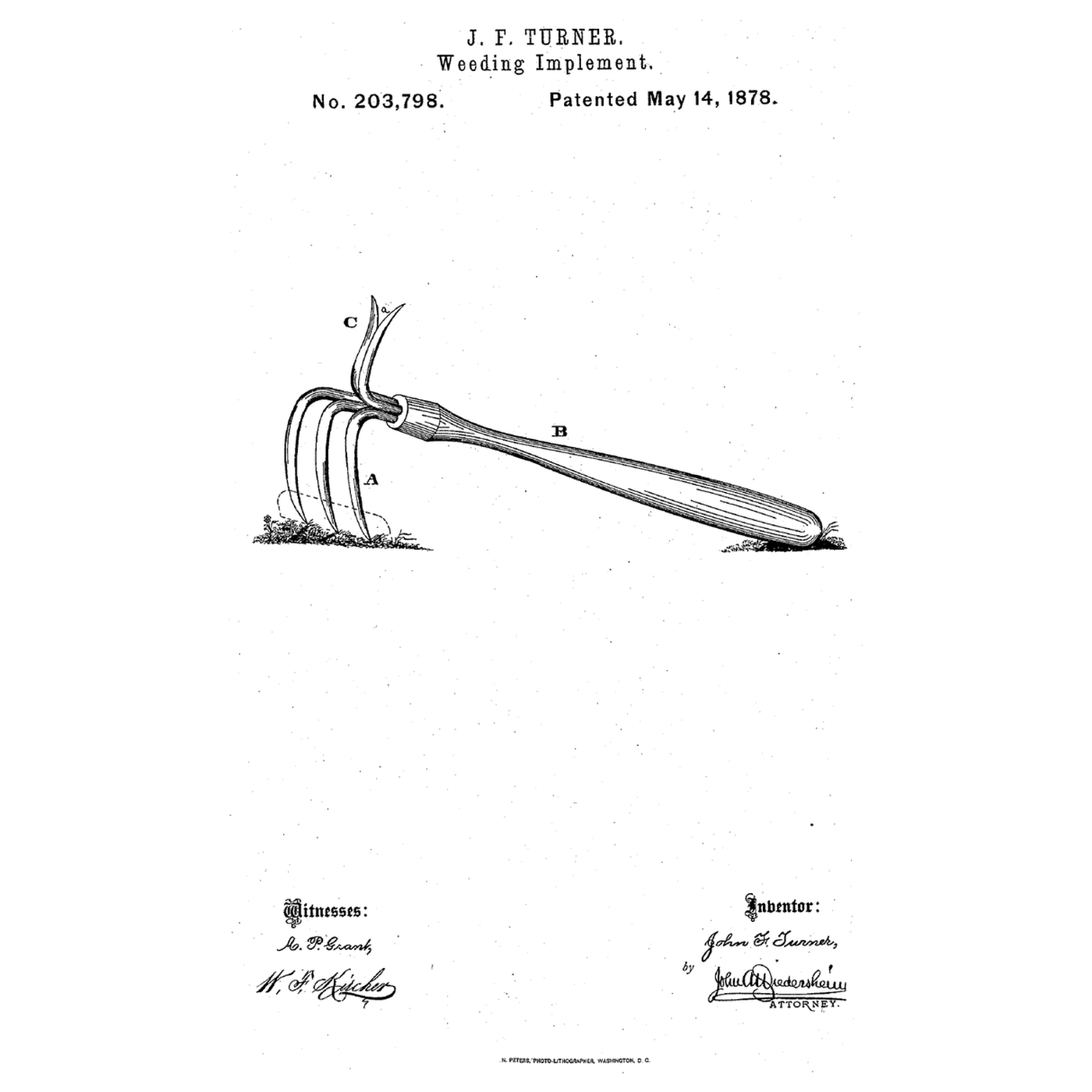


The Weeding Claw: A Wire Fork That Grips, Then Levers
A weed pulled by hand snaps at the root and grows back. A tool that grips it low and levers it out takes the root too.
John F. Turner of Philadelphia received US 203,798, dated 14 May 1878 (filed 30 March 1878), for a weeding implement: "a claw formed of wire, for readily pulling or removing weeds, grass, &c., without cutting them", curved back towards the handle with rounded inner faces, and teeth for loosening the earth.
This rung computes how much the claw's lever multiplies a pull, then measures weeds pulled by hand and levered with a claw.
Anfänger
About 1 hour
Anweisungen
1
1
Straight pull against lever
Straight pull against lever
Jupyter-Notebook wird geladen …
2
2
Why raising the handle helps
Why raising the handle helps
The embedded blueprint balances weight and distance on a lever; the claw's curved back is the fulcrum.
3
3
Read US 203,798
Read US 203,798
"My invention consists of a claw formed of wire, for readily pulling or removing weeds, grass, &c., without cutting them. It further consists of means for loosening the earth and weeds, and pulling or removing the latter."
The claw is "curved rearward or toward the handle, and formed of two pieces of wire", so that its inner faces are rounded. "When weeds, grass, &c., are to be pulled or removed, the claw is brought thereagainst, and the handle drawn toward the operator, so as to embrace the weeds".
"Should the weeds, grass, &c., be difficult of removal, the handle may be raised so that the claw turns on its outer curved face, the leverage thus exerted quickly overcoming the resistance of the weeds".
4
4
Weeding, as a program
Weeding, as a program
Blockly-Arbeitsbereich
Loading Blockly workspace...
5
5
Measure the pull
Measure the pull
Pick three weeds of the same kind. Tie a loop of string round the first at ground level, hook the force meter to it, and pull straight up slowly, reading the peak. Note whether the root came out or the stem snapped.
Lift the second with the claw as in the program and note whether the root came whole. Loosen the soil round the third first, then pull it with the force meter again. Compare the forces and the roots.
Materialien für diesen Schritt:
 Schnur1 Stück
Benötigte Werkzeuge:
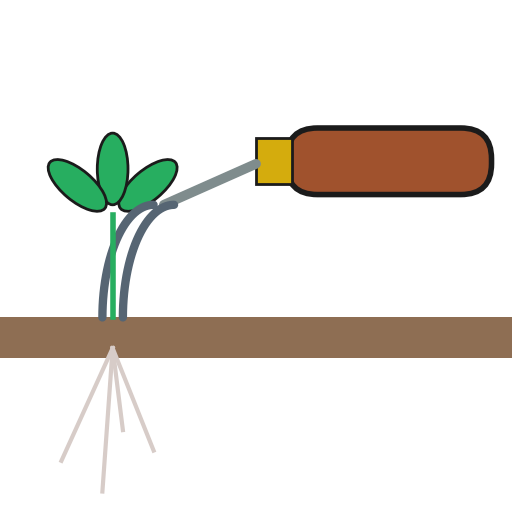 Unkrautstecher
 Pflanzkelle
 Federkraftmesser
 Lederarbeitshandschuhe
6
6
Weeds that snap, slip or come back
Weeds that snap, slip or come back
Weeding troubleshooting.
Flow
Loading...
7
7
History and honest limits
History and honest limits
**John F. Turner** of Philadelphia filed US 203,798 on 30 March 1878; it is dated 14 May 1878.
**Honest limits.** The lever model treats the claw as rigid and the fulcrum as a point; soil gives under it and roots break before they come out. Forces and lengths are examples. Your force-meter readings are the measurement.
Benötigte Werkzeuge
4- Platzhalter
- Platzhalter
- Platzhalter
- Platzhalter
Verwandte Blueprints
Diese Blueprints teilen Wissen — Techniken, Materialien oder Prinzipien



CC0 Gemeinfrei
Dieser Blueprint ist unter CC0 veröffentlicht. Sie dürfen dieses Werk für jeden Zweck frei kopieren, ändern, verbreiten und verwenden, ohne um Erlaubnis zu fragen.
Unterstützen Sie den Maker, indem Sie Produkte über seinen Blueprint kaufen, wo er eine Maker-Provision von Anbietern festgelegt, verdient. Oder erstellen Sie eine neue Iteration dieses Blueprints und verbinden Sie ihn in Ihrem eigenen Blueprint, um Einnahmen zu teilen.