Zusammenarbeit
KUNST
SCHÖNHEIT & WELLNESS
HANDWERK
KULTUR & GESCHICHTE
UNTERHALTUNG
UMFELD
ESSEN & GETRÄNKE
REVERSE ENGINEERING
WISSENSCHAFTEN
SPORT
TECHNOLOGIE
WEARABLES
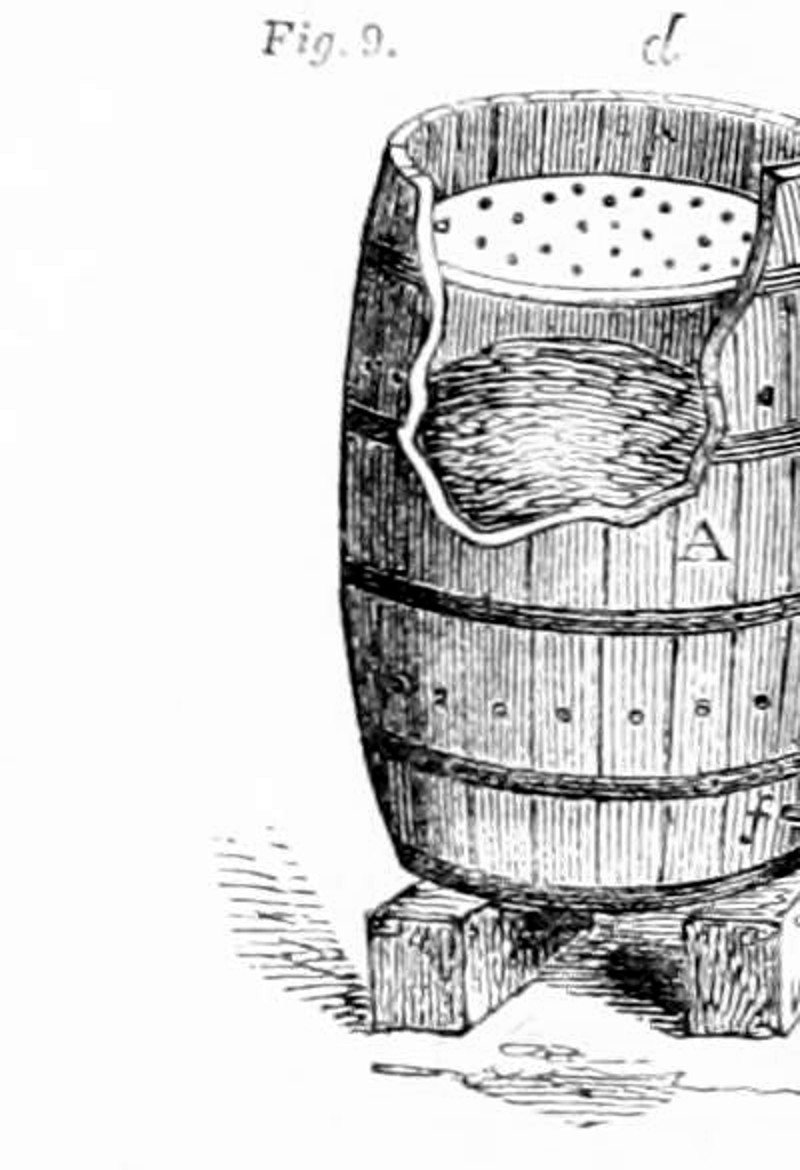


Quick Vinegar: Dilute Spirit Trickled Through Beech Shavings in Ventilated Oak Casks (Tomlinson, 1854)
The 'quick method' of the 1850s, from Tomlinson's Cyclopaedia of Useful Arts: a warm mixture of spirit, vinegar and water poured again and again over curled beech shavings in tall oak casks with air holes near the bottom, so the vinegar bacteria on the shavings turn the alcohol to acetic acid in days instead of months.
Fortgeschritten
A few days
Anweisungen
1
1
Mixtures and temperatures
Mixtures and temperatures
Jupyter-Notebook wird geladen …
2
2
Read the Cyclopaedia of Useful Arts
Read the Cyclopaedia of Useful Arts
"Vinegar is manufactured by one of two distinct methods called the slow and the quick method."
3
3
Prepare the casks
Prepare the casks
Use oak casks 5 to 7 ft high and 2-1/2 to 3 ft across, a little narrower at the bottom. About a foot from the bottom, just above the syphon, bore air holes about an inch wide sloping downward so air enters but liquor does not escape. Fit a cover with a centre hole 2 or 3 in square. Set them on frames or brick piers high enough to draw off the liquor.
Materialien für diesen Schritt:
 Holzfass1 Stück
Benötigte Werkzeuge:
 Bohrwinde mit Bohrer
 Handsäge
4
4
Fill with beech shavings
Fill with beech shavings
Scald curled beech shavings repeatedly with hot water to remove soluble matter, dry them, soak them in hot vinegar, and fill the cask. (Or fit an inner beech hoop about 6 in below the mouth carrying a perforated shelf, with cotton wicks knotted on top drawn through the holes, the edges packed with tow, and the shavings below; Fig. 9.)
Materialien für diesen Schritt:
 Buchenholzspäne1 Stück
 Essig1 Stück
 Dochtmaterial aus Baumwolle1 Stück
 Flachswerg1 Stück
Benötigte Werkzeuge:
 Großer Kochtopf
5
5
Run the mixture
Run the mixture
Mix 20 quarts alcohol, 40 vinegar and 120 water (or 15-1/2, 20 and 137), heating the water to 100-104 F first so the mixture is about 86-90 F. Pour 2-1/2 to 5 quarts on every half hour with the cover on and the centre hole open. When all has run through, draw it off, add a few quarts of alcohol and pass it through again; then less alcohol and a third time. It is then strong vinegar.
Materialien für diesen Schritt:
 Branntwein (destillierter Alkohol)1 StückEssig1 Stück
Benötigte Werkzeuge:
 Küchenthermometer
 20-Liter-EimerGroßer Kochtopf
6
6
Keep it working
Keep it working
Keep the room about 77 F; the cask inside runs 95-100 F and must not fall below 95 F. Cover the casks with paper or linen jackets, leaving the air holes open. Never more than 10 % alcohol; stay between 72 and 113 F. For fruit or malt vinegar the liquor must be clear.
Materialien für diesen Schritt:
 Baumwolltuch1 Stück
Benötigte Werkzeuge:
Küchenthermometer7
7
Troubleshooting
Troubleshooting
Quick vinegar troubleshooting.
Flow
Loading...
8
8
History and honest limits
History and honest limits
From Charles Tomlinson (ed.), **Cyclopaedia of Useful Arts** (1854), vol. I, "Acetic Acid" (checked on the archive.org scan cyclopaediaofuse01tomluoft, pp. 6-7). The Celsius figures and the tools are ours.
Materialien
7- 1 StückPlatzhalter
- 1 StückPlatzhalter
- 2 StückPlatzhalter
- 1 StückPlatzhalter
- 1 StückPlatzhalter
- Platzhalter
- 1 StückPlatzhalter
Benötigte Werkzeuge
5- Platzhalter
- Platzhalter
- Platzhalter
- Platzhalter
- Platzhalter
Dieser Bauplan stellt her

Verwandte Blueprints
Diese Blueprints teilen Wissen — Techniken, Materialien oder Prinzipien

CC0 Gemeinfrei
Dieser Blueprint ist unter CC0 veröffentlicht. Sie dürfen dieses Werk für jeden Zweck frei kopieren, ändern, verbreiten und verwenden, ohne um Erlaubnis zu fragen.
Unterstützen Sie den Maker, indem Sie Produkte über seinen Blueprint kaufen, wo er eine Maker-Provision von Anbietern festgelegt, verdient. Oder erstellen Sie eine neue Iteration dieses Blueprints und verbinden Sie ihn in Ihrem eigenen Blueprint, um Einnahmen zu teilen.