
Understanding Beryllium from Beryl — The Toxic Gem Metal Behind Emeralds
Beryllium (Be, element 4) is the lightest alkaline earth metal and one of the most paradoxical elements: its mineral forms include some of the world's most prized gemstones (emerald, aquamarine, morganite — all varieties of beryl, Be₃Al₂Si₆O₁₈), yet beryllium metal and its compounds are extraordinarily toxic, causing a fatal chronic lung disease called berylliosis.
Louis-Nicolas Vauquelin — the same chemist who discovered chromium — identified beryllium oxide ('glucina,' so named for its sweet taste) in beryl and emerald in 1798. Friedrich Wöhler and Antoine Bussy independently isolated metallic beryllium in 1828 by reducing beryllium chloride with potassium metal. The sweet taste of beryllium compounds gave the element its early name 'glucinium' (from Greek glykys, 'sweet'), but this was abandoned because tasting unknown chemicals is lethal recklessness and because beryllium compounds are severely toxic.
Beryllium cannot be reduced by carbon — like aluminum, it requires reactive-metal reduction or electrolysis. This blueprint is educational, focusing on understanding beryl mineralogy, the gemstone connection, and beryllium's unique properties.
EXTREME HAZARD: Beryllium is one of the most toxic metallic elements. Inhalation of beryllium dust or fumes causes chronic beryllium disease (CBD, berylliosis) — an incurable, progressive granulomatous lung disease. Even brief exposure to airborne beryllium can sensitize an individual for life. NEVER grind, saw, or heat beryl without professional-grade containment. This blueprint is educational only — do not attempt to isolate beryllium metal.
Anweisungen
Understand beryllium's extraordinary properties
Understand beryllium's extraordinary properties
Beryllium (Be, element 4) is a hard, brittle, steel-grey metal with remarkable properties. Its density is only 1.85 g/cm³ — lighter than magnesium (1.74 is lighter, but beryllium is the second lightest structural metal) and about two-thirds the density of aluminum. Its melting point is 1287 °C, and it has the highest specific stiffness (elastic modulus divided by density) of any metal — six times stiffer than steel per unit weight.
Beryllium is transparent to X-rays — it absorbs X-rays far less than any other structural material, making it the standard material for X-ray tube windows and synchrotron beamline components. It is also used in nuclear reactors as a neutron moderator and reflector because of its low neutron absorption cross-section. And beryllium-copper alloys (typically 2% Be) are non-sparking, non-magnetic, and extraordinarily strong, making them essential for tools used in explosive atmospheres (oil refineries, mines, ammunition factories).
The James Webb Space Telescope's primary mirror segments are made of beryllium — chosen for its low density, high stiffness, and dimensional stability at cryogenic temperatures. Each of the 18 hexagonal mirror segments is gold-plated beryllium, operating at −233 °C in the vacuum of space.
Identify beryl and its gemstone varieties
Identify beryl and its gemstone varieties
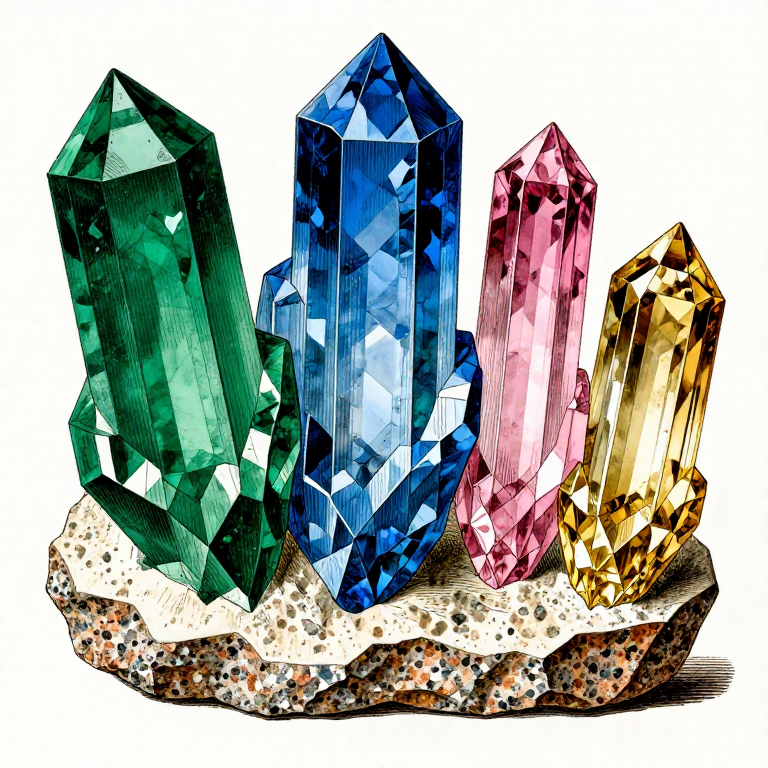
Beryl (Be₃Al₂Si₆O₁₈) is a beryllium aluminum silicate that crystallizes in hexagonal prismatic crystals — often large, well-formed, and spectacular. Key identification features: Mohs hardness 7.5–8 (harder than quartz), specific gravity 2.63–2.80, vitreous luster, conchoidal fracture, and typically pale green, blue, yellow, or colorless.
Beryl's gemstone varieties are defined entirely by trace impurity colors: Emerald — green, colored by chromium (Cr³⁺) and sometimes vanadium (V³⁺). One of the most valuable gemstones per carat. Aquamarine — blue to blue-green, colored by iron (Fe²⁺). Morganite — pink to peach, colored by manganese (Mn²⁺). Heliodor — yellow to golden, colored by iron (Fe³⁺). Red beryl (bixbite) — intense red, colored by manganese (Mn³⁺). Rarer than diamond. Goshenite — colorless, pure beryl.
Common (non-gem) beryl is widespread in granitic pegmatites worldwide — these are coarse-grained igneous rocks that form in the final stages of granite crystallization. Beryl crystals in pegmatites can be enormous: the largest single crystal ever found (from Madagascar) measured 18 meters long and weighed approximately 380 tonnes. Beryl is the only commercially significant beryllium mineral.
Materialien für diesen Schritt:
 Beryll-Stufe
Benötigte Werkzeuge:
 Geologenhammer
 Handlupe 10-fachHandlupe 10-fach
 Strichtafel (unglasiertes Porzellan)
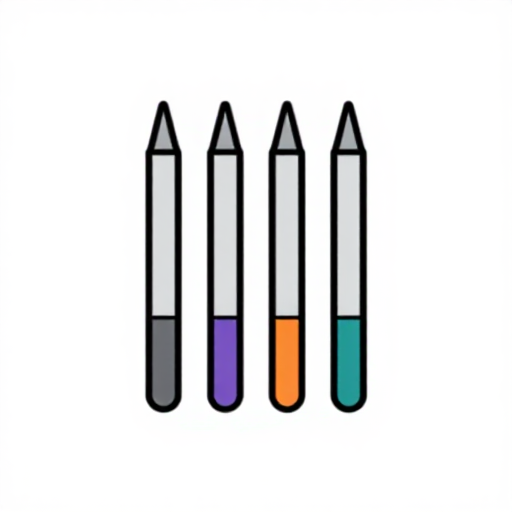 Mohs-Härteprüfstifte
Understand why beryllium extraction is uniquely difficult
Understand why beryllium extraction is uniquely difficult
Beryllium extraction faces two barriers that most metals do not. First, the thermodynamic barrier: beryllium oxide (BeO) is extremely stable, with a Gibbs free energy of formation of −581 kJ/mol. Carbon cannot reduce it at any practical temperature. This places beryllium in the same category as aluminum, titanium, and the alkali metals — elements that required 19th or 20th century technology to isolate.
Second, the toxicity barrier: every step of beryllium processing generates fine dust or fumes that can cause berylliosis. The disease is an immune-mediated hypersensitivity reaction — approximately 2–6% of exposed individuals become sensitized to beryllium, after which even trace exposure triggers a chronic granulomatous inflammation in the lungs that progressively destroys lung tissue. There is no cure. This makes beryllium processing uniquely hazardous even among toxic elements.
Modern beryllium production uses either fluoride reduction (BeF₂ + Mg → Be + MgF₂ at 900 °C) or electrolysis of molten BeCl₂ in NaCl flux. Both processes require sealed, ventilated containment systems that maintain airborne beryllium below 0.2 micrograms per cubic meter — a limit so stringent that it effectively requires industrial-scale containment. Small-scale beryllium production is not feasible without professional facilities.
Understand the emerald-chromium connection
Understand the emerald-chromium connection
The most culturally significant application of beryllium's mineral — beryl — is the gemstone emerald. Emerald's green color comes from approximately 0.1–0.5% chromium substituting for aluminum in beryl's crystal structure. This is the same chromium-in-oxide color mechanism that produces ruby in corundum — but in beryl's different crystal field environment, the Cr³⁺ ion absorbs different wavelengths, producing green instead of red.
Vauquelin's 1798 discovery connected emerald to a new element. He demonstrated that beryl and emerald were chemically identical (same mineral, different trace impurities) and both contained a new earth — 'glucina' (beryllium oxide). This was significant: it showed that the celebrated green of emerald came not from the beryllium but from a trace impurity. The beryllium merely provided the crystal structure; the chromium provided the color.
This insight — that gemstone color is caused by trace impurities, not by the bulk mineral composition — was a milestone in mineralogy. It explained why the same mineral (beryl) could produce green, blue, pink, yellow, and colorless gemstones; why corundum could be red (ruby) or blue (sapphire); and why diamond could be yellow, blue, pink, or colorless. Color in minerals is almost always a trace-impurity phenomenon, not a bulk-composition one.
Understand beryllium-copper alloys and non-sparking tools
Understand beryllium-copper alloys and non-sparking tools
The most commercially important application of beryllium metal is as an alloying element in copper. Beryllium-copper (BeCu, typically 0.5–3% beryllium) is a remarkable alloy: it can be heat-treated to a tensile strength of 1,400 MPa — stronger than many steels — while retaining copper's electrical conductivity, corrosion resistance, and non-magnetic properties.
Critically, beryllium-copper is non-sparking. When struck against steel or other hard surfaces, it does not generate incendiary sparks (unlike steel, which produces hot iron particles that can ignite flammable vapors). This makes BeCu the standard material for tools used in explosive or flammable atmospheres: wrenches, hammers, screwdrivers, and pliers for oil refineries, ammunition magazines, grain silos, and chemical plants are typically beryllium-copper.
The alloy is also used for high-performance electrical contacts and springs (telecommunication connectors, automotive relays), precision instruments, and molds for plastic injection molding. Despite beryllium's toxicity in dust form, solid beryllium-copper alloys are safe to handle — the hazard arises only when the alloy is machined, ground, or melted, generating dust or fumes. The tiny beryllium content (2% typical) transforms copper's properties while adding negligible weight.
Document findings and safety considerations
Document findings and safety considerations
Document your observations of beryl specimens: crystal form (hexagonal prism), hardness (>7, scratches quartz), density, luster, color, and any gemstone-quality material identified. If you have access to multiple beryl specimens of different colors, documenting the color variations and relating them to specific trace impurities is a valuable mineralogical exercise.
CRITICAL SAFETY NOTE for all future work: Never attempt to grind, saw, cut, or heat beryl with the intention of extracting beryllium. The dust generated by any mechanical processing of beryl contains beryllium silicate particles that can cause berylliosis. Even collecting beryl specimens for mineral identification poses no hazard — the risk comes exclusively from generating airborne dust. Solid specimens are completely safe to handle, examine, and store.
Beryllium's story encapsulates the progression from mineralogy (beryl, known for millennia) through analytical chemistry (Vauquelin, 1798) to nuclear physics (neutron moderation) to space exploration (JWST mirrors). Few elements span such a range of human achievement. The irony that one of Earth's most beautiful minerals (emerald) contains one of the most insidiously toxic metals adds a sobering note to the narrative.
Ore grade: how much beryl per kilogram
Ore grade: how much beryl per kilogram
Materialien
1- 1 StückPlatzhalter
Benötigte Werkzeuge
4- Platzhalter
- Platzhalter
- Platzhalter
- Platzhalter
CC0 Gemeinfrei
Dieser Blueprint ist unter CC0 veröffentlicht. Sie dürfen dieses Werk für jeden Zweck frei kopieren, ändern, verbreiten und verwenden, ohne um Erlaubnis zu fragen.
Unterstützen Sie den Maker, indem Sie Produkte über seinen Blueprint kaufen, wo er eine Maker-Provision von Anbietern festgelegt, verdient. Oder erstellen Sie eine neue Iteration dieses Blueprints und verbinden Sie ihn in Ihrem eigenen Blueprint, um Einnahmen zu teilen.