

Preserving Food in Fermented Whey — Viking Acid Pickling
Anweisungen
Collect Whey from Skyr-Making
Collect Whey from Skyr-Making
Begin with the whey left over from making skyr — the Viking cultured dairy product. When you strain the set skyr through cloth, the liquid that drains off is your whey. You need several liters for effective preservation — a large batch of skyr produces abundant whey. Collect in a clean wooden barrel or clay vessel.
The whey is already slightly acidic from the skyr-making process. It contains lactose (milk sugar), whey proteins, and lactobacillus bacteria that will continue to ferment.
Materialien für diesen Schritt:
 MagermilchSeveral liters Stück
 LammfleischAs needed Stück
 Feines MeersalzSmall amount Stück
Benötigte Werkzeuge:
 Holzfass
 Messer
Ferment the Whey
Ferment the Whey
Allow the whey to sit at room temperature in a loosely covered vessel for several days to one week. The naturally present lactobacillus bacteria ferment the remaining lactose into lactic acid, progressively lowering the pH. The whey becomes noticeably sour and sharp-smelling.
The target is a pH of approximately 3.5-4.0 — strongly acidic, comparable to vinegar. At this acidity, most spoilage bacteria and pathogens cannot survive, making the whey an effective preserving medium. Taste cautiously — it should be very sour but not putrid or foul.
Prepare the Meat
Prepare the Meat
Cut meat (lamb or mutton is traditional in Iceland; fish, beef, or sausages also work) into manageable pieces — joints, thick slices, or chunks. Optionally, lightly rub salt on the surfaces. Some historical accounts mention briefly searing or smoking the meat before whey-pickling for additional flavor and an extra preservation boost.
The meat should be fresh and clean. Trim away excess fat if desired — lean meat preserves better in whey than fatty cuts, as fat can go rancid separately.
Submerge in Fermented Whey
Submerge in Fermented Whey
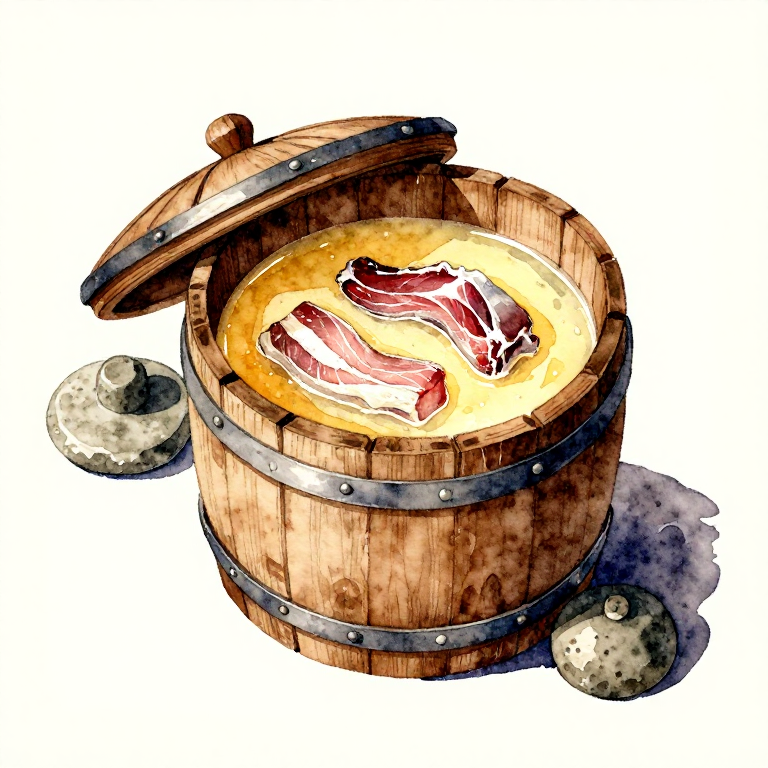
Pack the prepared meat tightly into a barrel, crock, or sturdy wooden vessel. Pour fermented whey over the meat until it is fully submerged — no meat should be exposed to air. Air exposure above the whey line invites mold and spoilage.
Press a wooden disc or clean stone on top to keep the meat submerged. If needed, add more fermented whey to ensure complete coverage.
Seal and Store
Seal and Store
Seal the vessel with a tight-fitting wooden lid. Store in a cool, dark location — a root cellar, underground storage pit, or cool outbuilding. In Iceland, the cool climate was ideal for long-term whey storage.
The acidic whey environment inhibits bacterial growth, preserving the meat for months — through an entire winter if conditions are right. Check occasionally for signs of mold on the surface (skim it off if it appears) and ensure the meat remains submerged.
Retrieve and Prepare
Retrieve and Prepare
Remove meat pieces as needed throughout the winter. Rinse lightly to remove excess whey sourness if desired. The preserved meat can be cooked by boiling in water or broth, roasting over a fire, or adding to stews and soups.
Whey-preserved meat has a distinctive tangy flavor that is an acquired taste — it was a staple of Icelandic cuisine for over a thousand years. The preservation method is simple, requires no salt supply (valuable in island communities), and produces no waste since the whey is a byproduct of dairy processing.
Materialien
3- Several liters StückPlatzhalter
- As needed StückPlatzhalter
- Small amount StückPlatzhalter
Dieser Bauplan stellt her

CC0 Gemeinfrei
Dieser Blueprint ist unter CC0 veröffentlicht. Sie dürfen dieses Werk für jeden Zweck frei kopieren, ändern, verbreiten und verwenden, ohne um Erlaubnis zu fragen.
Unterstützen Sie den Maker, indem Sie Produkte über seinen Blueprint kaufen, wo er eine Maker-Provision von Anbietern festgelegt, verdient. Oder erstellen Sie eine neue Iteration dieses Blueprints und verbinden Sie ihn in Ihrem eigenen Blueprint, um Einnahmen zu teilen.