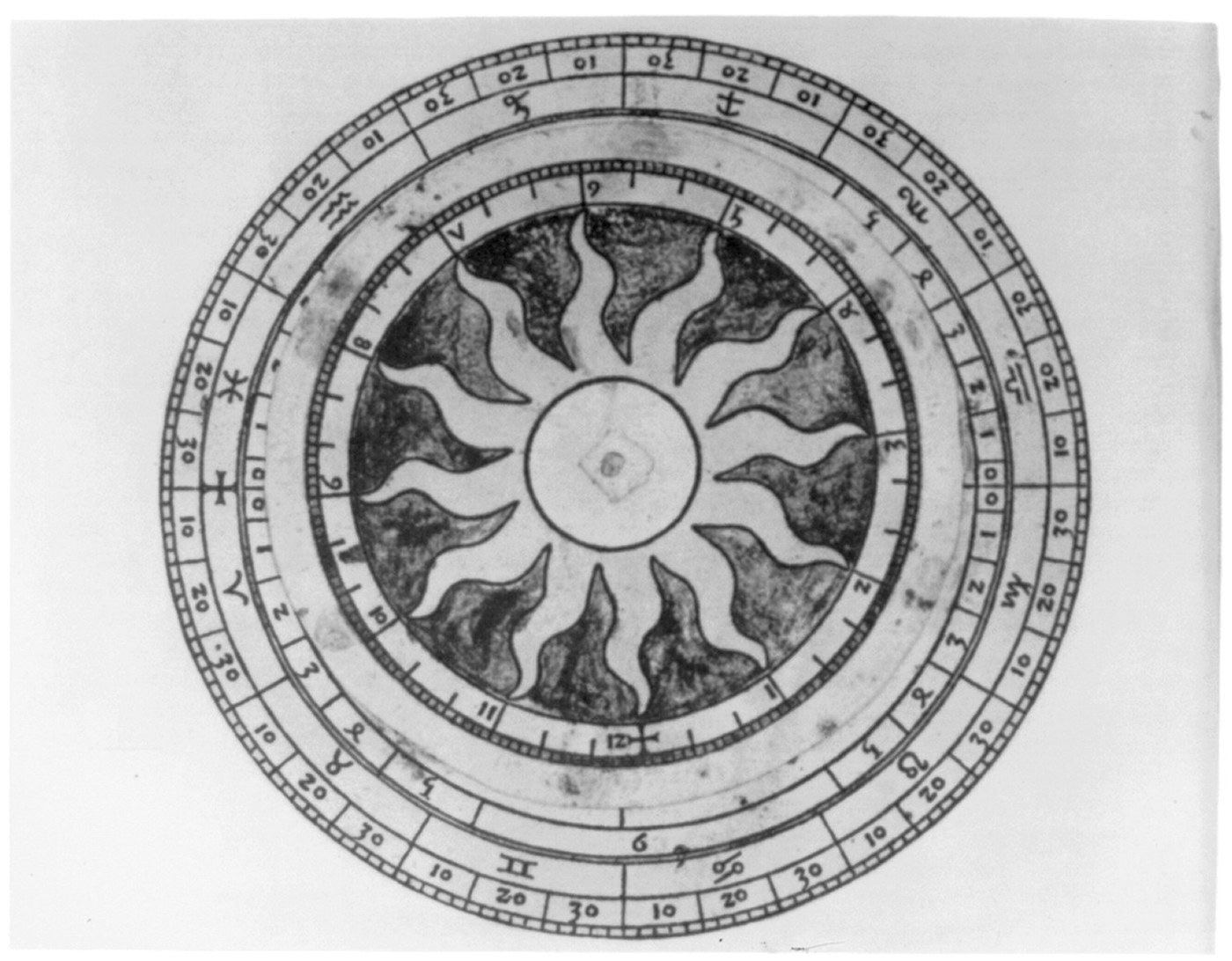


Volvelle Wheel Chart
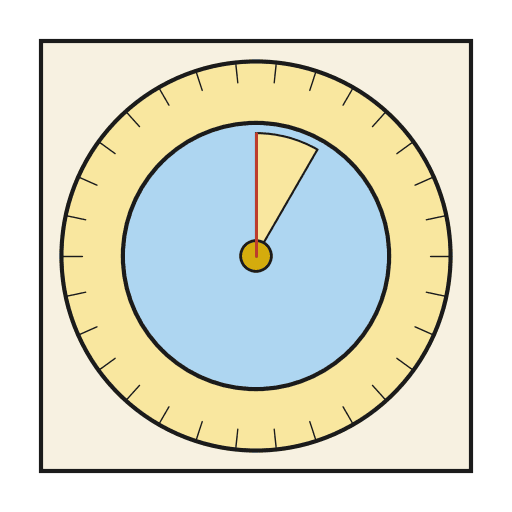
A volvelle is a paper computer. Discs of card pinned through a common centre, each carrying a scale; rotate one against another and read the answer off where the marks line up. No batteries, no arithmetic, and the whole calculation happens in your fingers.
They were bound into medieval and Renaissance manuscripts and printed books to compute things people needed regularly and could not easily work out by hand: the phase of the moon, the date of Easter, the position of a planet, the hour from the height of the sun.
The interesting part for a maker is that a volvelle turns a mathematical relationship into a physical constraint. Once two scales are correctly laid out on two discs, the geometry does the reasoning. Get the scale spacing right and the device cannot give a wrong answer; get it wrong and it cannot give a right one.
Anweisungen
Cut the base disc
Cut the base disc
Cut a 150 mm disc from heavy card. Mark the exact centre with a compass point before cutting — every scale is measured from it.
Materialien für diesen Schritt:
 Karton1 Blatt
Benötigte Werkzeuge:
 Kompass
Cut the upper disc smaller
Cut the upper disc smaller
Cut a second disc at 110 mm from the same card, again marking the centre. The 20 mm of base left showing all round is where the fixed scale goes.
Divide the base into 29.5 parts
Divide the base into 29.5 parts
Step off 29.5 equal divisions around the base rim — 12.2° apart. That is the lunar month: the moon returns to the same phase every 29.53 days, and the half day is why the marks do not fall on neat degrees.
Benötigte Werkzeuge:
 Winkelmesser
Number the days
Number the days
Number the divisions 1 to 29 clockwise, with the half division between 29 and 1. Day 1 is new moon.
Draw the moon phases on the upper disc
Draw the moon phases on the upper disc
Around the upper disc's rim, draw the moon at eight stages: new, waxing crescent, first quarter, waxing gibbous, full, waning gibbous, last quarter, waning crescent. Space them equally.
Cut a sight window
Cut a sight window
Cut a small rectangular window near the upper disc's rim. This is the reading aperture — it isolates one value from the scale beneath and is what makes the device unambiguous.
Benötigte Werkzeuge:
 Bastelmesser
Pierce both centres
Pierce both centres
Pierce both discs exactly at their marked centres. An off-centre hole is fatal — the scales will drift in and out of register as the disc turns, and no amount of care in the marking will fix it.
Join with a brass fastener
Join with a brass fastener
Push a brass paper fastener through both centres and open the legs. Tight enough to hold position, loose enough to turn with a fingertip.
Materialien für diesen Schritt:
 Musterklammern aus Messing1 Packung
Check the register all the way round
Check the register all the way round
Rotate a full turn and watch the window track the scale. The gap between discs must stay constant. If it wanders, one centre is off — repierce rather than trying to compensate.
Calibrate against a known new moon
Calibrate against a known new moon
Look up the date of a recent new moon. Set the disc so day 1 aligns with it and mark that as the reference position. An uncalibrated volvelle is geometry without meaning.
Read today's phase
Read today's phase
Count days since that new moon, turn to that number, and read the phase in the window. Then go outside and look at the moon.
Check the drift after two months
Check the drift after two months
Come back in two months and compare prediction against sky. Small errors accumulate, because the real lunar month varies slightly around 29.53 days. Note the drift — that is a measurement, not a failure.
History & Context
History & Context
What a volvelle is for. Rotating paper wheel charts were bound into manuscripts and later printed books to compute recurring astronomical and calendrical quantities — lunar phase, the movable date of Easter, planetary positions, the hour from solar altitude. These are calculations that are tedious by hand and needed often, which is exactly the niche a special-purpose analogue computer fills.
Be careful with attribution. Ramon Llull is frequently credited with inventing the volvelle, and his rotating diagrams are genuinely important. But rotating-disc instruments long predate him — the astrolabe is one, and it is far older — and paper wheel charts appear in several traditions. Similarly, calling the volvelle "the first pop-up book" is a modern retrofit of a modern category onto a device whose purpose was calculation, not surprise. State what the object does; be sparing about who was first.
Why the half day matters. The synodic month — new moon to new moon — averages about 29.53 days, not 29 or 30. A volvelle divided into a whole number of days therefore drifts, and medieval calendar computation is largely the story of managing exactly this kind of mismatch between convenient whole numbers and awkward astronomical ones. The date of Easter is difficult for the same reason: it depends on reconciling a lunar cycle with a solar calendar that do not divide evenly.
Geometry doing the arithmetic. The deep idea is that a correctly-constructed physical relationship can substitute for calculation. This is the principle behind the slide rule, the astrolabe, the nomogram and the planimeter — a whole family of analogue instruments that dominated technical work until electronic calculators arrived in the 1970s. A volvelle is the simplest member of that family and the easiest to build from scratch.
Fragility is why they are rare. Moving paper parts in a bound book wear out, tear and get lost. Many surviving volvelles have missing discs or replacement fasteners, and libraries treat intact ones as significant. Building one makes the reason obvious: the whole device depends on a single fastener through a single hole.
Benötigte Werkzeuge
3- Platzhalter
- Platzhalter
- Platzhalter
Dieser Bauplan stellt her
CC0 Gemeinfrei
Dieser Blueprint ist unter CC0 veröffentlicht. Sie dürfen dieses Werk für jeden Zweck frei kopieren, ändern, verbreiten und verwenden, ohne um Erlaubnis zu fragen.
Unterstützen Sie den Maker, indem Sie Produkte über seinen Blueprint kaufen, wo er eine Maker-Provision von Anbietern festgelegt, verdient. Oder erstellen Sie eine neue Iteration dieses Blueprints und verbinden Sie ihn in Ihrem eigenen Blueprint, um Einnahmen zu teilen.