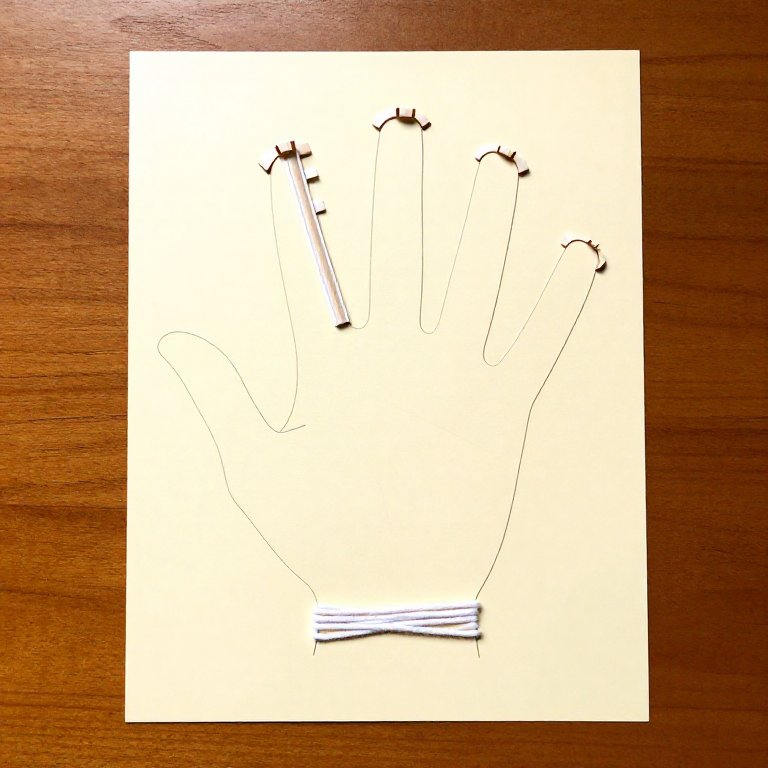


Articulated Hand Model
Open and close your hand and watch the back of your forearm. Something moves there, well above the wrist. That is the surprise this model is built to make obvious: there are no muscles inside your fingers at all.
Fingers are bones, joints, ligaments and tendons. The engines sit in the forearm and pull on long cables that run through the wrist and out to the fingertips. It is remote actuation, and it is the same solution a cable-driven robot arm uses for exactly the same reason — you cannot afford the mass at the far end.
Cut card fingers, thread cord through straw segments for tendon sheaths, and pull. The hand closes. Release, and elastic on the back opens it again — because a cable can only pull, never push.
Instructions
Trace your own hand flat on card
Trace your own hand flat on card
Spread your fingers and draw around them. Life size is the right size — you can check every proportion against the original.
Materials for this step:
 Cardstock Assorted Pack (50 Sheets)2 sheets
Feel for your own knuckles and mark them
Feel for your own knuckles and mark them
Bend each finger and mark where it actually creases. Three joints per finger, two for the thumb — and the first knuckle is much further back in the palm than most people draw it.
Tools needed:
 Measuring Ruler
Cut out the hand outline
Cut out the hand outline
Cut cleanly around the traced shape, keeping the palm intact as one piece.
Tools needed:
 Craft Knife
Score across each joint line, do not cut through
Score across each joint line, do not cut through
Press a blunt point along each mark to make a hinge. Score on the back of the hand so the finger folds toward the palm and not away from it.
Cut straw into short segments
Cut straw into short segments
Cut 10-15 mm lengths of drinking straw. These are your tendon sheaths — the tunnels that keep the cord running close to the bone.
Materials for this step:
 Paper Drinking Straws6 pieces
Glue segments along the palm side of each finger
Glue segments along the palm side of each finger
Stick one segment to each bone section, leaving each joint clear. A straw glued across a joint locks it — the gaps are what allow bending.
Materials for this step:
 PVA Wood Glue10 ml
Add a run of segments across the palm to the wrist
Add a run of segments across the palm to the wrist
Continue the tunnel from each finger down the palm. All five cords should emerge together at the wrist, exactly as the real flexor tendons do through the carpal tunnel.
Thread cord from fingertip to wrist
Thread cord from fingertip to wrist
Run a length of cotton cord through each finger's straws. Tie a knot at the fingertip large enough not to pull back through.
Materials for this step:
 Kitchen Twine (Cotton)3 meters
Pull one cord and watch the finger curl
Pull one cord and watch the finger curl
Draw the cord at the wrist. The whole finger rolls up joint by joint — you have not moved anything inside the finger, only pulled at the far end.
Notice the finger will not straighten by itself
Notice the finger will not straighten by itself
Release the cord and nothing happens. A cable can only pull. A one-cable finger is a one-way finger, and this is the moment the design problem becomes obvious.
Fit elastic along the back of each finger
Fit elastic along the back of each finger
Glue a light elastic strip from fingertip to knuckle on the back. This is the extensor side, and now releasing the cord springs the finger open.
Materials for this step:
 Elastic Cord1 meter
Attach a forearm board and pin the cords to it
Attach a forearm board and pin the cords to it
Fasten the palm to a strip of card representing the forearm and bring all five cords to it. The controls now sit where your real muscles sit.
Materials for this step:
 Brass Paper Fasteners6 pieces
Pull all five at once to make a fist
Pull all five at once to make a fist
Gather the cords into a ring and pull. The hand closes as a unit — and holding the ring is exactly the grip a cable-driven prosthetic gives its wearer.
Test the thumb separately
Test the thumb separately
Try to make the thumb touch each fingertip. It will not, because your model's thumb joint is a hinge and the real one is a saddle. Note what is missing rather than fudging it.
Compendium — the engines are in the forearm
Compendium — the engines are in the forearm
Twenty-seven bones and no finger muscles. Each hand has 27 bones: 8 carpals in the wrist, 5 metacarpals in the palm, and 14 phalanges — three in each finger, two in the thumb. The muscles that curl and straighten the fingers are the extrinsic muscles, and their bellies lie in the forearm; only their tendons continue into the hand. There are intrinsic muscles inside the palm — the lumbricals, interossei and thenar group — which handle spreading, fine positioning and the thumb, but the powerful flexion of a grip comes from the forearm. This is why a clenched fist makes the forearm bulge and the fingers do not.
Why evolution put them there. Mass at the end of a limb is expensive: it must be accelerated and decelerated with every movement, and it raises the moment of inertia about the wrist. Moving the actuators back toward the body and transmitting force through tendons keeps the fingers slim and quick. Robotics arrived at the same answer independently — most dexterous robot hands are cable-driven or tendon-driven for exactly this reason, and the ones that put a motor in each finger joint end up bulky and slow.
Antagonistic pairs are not optional. A tendon can pull and cannot push, so every joint needs at least two opposing actuators. In the hand the flexor digitorum profundus and superficialis curl the finger and the extensor digitorum straightens it. Your elastic strip plays the extensor's part. The same constraint governs every muscle in the body — biceps against triceps, and so on — and it is a genuine engineering limitation, not a quirk of anatomy.
What the model cannot show. The carpometacarpal joint of the thumb is a saddle joint, allowing opposition — the ability to bring the thumb pad against each fingertip, which underpins precision grip. A card hinge cannot reproduce it. The real tendons also run in synovial sheaths lubricated well enough that friction is nearly negligible, whereas cotton cord in a paper straw binds noticeably. Both gaps are worth naming: a model that hides its own limits teaches the wrong lesson.
Materials
6- 2 sheetsPlaceholder
- 6 piecesPlaceholder
- 10 mlPlaceholder
- 3 metersPlaceholder
- 1 meterPlaceholder
- 6 piecesPlaceholder
Connected Blueprint Materials

Related Blueprints
These blueprints share knowledge with this one — techniques, materials, or principles that connect them in the learning graph.

CC0 Public Domain
This blueprint is released under CC0. You are free to copy, modify, distribute, and use this work for any purpose, without asking permission.
Support the Maker by purchasing products through their Blueprint where they earn a Maker Commission set by Vendors, or create a new iteration of this Blueprint and include it as a connection in your own Blueprint to share revenue.