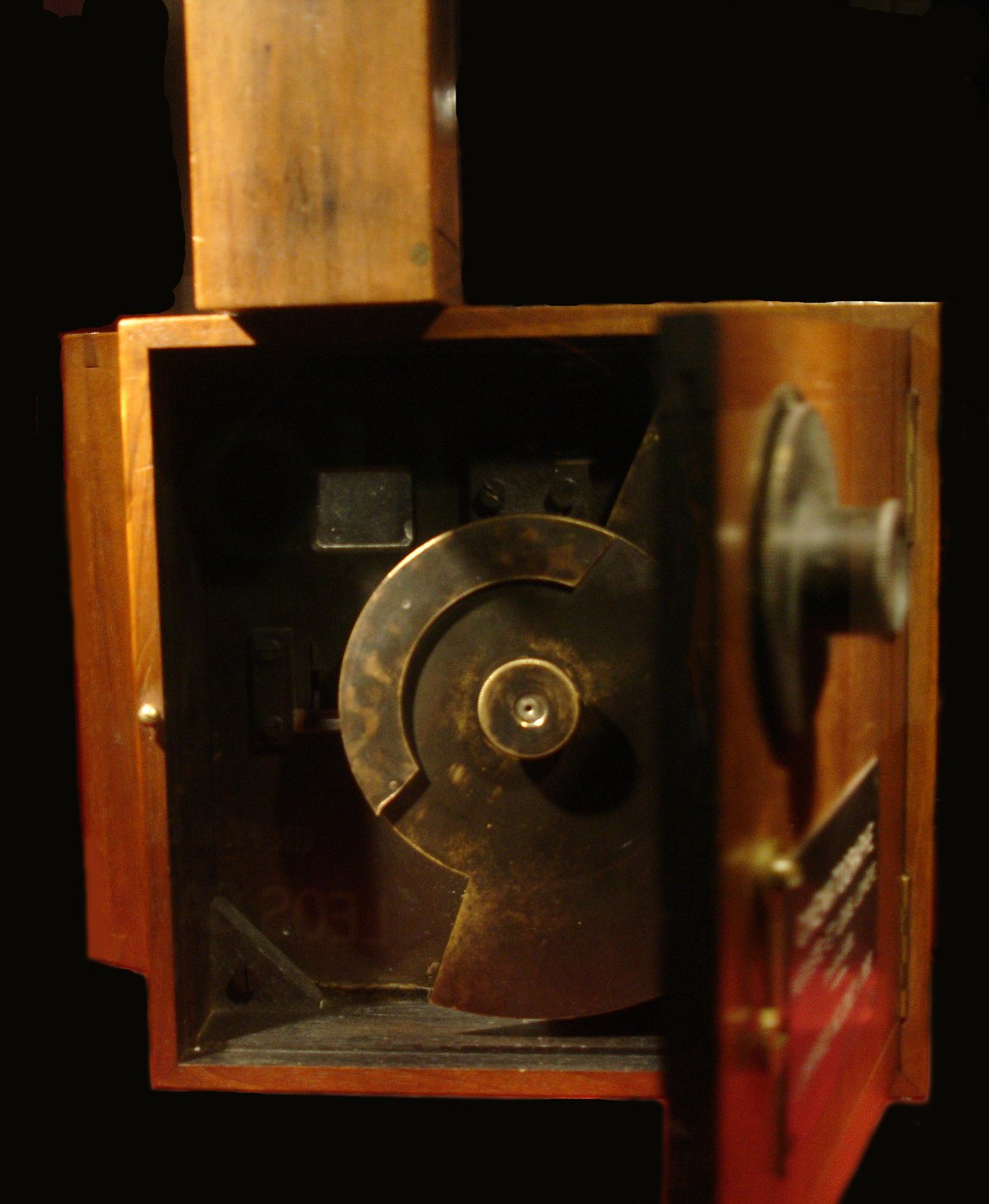


Cinématographe
Edison's Kinetoscope already worked: you put in a coin, put your eye to a peephole, and watched a film run continuously on your own. One person at a time, a heavy machine, mains powered.
The Lumière brothers' apparatus does three things with one mechanism: it films, it prints the copies and it projects. It weighs about five kilos, is turned by a crank, and needs no electricity at all. So it can be carried — and that is why cinema spread from Lyon to Russia and Egypt in under two years.
The heart of the mechanism is borrowed from the sewing machine: a claw that pierces the perforation, pulls the film down by one frame, withdraws and rises again. The film advances in jerks and stands still during exposure. French patent FR 245,032, filed 13 February 1895.
Instructions
Never use nitrate film
Never use nitrate film
Period film stock was cellulose nitrate: it self-ignites, burns without outside oxygen and caused many cinema fires. Work only on acetate or polyester base.
Read patent FR 245,032
Read patent FR 245,032
Title: “Apparatus for obtaining and viewing chronophotographic proofs”. One apparatus to take the pictures AND to see them — it is all in the title.
Understand why continuous motion shows nothing
Understand why continuous motion shows nothing
Slide a strip of images past a window without stopping: all you see is a blur. Each frame has to be still while you look at it.
Build the film gate
Build the film gate
Machine a channel that guides the film perfectly flat behind a rectangular window. Film that buckles gives an image blurred along one edge only.
Materials for this step:
 Brass 260 Sheet 24 Gauge1 sheet
Tools needed:
 Metal File
Punch the perforations at an even pitch
Punch the perforations at an even pitch
Perforation pitch sets frame height. An irregularity of a few tenths makes the picture jump vertically on projection.
Tools needed:
 Measuring Ruler
Make the claw
Make the claw
Cut two fine points mounted on a moving carrier. They must enter the perforation without tearing it and withdraw cleanly.
Materials for this step:
 Mild Steel Rod (6mm)1 piece
Fit the eccentric cam that traces a rectangle
Fit the eccentric cam that traces a rectangle
The claw must follow four movements: in, down, out, up. This is the motion of a sewing machine needle feed, and the Lumières took it directly.
Check the stroke is exactly one frame
Check the stroke is exactly one frame
Measure the claw's travel. Too short and the picture creeps up; too long and it creeps down. The setting must be exact, not close.
Add the rotating shutter
Add the rotating shutter
Fit a disc with an opaque sector, timed to mask the window while the film moves. Without it you see the film sliding between frames.
Synchronise shutter and claw on one shaft
Synchronise shutter and claw on one shaft
Both must run from the same axle. Approximate synchronisation gives either a light veil or an image smeared vertically.
Leave free loops above and below
Leave free loops above and below
Allow a loop of slack each side of the gate. It absorbs the jerk: without loops the film tears at the perforations within seconds.
Crank at sixteen frames per second
Crank at sixteen frames per second
Count two turns per second for eight frames per turn. That was the Lumière rate; 24 frames per second only arrives with sound.
Switch to projection changing nothing
Switch to projection changing nothing
Replace the taking lens with a lamphouse and a projection lens. The transport mechanism stays the same — that is the governing idea of the apparatus.
Look for flicker and cure it
Look for flicker and cure it
At sixteen frames per second the image flickers. Add extra blades to the shutter so the light is cut two or three times per frame: the frame rate is unchanged and the flicker disappears.
Compendium — cinema's sewing machine
Compendium — cinema's sewing machine
The patent. Auguste and Louis Lumière filed French patent no. 245,032 on 13 February 1895, “Apparatus for obtaining and viewing chronophotographic proofs”. Louis Lumière designed the mechanism with the engineer Charles Moisson, and Jules Carpentier manufactured it. The first paying public projection took place on 28 December 1895 at the Salon Indien of the Grand Café, boulevard des Capucines in Paris.
An apparatus against a machine. Edison's earlier Kinetoscope worked perfectly well but could only be watched through a peephole, one person at a time, on a heavy mains-powered machine. The Cinématographe weighs about five kilos, runs on a crank, and serves in turn as camera, printer and projector. That portability explains the spread: Lumière operators went out to film and project in Russia, Egypt, Japan and South America, and brought back views of the whole world in under two years. The advantage was not optical, it was logistical.
The claw comes from sewing. The central problem of any cinema apparatus is contradictory: the film must advance and stand still during exposure. The Lumière solution is a claw mechanism derived from the cloth feed of a sewing machine — two points trace a rectangle, pierce the perforation, pull the film down one frame, disengage and rise. During the still period the shutter opens; during the movement it closes. The slack loops on either side absorb the jerk, without which the film tears at the perforations.
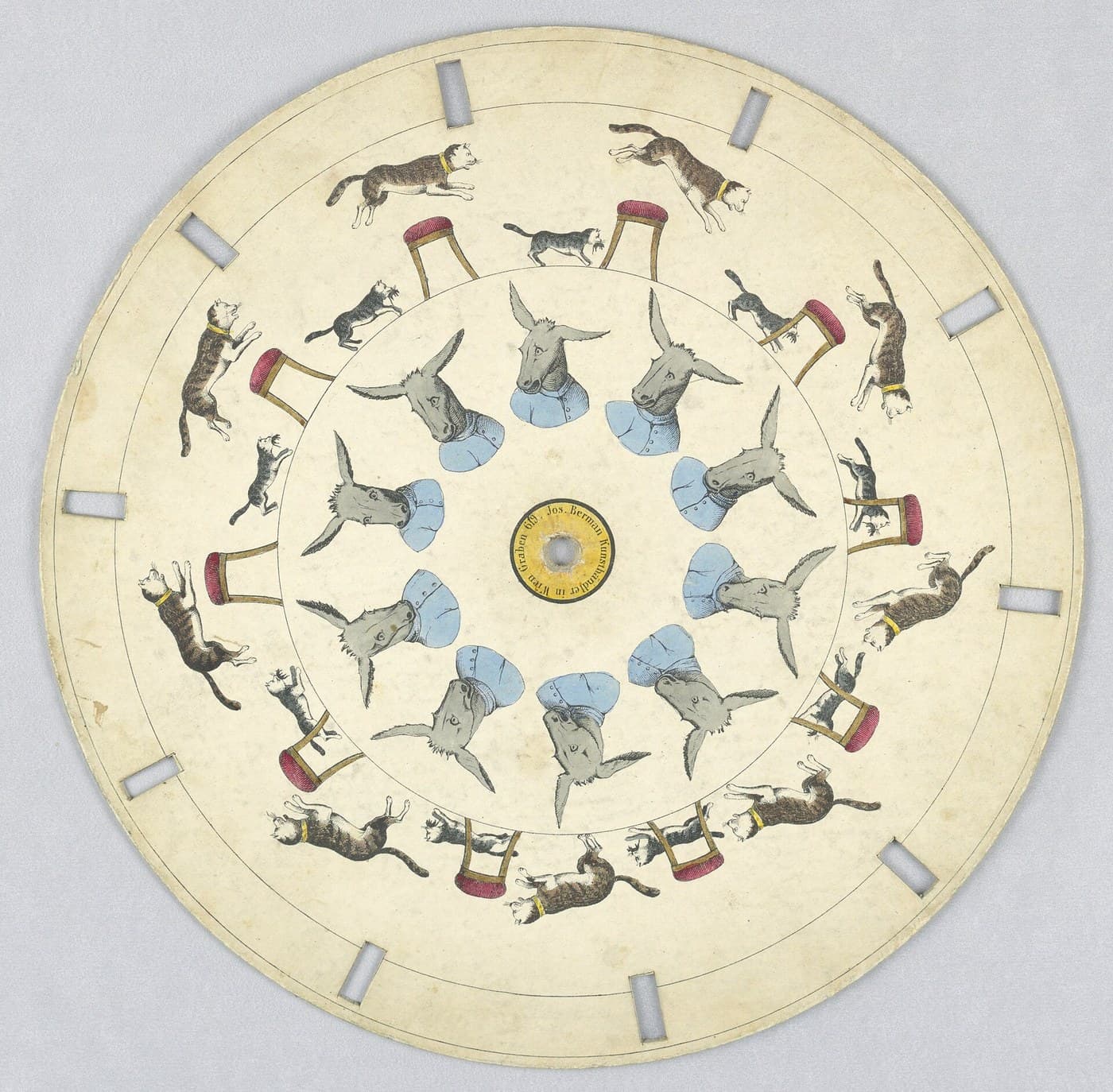
On persistence of vision. Cinema is often explained by “persistence of vision”. This is inaccurate: the after-image exists but does not explain perceived motion. Psychologists now attribute the illusion to the phi phenomenon and beta movement — that is, to processing in the brain rather than the eye. At sixteen frames per second motion reads but the image flickers; so shutter blades were multiplied to interrupt the light two or three times per frame. That raises the flicker frequency without raising the frame rate — an engineer's trick that treats the eye and the perception as two separate problems.
Materials
2- 1 sheetPlaceholder
- 1 piecePlaceholder
Related Blueprints
These blueprints share knowledge with this one — techniques, materials, or principles that connect them in the learning graph.


CC0 Public Domain
This blueprint is released under CC0. You are free to copy, modify, distribute, and use this work for any purpose, without asking permission.
Support the Maker by purchasing products through their Blueprint where they earn a Maker Commission set by Vendors, or create a new iteration of this Blueprint and include it as a connection in your own Blueprint to share revenue.