ART
BEAUTY & WELLNESS
CRAFT
CULTURE & HISTORY
ENTERTAINMENT
ENVIRONMENT
FOOD & DRINKS
REVERSE ENGINEERING
SCIENCES
SPORTS
TECHNOLOGY
WEARABLES
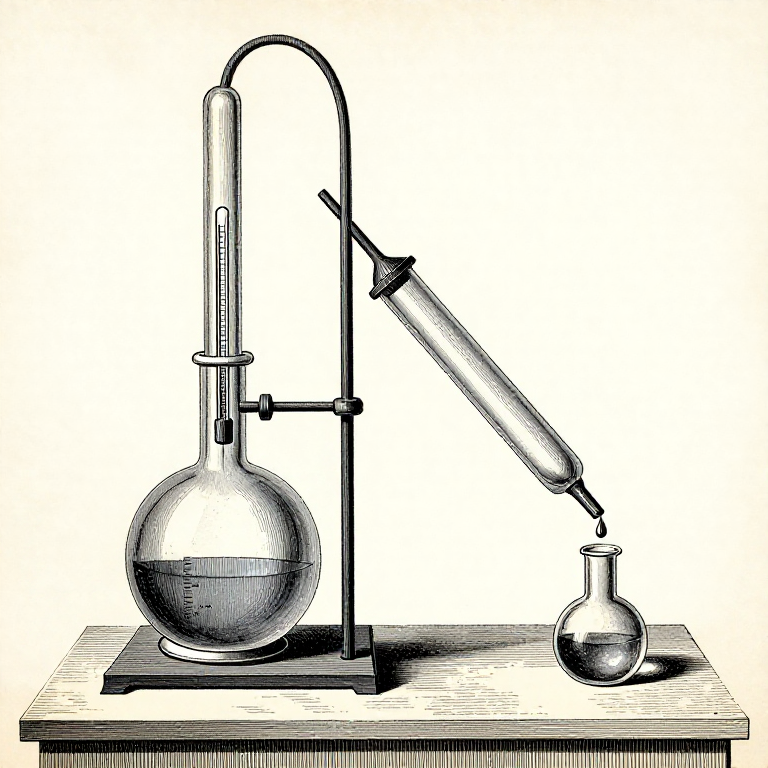


Distilling Well: One Plate, Ten Plates, and the Wall You Cannot Pass
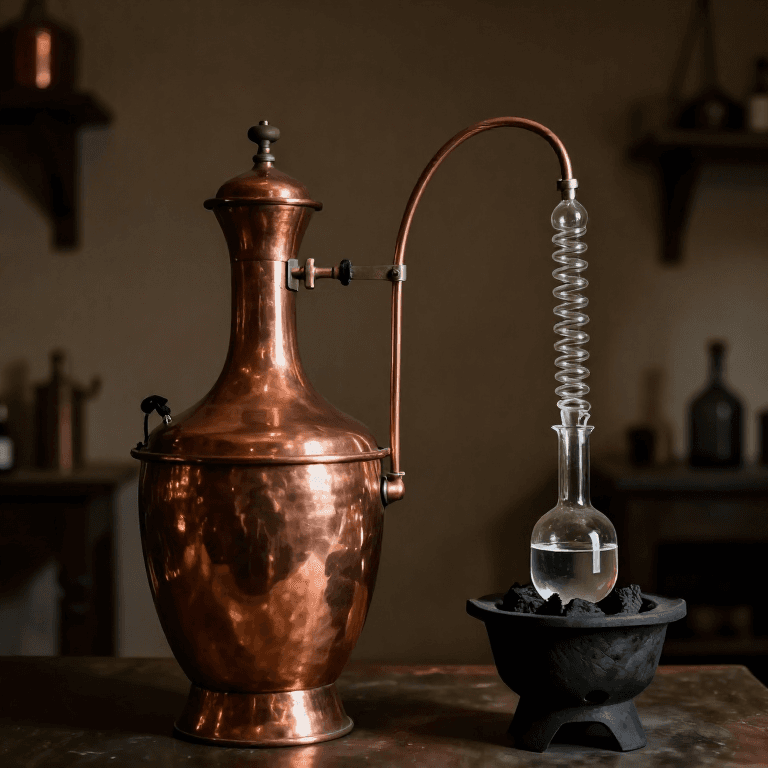
Distillation separates liquids by boiling point, and the catalogue is full of it — alembics, coal tar fractions, essential oils, turpentine, spirits. What none of those blueprints says is how good a separation to expect, or when the apparatus has to change.
The answer is in one idea: a **theoretical plate**, one cycle of evaporation and condensation. A simple still is one plate. A column is several, and the number needed follows from how far apart the boiling points are.
It is hazard-gated because distillation combines heat, flammable vapour and sealed glassware — the three ingredients of the commonest serious laboratory accident.
Advanced
5 hours
Instructions
1
1
Setting one up without an accident
Setting one up without an accident
**Never heat a closed system.** There must be an opening to atmosphere somewhere. A sealed apparatus that is heated becomes a bomb, and this is the single most dangerous mistake in the whole of practical chemistry.
**Never distil to dryness.** Peroxides, and in some cases residues that decompose violently, concentrate in the pot. Stop with liquid still in it, always.
**Boiling chips or a stirrer bar, added COLD.** A smooth-walled flask of a superheated liquid bumps — it erupts as a slug of boiling liquid — and adding a chip to an already-hot liquid causes exactly that eruption.
**Water into the condenser at the BOTTOM, out at the top.** Fed the other way it never fills and barely cools.
**Secure every joint, and clamp the flask, not the condenser.** Glassware that shifts pulls joints apart.
**No naked flame anywhere near a flammable solvent.** A heating mantle or a hot water bath, never a bunsen under ether.
**Thermometer bulb level with the side arm**, so it reads the vapour that is leaving rather than the vapour above the liquid.
Ventilation, eye protection and a clear path away from the bench.
Materials for this step:
 Ethanol - Lab Grade, 95%1 piece
Tools needed:
 Round-Bottom Flask
 Condenser Coil
 Thermometer - Lab
 Hot Plate Magnetic Stirrer
 Clear Safety Glasses
 Chemical-Resistant Gloves
2
2
Plates, boiling point gaps and azeotropes
Plates, boiling point gaps and azeotropes
Loading Jupyter Notebook...
Tools needed:
 Desktop Computer
3
3
Reading the thermometer
Reading the thermometer
The temperature at the still head is the whole record of what is happening, and it reads like a graph.
**A slow rise, then a plateau.** The plateau is a fraction coming over, and it sits at that component's boiling point. Collect while it holds steady.
**The plateau ends and the temperature climbs.** That fraction is finishing. Change the receiver.
**No plateau at all, just a steady climb.** The components are too close to separate with this apparatus. Either accept a mixture or fit a column.
**The temperature falls.** The heating is too low, or the vapour is no longer reaching the head. On a column this usually means it has flooded.
**Collect in three parts, always.** The **fore-run** — the first few per cent, containing the lowest boiling impurities and any residual solvent. The **main fraction**, over the plateau. The **tail**, as the temperature climbs again. Combining them is how a careful distillation is thrown away.
**Go slowly.** A fast distillation gives the column no time to equilibrate and loses most of its plates. One to two drops a second at the receiver is the usual guidance.
Materials for this step:
Ethanol - Lab Grade, 95%1 pieceTools needed:
Thermometer - Lab Distillation Column Assembly
 Erlenmeyer Flask
4
4
When to use a different kind of distillation
When to use a different kind of distillation
**Vacuum distillation.** Lowering the pressure lowers the boiling point, which is how a substance that would decompose at its atmospheric boiling point is distilled at all. A rough rule: halving the pressure drops the boiling point by roughly 15 C, and the first 10 mmHg matters more than everything above it.
Use thick-walled glass rated for vacuum, never a flat-bottomed flask, and let it down slowly at the end.
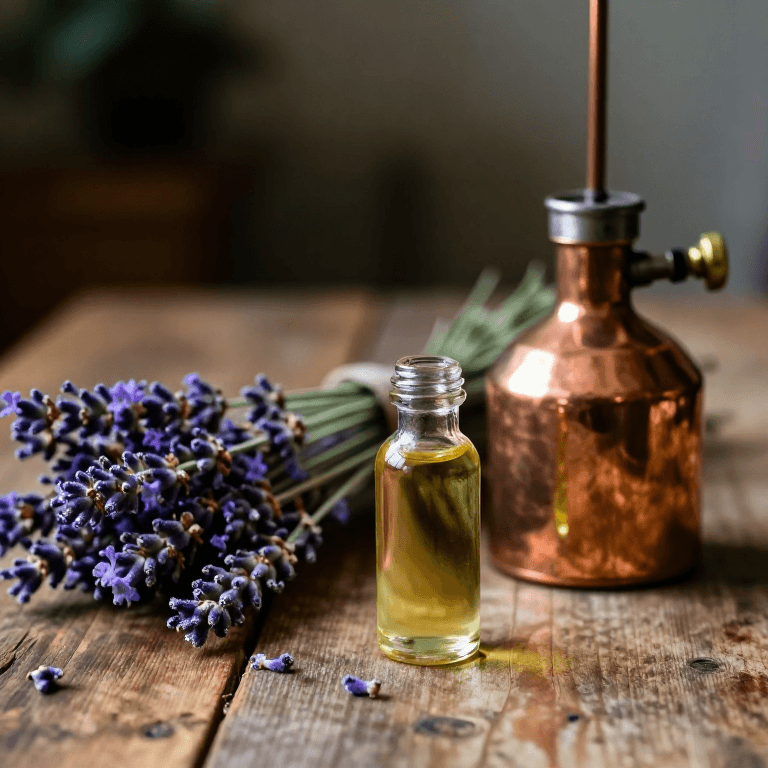
**Steam distillation.** Passing steam through carries over compounds that are immiscible with water at a temperature BELOW 100 C, because the two partial pressures add. This is how essential oils are obtained without cooking them, and the lavender blueprint is exactly this.
**Short-path and Kugelrohr.** For small quantities, where the surface area of ordinary apparatus would hold most of the product.
**Simple distillation is enough** when the boiling points are far apart and the impurity is non-volatile — removing a solvent, for instance, which is the commonest distillation there is and needs no column at all.
Choose by the gap and by the thermal stability, and reach for a column only when the plate count says you must.
Tools needed:
Round-Bottom Flask Vacuum PumpCondenser Coil
Materials
1- 2 piecesPlaceholder
Tools Required
10- Placeholder
- Placeholder
- Placeholder
- Placeholder
- Placeholder
- Placeholder
- Placeholder
- Placeholder
- Placeholder
- Vacuum Pump10% commissionMagento Legacy Storeships internationallyPlaceholder
Related Blueprints
These blueprints share knowledge with this one — techniques, materials, or principles that connect them in the learning graph.



CC0 Public Domain
This blueprint is released under CC0. You are free to copy, modify, distribute, and use this work for any purpose, without asking permission.
Support the Maker by purchasing products through their Blueprint where they earn a Maker Commission set by Vendors, or create a new iteration of this Blueprint and include it as a connection in your own Blueprint to share revenue.