ART
BEAUTY & WELLNESS
CRAFT
CULTURE & HISTORY
ENTERTAINMENT
ENVIRONMENT
FOOD & DRINKS
REVERSE ENGINEERING
SCIENCES
SPORTS
TECHNOLOGY
WEARABLES
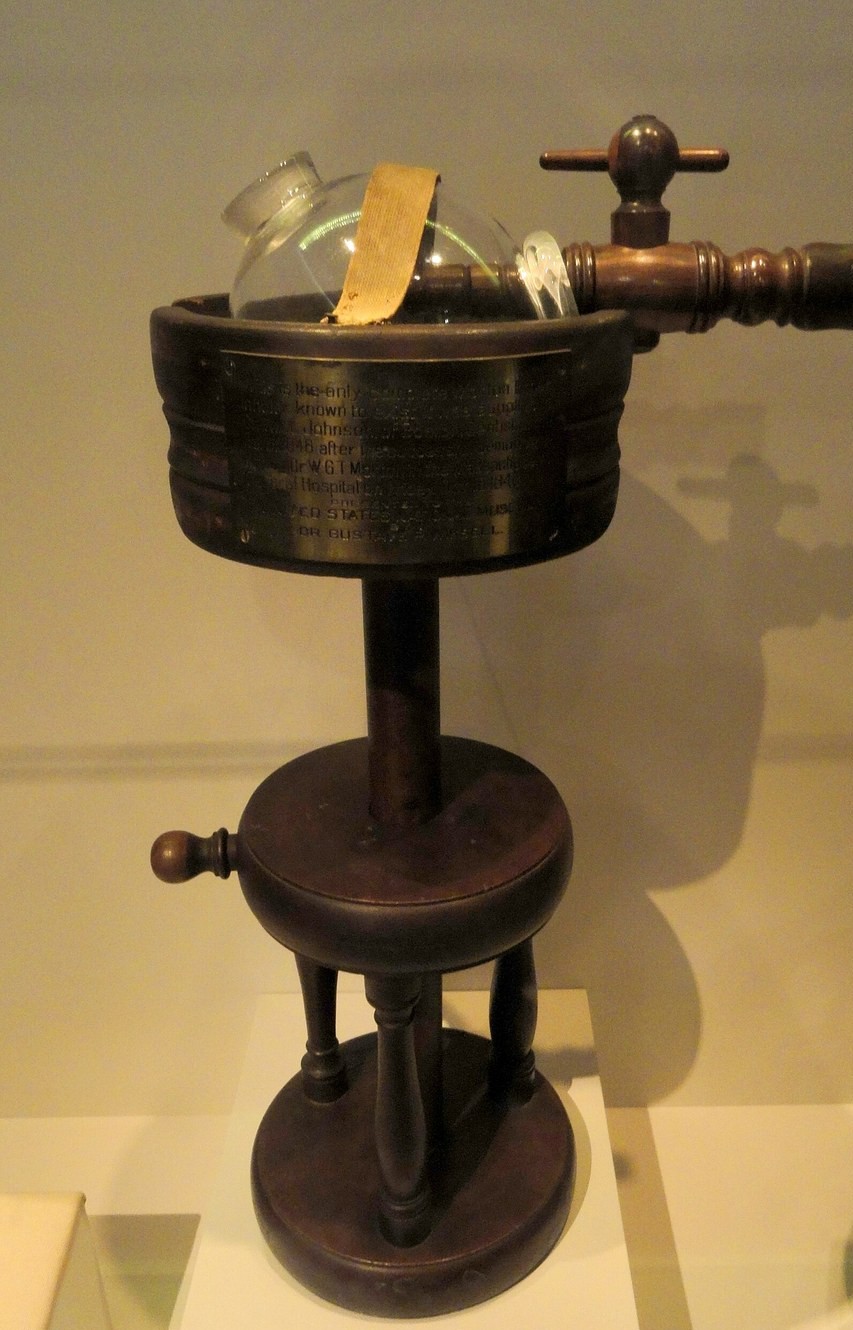


The Ether Inhaler
Before 16 October 1846 surgery was speed. A surgeon's reputation rested on how few seconds an amputation took, because the patient was awake and held down. On that morning at Massachusetts General Hospital a glass globe with a sponge in it ended that era in about five minutes.
The device looks trivial and is not. Diethyl ether boils at 34.6 degrees Celsius, which means at room temperature the air above it is already saturated with roughly 58 percent ether vapour. The concentration that produces surgical anaesthesia is around 2 percent. So the inhaler is not a vaporiser at all — the ether vaporises perfectly well on its own. The inhaler is a DILUTER, and every part of it exists to stop the patient receiving thirty times the dose they need.
That inversion is the whole engineering lesson, and it is why this blueprint is a fluid-mechanics build rather than a chemistry one. You will build the glass draw-over vaporiser and characterise it — with a safe surrogate, never with ether. Ether itself is here as the subject, described honestly, behind the hazard gate: it is extremely flammable with an explosive range in air from about 1.9 to 36 percent, it autoignites near 160 degrees Celsius, and on storage in light and air it forms shock-sensitive peroxides. The clinical boundary is absolute — this is a bench instrument for understanding a vapour circuit. It is not an anaesthetic machine and must never be connected to a person.
Advanced
6 hours
Instructions
1
1
Understand what the globe actually does
Understand what the globe actually does
Set the chemistry down before touching glass, because it explains every later choice.
Diethyl ether at 20 degrees Celsius has a vapour pressure of about 442 mmHg against an atmosphere of 760 mmHg. Divide: the gas immediately above liquid ether is roughly 58 percent ether by volume. A patient breathing that dies. Surgical anaesthesia sits near 2 percent.
So the globe has three jobs and only three. First, present a large liquid surface — Morton used a sponge precisely to multiply surface area, so the vapour space stays saturated even while gas is being drawn off. Second, split the inspired flow so that only a fraction passes over that surface and the rest bypasses it. Third, make the patient's exhaled breath leave without going back through the ether, or the circuit accumulates.
Work out the splitting ratio you need. If saturated vapour is 58 percent and you want 2 percent delivered, the fraction of total flow that may pass through the vaporising chamber is 2/58, about 3.4 percent. Thirty parts of bypass to one part of carrier. Hold that number — it is why every draw-over vaporiser ever built has a large, deliberately leaky bypass channel, and why the ones that killed people were the ones where the bypass blocked.
Record this in your build notes as the design target before you cut any glass.
2
2
Compute the vapour curve and the splitting ratio
Compute the vapour curve and the splitting ratio
Loading Jupyter Notebook...
Tools needed:
 Desktop Computer
3
3
Blow the globe and set the two ports
Blow the globe and set the two ports
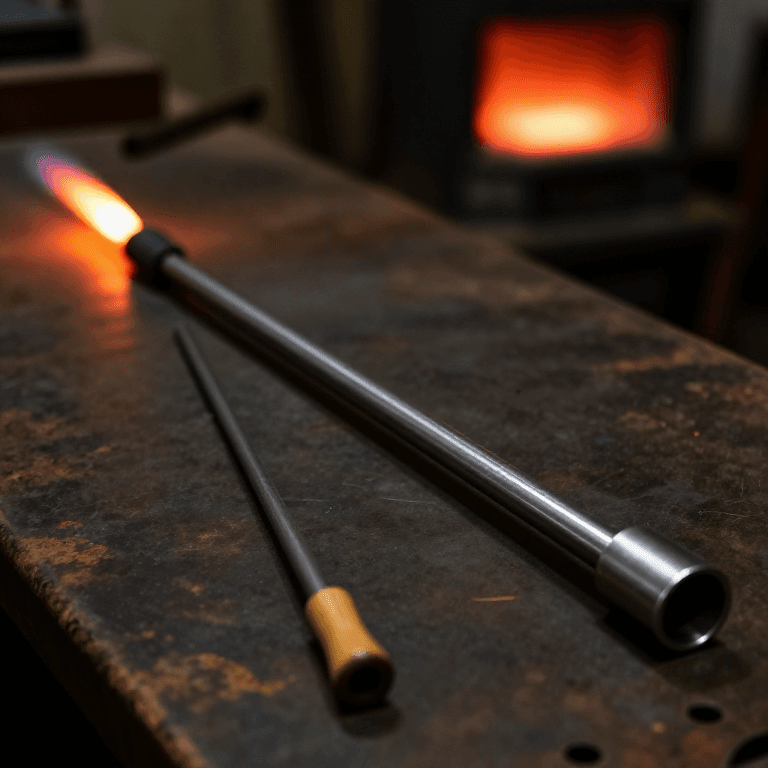
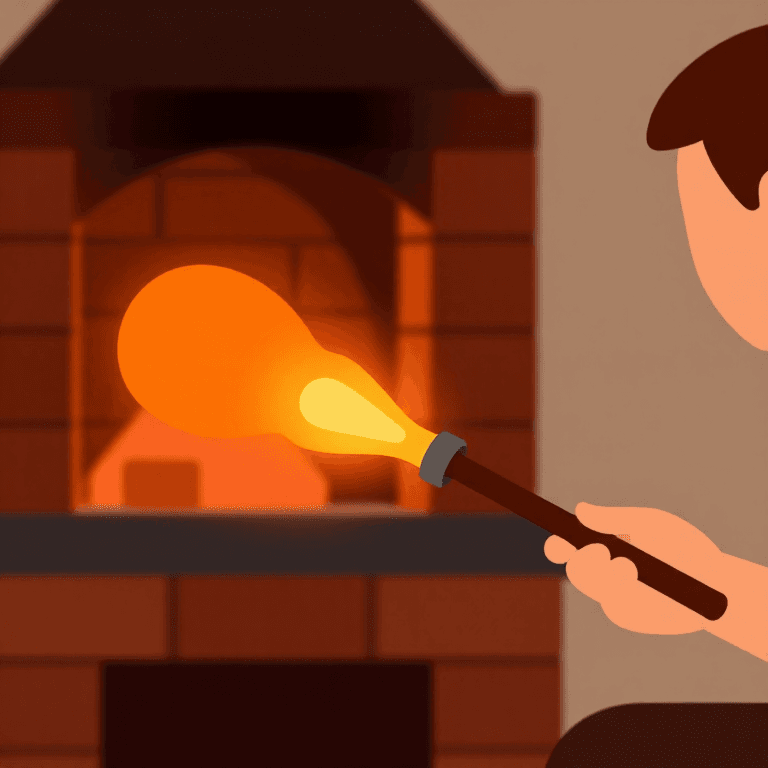
Work the borosilicate on the bench lathe. The historic form is a globe of roughly 200 to 300 millilitres with two ports on the same hemisphere, and there is a reason for the geometry: a sphere gives the largest vapour volume for the smallest surface losing heat, and vaporisation chills the liquid fast.
That cooling is not a detail. Pulling ether vapour off the surface removes its enthalpy of vaporisation from the remaining liquid, the liquid temperature drops, the vapour pressure drops with it, and the delivered concentration falls during use. Nineteenth-century practice was to stand the globe in a bowl of warm water for exactly this reason. Your build should reproduce the effect rather than hide it, so keep the glass thin and do not lag it.
Set the inlet port so its tube ends well above the liquid line, and the outlet port so it draws from the top of the vapour space. Anneal properly after working — an unannealed globe under thermal cycling will craze and, with a flammable charge inside, that is not a recoverable failure. Fit the sponge through the wider port before you constrict it.
Cut the bypass as a separate T in the silicone line downstream, not into the glass. Making it external means it is inspectable, and after the last notebook you know that inspectability is the safety case.
Materials for this step:
 Borosilicate Glass Rod2 pieces
 Borosilicate Flask1 piece
 Silicone Tubing (6mm ID)2 metre
 Natural Sea Sponge1 piece
Tools needed:
 Bench Glassblowing Torch
 Glassworking Lathe
 Bunsen Burner
 Digital Caliper 6-Inch
4
4
The breathing circuit, and where it must not close
The breathing circuit, and where it must not close
A vaporiser is only half the device. The other half is a circuit that guarantees exhaled gas leaves, because carbon dioxide accumulation kills long before the anaesthetic does.
This flow diagram lays out the draw-over circuit: fresh air in, split at the bypass T, carrier through the vaporising chamber, recombined at the mixing point, past a one-way inspiratory valve to the mask, and exhaled gas out through a separate expiratory valve to atmosphere. The two valves are what make the circuit unidirectional. If either sticks, the circuit rebreathes.
Trace it and check the failure branches, which are drawn deliberately: a stuck inspiratory valve, a stuck expiratory valve, and a blocked bypass. Each has a different signature and a different consequence, and recognising them from the diagram is the point of the step.
Flow
Loading...
Materials for this step:
 Brass Check Valve (1/2 inch)2 piecesSilicone Tubing (6mm ID)1 metre
Tools needed:
 Digital Multimeter (Lab Grade)
5
5
Characterise it with a surrogate, and stop there
Characterise it with a surrogate, and stop there
Charge the chamber with ethanol, not ether. Ethanol has a vapour pressure near 44 mmHg at 20 degrees — about a tenth of ether's — so the circuit runs at a concentration you can measure safely and the arithmetic from step 2 still applies with one substitution.
Draw a known flow through the circuit with a hand bellows or a low-flow pump and measure delivered concentration. The cheap and honest method is gravimetric: weigh the whole vaporiser before and after a timed run, and divide the mass lost by the volume of air drawn through. That gives you grams per litre, which converts to percent by volume through the molar mass. Repeat at three chamber temperatures by standing the globe in water baths at 15, 20 and 25 degrees, and plot your measurements on top of the curve the notebook predicted.
Expect your delivered concentration to fall during each run. That is the vaporisation cooling from step 3 showing up as data, and if you do not see it your run was too short.
Where this stops: you have built and calibrated a draw-over vapour circuit. That is a genuine and complete piece of instrument physics. It is not an anaesthetic machine. Modern vaporisers are temperature-compensated, flow-compensated, agent-specific and keyed so the wrong agent cannot be filled, and they are verified against a gas analyser before every use. The gap between this bench circuit and that is the whole of twentieth-century anaesthetic engineering, and it is a gap you do not close with a sponge.
Materials for this step:
 Ethanol (95%, Denatured)250 millilitre
Tools needed:
 Precision Digital Scale (0.01g)
 Thermometer (Lab)
 Glass Beaker
Materials
6- 2 piecesPlaceholder
- 1 piecePlaceholder
- 3 metrePlaceholder
- 1 piecePlaceholder
- 2 piecesPlaceholder
- 250 millilitrePlaceholder
Tools Required
9- Placeholder
- Placeholder
- Placeholder
- Placeholder
- Placeholder
- Placeholder
- Placeholder
- Placeholder
- Placeholder
Related Blueprints
These blueprints share knowledge with this one — techniques, materials, or principles that connect them in the learning graph.


CC0 Public Domain
This blueprint is released under CC0. You are free to copy, modify, distribute, and use this work for any purpose, without asking permission.
Support the Maker by purchasing products through their Blueprint where they earn a Maker Commission set by Vendors, or create a new iteration of this Blueprint and include it as a connection in your own Blueprint to share revenue.