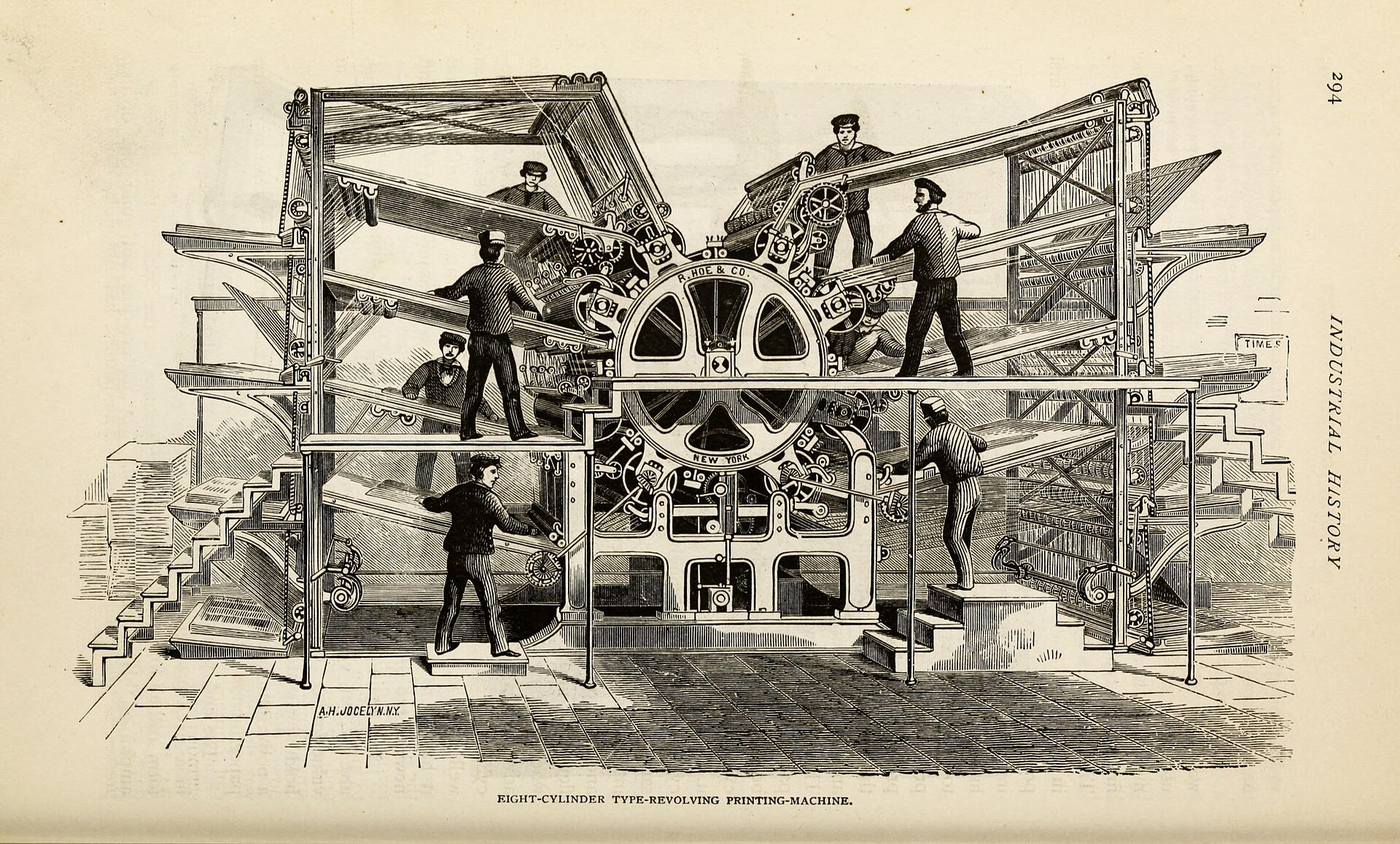


Hoe Rotary Printing Press
A flatbed press prints by pressing a flat plate against a flat sheet. Every impression means bringing a heavy platen down, lifting it, changing the sheet and doing it again — and the machine spends most of its life reversing direction. Speed is capped by inertia, not by ink.
Richard Hoe's answer was to stop reciprocating and start rotating. Wrap the type around a cylinder, run the paper against it, and nothing ever stops or reverses. The press becomes a continuous machine, and its output is limited only by how fast you dare spin it.
The hard part was keeping loose metal type on a spinning drum. Hoe's wedge-shaped column rules lock each line in place against centrifugal force — a fastening problem, not a printing one. US Patent 5,199, "Improvement in rotary printing-presses", granted 24 July 1847.
Instructions
Nip points on rollers take fingers
Nip points on rollers take fingers
Any pair of counter-rotating cylinders will pull in whatever touches them. Guard the nips before turning anything, and never feed paper by hand into a running machine.
Read US 5,199 and find the column rules
Read US 5,199 and find the column rules
Hoe claims arranging type on a segment of a cylinder with wedge-section rules between columns. Those wedges are what stop the type flying off.
Time a flatbed cycle by hand
Time a flatbed cycle by hand
Ink a flat block, press a sheet, lift, change, repeat. Time ten impressions. Most of that time is the machine changing direction, not printing.
Build a type cylinder
Build a type cylinder
Make a drum on a shaft with a machined outer surface. Everything is referenced from this cylinder, so it must run true.
Materials for this step:
 Hardwood Board1 piece
Tools needed:
 Hand Saw
Understand the real problem before solving it
Understand the real problem before solving it
Loose type on a spinning drum is thrown outward. Centrifugal force rises with the SQUARE of speed, so the faster the press runs the harder it tries to shed its own type.
Cut column rules with a wedge section
Cut column rules with a wedge section
Make the rules between columns tapered, wider at the outside. Tightening them drives the type inward and locks each line mechanically.
Materials for this step:
 Brass 260 Sheet 24 Gauge1 sheet
Tools needed:
 Metal File
Lock up a column and spin it by hand
Lock up a column and spin it by hand
Fit type between the wedges and rotate the drum. Nothing should shift. Test at low speed before ever running under power.
Fit inking rollers that ride on the type
Fit inking rollers that ride on the type
Mount soft rollers bearing on the cylinder. They must ink continuously, because the press never pauses for a separate inking stroke.
Materials for this step:
 Writing Ink50 ml
Add an ink train, not just one roller
Add an ink train, not just one roller
Use several rollers in series to distribute ink evenly. A single roller delivers heavy ink at first contact and starves by the end of the revolution.
Fit an impression cylinder pressing against the type
Fit an impression cylinder pressing against the type
Run a second cylinder against the first with the paper between them. Impression comes from the nip, which exists continuously rather than momentarily.
Set the nip pressure carefully
Set the nip pressure carefully
Too light and the impression is grey; too heavy and the type is crushed and the paper embossed. This is the single adjustment that decides print quality.
Add more impression cylinders around the type drum
Add more impression cylinders around the type drum
Hoe's machines had up to ten feeders around one type cylinder — each one printing a sheet on every revolution. The type is the expensive part, so run it against as many sheets as possible.
Time the rotary and compare with step 3
Time the rotary and compare with step 3
Count impressions per minute. Hoe's presses reached several thousand sheets an hour against a few hundred for a good flatbed.
Find the new bottleneck
Find the new bottleneck
With the press this fast, the limit becomes feeding and taking off single sheets by hand. That bottleneck is what drove the move to continuous reel-fed paper.
Compendium — rotation, and the problem it created
Compendium — rotation, and the problem it created
The patent. US 5,199, "Improvement in rotary printing-presses", granted 24 July 1847 to Richard March Hoe of New York. The machine became known as the Hoe type-revolving press or, in the trade, the "lightning press". The first was installed at the Philadelphia Public Ledger in 1847. Later versions carried up to ten feeding stations around a single central type cylinder, each fed by its own operator, and could produce on the order of twenty thousand impressions an hour.
Why reciprocating machines have a speed ceiling. A flatbed press must accelerate a heavy bed and platen, stop them, and reverse — and the energy spent on that acceleration is wasted twice per cycle. Rotation removes the reversal entirely: everything moves continuously in one direction at constant speed, so inertia works with the machine instead of against it. This is one of the most general moves in mechanical design, and the same substitution appears in the rotary engine, the turbine and the continuous mill.
The fastening problem is the actual invention. Wrapping type around a drum is obvious; keeping it there is not. Centrifugal force scales with ω²r, so doubling the speed quadruples the outward force trying to throw the type off — at newspaper speeds this is not a small effect, and a single letter leaving the cylinder would wreck the rollers. Hoe's wedge-section column rules convert a tightening screw into inward clamping pressure on every line of type. The patent is, properly read, about a clamping geometry that happens to be for printing.
What it enabled and what came next. Cheap, fast printing is the precondition for the mass-circulation newspaper, and the penny press expanded enormously in the decades after 1847. But Hoe's press still printed on individual sheets fed by hand, and once the cylinder was fast enough the human feeders became the limit. William Bullock's web press of 1863 fed from a continuous roll and printed both sides, removing the feeders altogether. Stereotyping — casting a curved metal plate of a whole page — then removed the loose-type problem entirely, which is to say the elegant solution in this patent was superseded by making its problem disappear.
Materials
3- 1 piecePlaceholder
- 1 sheetPlaceholder
- 50 mlPlaceholder
Tools Required
2- Placeholder
- Placeholder
Related Blueprints
These blueprints share knowledge with this one — techniques, materials, or principles that connect them in the learning graph.



CC0 Public Domain
This blueprint is released under CC0. You are free to copy, modify, distribute, and use this work for any purpose, without asking permission.
Support the Maker by purchasing products through their Blueprint where they earn a Maker Commission set by Vendors, or create a new iteration of this Blueprint and include it as a connection in your own Blueprint to share revenue.