
Melitta Coffee Filter
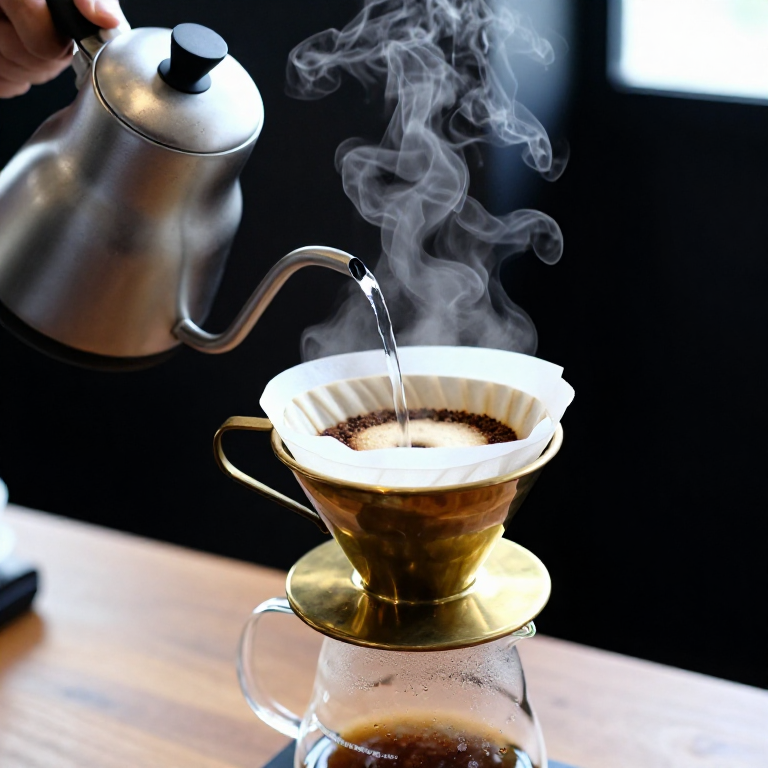
Around 1900 coffee was boiled in a pot or poured through a linen cloth. Both have the same two faults: grounds in the cup, and a bitter taste, because the coffee stays in contact with the water too long and too hot. The linen cloth also went rancid and had to be washed out.
Melitta Bentz replaced the cloth with paper — used once, then thrown away. She took a sheet of blotting paper from her son's school exercise book, laid it in a brass pot whose base she had pierced with a nail, and poured hot water over it. No grounds, no stale fat, no washing out.
On 20 June 1908 she filed it at the Imperial Patent Office in Berlin — as a utility model, not a patent. Registered 8 July 1908, patent gazette page 1145.
Instructions
First reproduce the fault: boil coffee in a pot
First reproduce the fault: boil coffee in a pot
Boil grounds with water and pour into a cup. Sediment at the bottom, bitter aftertaste. That was exactly the starting position in 1908.
Materials for this step:
 Ground Coffee100 g
Then filter through a linen cloth
Then filter through a linen cloth
Stretch a cloth over a cup and pour through. Clearer, but the cloth retains oil and odour — after a few days every coffee made through it tastes stale.
Raise a vessel from brass sheet
Raise a vessel from brass sheet
Form a shallow bowl from sheet that sits on a cup. Melitta Bentz used a brass pot she had at home.
Materials for this step:
 Brass 260 Sheet 24 Gauge1 sheet
Tools needed:
 Metal File
Dome the base, do not leave it flat
Dome the base, do not leave it flat
The base gets a slight curve. This is literally in the utility model description: a domed, recessed bottom — so the paper does not lie flat against it.
Punch the holes at an angle
Punch the holes at an angle
Punch inclined flow holes with a nail. Angled, so the water does not drop straight through but drains with a delay.
Check the paper touches nowhere
Check the paper touches nowhere
Paper stuck tight against the metal seals off the holes beneath it. The dome keeps a gap open — that is the actual trick.
Cut a round filter from blotting paper
Cut a round filter from blotting paper
Cut a disc of absorbent paper slightly larger than the base. The world's first filter was a sheet of blotting paper from a school exercise book.
Materials for this step:
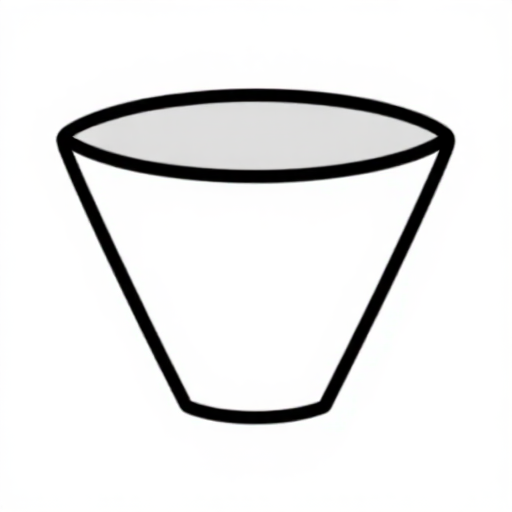 Filter Paper20 pieces
Wet the paper before brewing
Wet the paper before brewing
Rinse it through with hot water and discard that water. This removes the papery taste and pre-warms the filter and the cup.
Set the grind
Set the grind
Grind medium-fine. Too fine blocks the paper and the water stands; too coarse and it runs through before it has dissolved anything.
Bring the water to 92-96 °C
Bring the water to 92-96 °C
Let boiling water stand briefly. Brewing with boiling water makes it bitter — exactly the fault of the pot, only in a filter.
Tools needed:
 Thermometer
Pour a little first and wait
Pour a little first and wait
Wet the grounds with a small amount of water and wait half a minute. It swells up — carbon dioxide escaping from the roast.
Continue pouring in slow circles
Continue pouring in slow circles
Pour evenly from the centre outwards. Water that runs down the edge has not touched the coffee at all.
Time the draw-down
Time the draw-down
About three to four minutes for a pot. Much faster means the grind is too coarse, much slower means too fine.
Taste all three methods side by side
Taste all three methods side by side
Compare pot, cloth and paper filter directly. The difference is large enough that you do not have to look for it.
Compendium — a utility model, not a patent
Compendium — a utility model, not a patent
What was actually registered. Melitta Bentz, a housewife from Dresden, filed a Gebrauchsmuster (utility model) at the Imperial Patent Office in Berlin on 20 June 1908: “Coffee filter with a domed, recessed bottom on the underside and inclined flow holes.” The right came into being on registration on 8 July 1908, published on page 1145 of the patent gazette. A utility model is not a patent: it is registered rather than substantively examined, it runs for a shorter term, and it is therefore often called a “small patent”. The German Patent and Trade Mark Office does not publish the 1908 registration number — anyone who quotes one has invented it.
The citable patent number came later. Melitta Werke AG filed patent DE 653796 on 3 December 1937: “Filter paper insert for coffee brewing filters and the like” — the folded paper insert that forms a bag from three circular segments while using less paper. That is the filter paper you buy today. The famous ribbed conical filter therefore dates from the 1930s, not from 1908.
Why paper filters better than cloth. Paper retains not only the grounds but also a large share of the coffee oils, among them cafestol and kahweol — the same compounds unfiltered coffee delivers to the cup, and which measurably affect cholesterol. Paper-filtered coffee therefore tastes cleaner and lighter; French press and boiled coffee taste fuller because the oils come with them. Which you prefer is a matter of taste, but the difference is chemically real and not imagined.
What became of it. Melitta Bentz founded the company in 1908 with a starting capital of 73 pfennigs and a trade licence; her husband and sons worked in it. At the 1909 Leipzig fair she sold 1,200 filters. The company still carries her first name. What is remarkable about this invention is not its technical depth — a piece of pierced sheet metal and a sheet of paper — but that it removed a daily annoyance everyone knew about and nobody considered solvable.
Materials
3- 100 gPlaceholder
- 1 sheetPlaceholder
- 20 piecesPlaceholder
Tools Required
2- Placeholder
- Placeholder
This blueprint makes

Related Blueprints
These blueprints share knowledge with this one — techniques, materials, or principles that connect them in the learning graph.
CC0 Public Domain
This blueprint is released under CC0. You are free to copy, modify, distribute, and use this work for any purpose, without asking permission.
Support the Maker by purchasing products through their Blueprint where they earn a Maker Commission set by Vendors, or create a new iteration of this Blueprint and include it as a connection in your own Blueprint to share revenue.