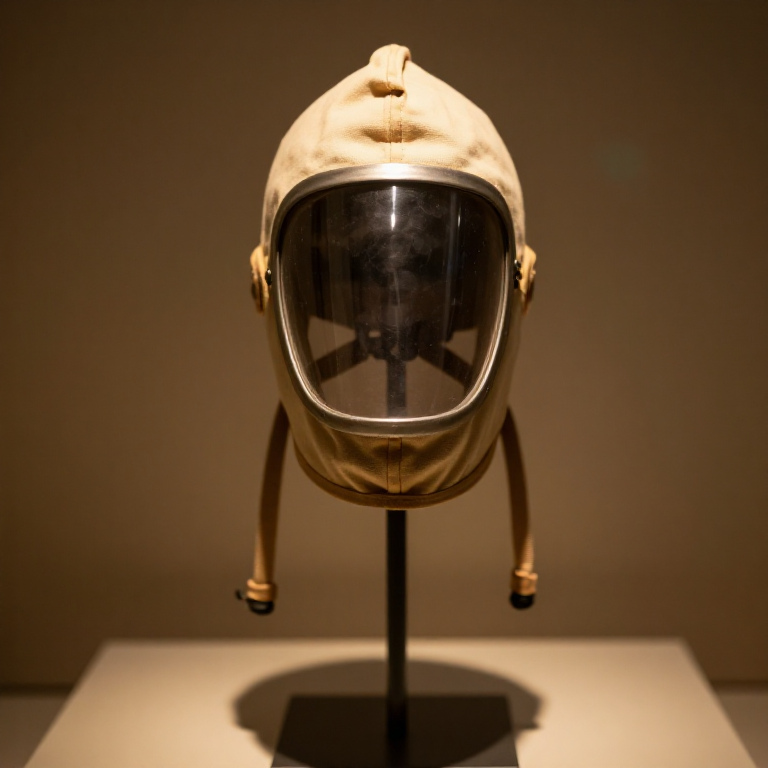


Morgan Safety Hood
Smoke rises. That single fact is the whole of Garrett Morgan's invention: if the foul air is at the top of a burning room, then breathable air is still near the floor, and a firefighter only needs a way to reach it.
His safety hood is a canvas hood with two long tubes hanging from it to floor level, and a valve at the top to let exhaled air out. No filter, no chemistry, no oxygen supply — it simply moves the intake to where the air is. In 1916 Morgan and his brother used them to bring men out of a collapsed tunnel under Lake Erie after other rescuers had died trying.
It is the direct ancestor of the World War I gas mask, and it is buildable from cloth and hose.
Instructions
Build this as a historical reconstruction only
Build this as a historical reconstruction only
This is a museum piece, not breathing apparatus. Never wear it in smoke, fire, a confined space or any atmosphere you would not breathe unprotected. Real respiratory protection is certified equipment and this is not it — the original was superseded for good reasons.
Measure the wearer's head
Measure the wearer's head
Take the circumference over the brow and the height from crown to collarbone. The hood must clear the face entirely without pressing on it.
Tools needed:
 Measuring Ruler
Cut the hood panels from canvas
Cut the hood panels from canvas
Cut four panels that sew into a rounded hood reaching to the shoulders, with generous internal volume. Close-fitting is wrong here — the air space is part of the design.
Materials for this step:
 Burlap / Hessian1 sqm
Sew the panels with a flat felled seam
Sew the panels with a flat felled seam
Join the panels with a doubled, enclosed seam. Every open seam is a leak, and a leak at head height is precisely where you do not want one.
Materials for this step:
 Waxed Linen Thread5 meters
Tools needed:
 Large-Eye Needle
Fit a transparent viewing panel
Fit a transparent viewing panel
Cut an opening at eye level and sew in a clear panel, sealing all round. Mica was used originally; thin acrylic sheet works and does not shatter.
Materials for this step:
 Mica Sheet1 sheet
Line the hood to make it airtight
Line the hood to make it airtight
Coat or line the canvas so it does not simply breathe through the weave. The whole principle fails if the wearer can draw air through the fabric.
Fit the two intake tubes at the hood base
Fit the two intake tubes at the hood base
Set two flexible tubes into the lower edge, sealed where they pass through. Two tubes, not one — Morgan's patent specifies a pair.
Make the tubes long enough to reach the floor
Make the tubes long enough to reach the floor
Cut them so the open ends hang at floor level when the hood is worn upright. The length IS the invention — it is what places the intake in the cool clear layer.
Weight the tube ends
Weight the tube ends
Fit a weighted, open fitting at each tube end so they stay down on the floor instead of trailing up as the wearer moves.
Screen the tube openings
Screen the tube openings
Cover each intake with a coarse mesh. It keeps debris out; it filters nothing, and it must not be described as a filter.
Fit the exhaust valve at the crown
Fit the exhaust valve at the crown
Make a simple one-way flap at the top so exhaled air escapes upward and cannot be re-breathed. Without it the hood fills with carbon dioxide within a minute.
Check the valve opens outward only
Check the valve opens outward only
Blow gently: the flap should lift. Draw in: it should seal. A valve that leaks inward defeats the tubes entirely.
Seal the hood at the shoulders
Seal the hood at the shoulders
Fit a drawcord or apron at the base so the hood closes against the chest and back, leaving the tubes as the only intake path.
Test the airflow in clean air only
Test the airflow in clean air only
In clean air, hold a light ribbon at a tube opening and breathe. It should draw in on inhalation, and the crown valve should lift on exhalation. That is the full extent of safe testing.
History & Context — the man who had to hide his own name
History & Context — the man who had to hide his own name
The patent. Garrett A. Morgan was granted US Patent 1,113,675 on 13 October 1914 for a breathing device. The specification states the object plainly: to let a fireman enter a building filled with suffocating gases and smoke and breathe freely long enough to do his work. The design is a hood with depending tubes and an escape valve, and it won a gold medal at the Second International Exposition of Safety and Sanitation.
The Lake Erie rescue. In 1916 an explosion trapped workers in a water intake tunnel under Lake Erie, off Cleveland. Rescue parties went in and did not come out. Morgan and his brother went down wearing his hoods and brought survivors and bodies to the surface. The episode made the device famous — and also exposed something uglier: Morgan, a Black inventor, had been selling the hood through a white actor hired to pose as the inventor at demonstrations, because Southern fire departments would not buy from him otherwise. After the rescue publicity identified him, orders were cancelled.
Why it works, and its hard limit. Hot smoke is buoyant and stratifies near the ceiling, leaving a cooler, clearer layer at floor level — the reason you are still told to crawl in a fire. Morgan's hood exploits that stratification instead of trying to purify air. But it supplies no oxygen and removes nothing: in a genuinely oxygen-depleted space, or where the toxic gas is heavier than air and pools at the floor, the tubes deliver exactly the wrong thing. That limitation is why filtering and self-contained apparatus replaced it.
What it led to. The design was adapted into gas masks used by US troops in the First World War, where the problem was chemical rather than thermal and the answer became an absorbent canister. Morgan went on to patent an improved three-position traffic signal in 1923 — the invention that introduced a warning interval between stop and go, and the direct ancestor of the amber light.
Materials
3- 1 sqmPlaceholder
- 5 metersPlaceholder
- 1 sheetPlaceholder
CC0 Public Domain
This blueprint is released under CC0. You are free to copy, modify, distribute, and use this work for any purpose, without asking permission.
Support the Maker by purchasing products through their Blueprint where they earn a Maker Commission set by Vendors, or create a new iteration of this Blueprint and include it as a connection in your own Blueprint to share revenue.