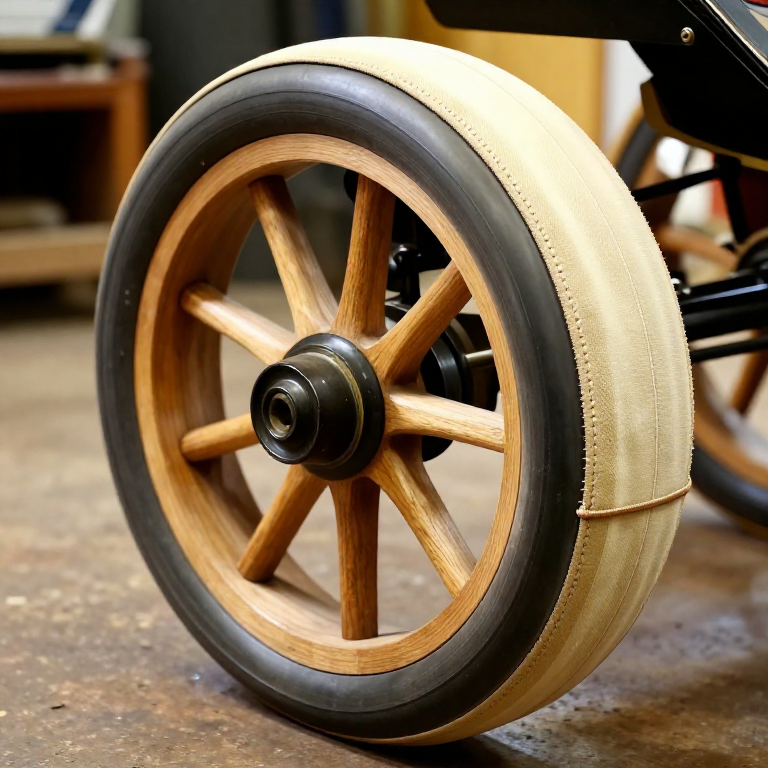


Pneumatic Tyre
A solid wheel transmits every stone in the road straight into the frame and the rider. Make the rim softer and it absorbs shock but wastes energy; make it harder and it rolls well and shakes you apart. There is no material that is both.
The pneumatic tyre escapes the choice by not being a material at all. The load is carried by air pressure, and the casing only contains it. Air is a near-perfect spring — it stores energy on compression and gives almost all of it back — so the tyre absorbs a bump and returns the energy instead of turning it into heat.
The usual story credits John Boyd Dunlop, 1888. It is wrong. Dunlop's patent was later declared invalid, because Robert William Thomson had patented the pneumatic tyre in 1845 — GB 10,990, the "Aerial Wheel" — forty-three years earlier. This blueprint builds Thomson's idea and tells both halves.
Instructions
Measure rolling resistance on a solid wheel first
Measure rolling resistance on a solid wheel first
Roll a solid-tyred wheel down a fixed ramp and record how far it runs. This number is your baseline and the whole experiment depends on it.
Tools needed:
 Measuring Ruler
Repeat over a rough surface
Repeat over a rough surface
Run the same test over battens laid across the floor. The solid wheel loses far more distance on the rough run — that gap is what the pneumatic tyre recovers.
Read both patents and note the dates
Read both patents and note the dates
Thomson's GB 10,990 of 10 December 1845 and Dunlop's GB 10,607 of 1888. Forty-three years apart, and the later one was struck down because of the earlier.
Separate the two jobs in your head
Separate the two jobs in your head
The inner tube HOLDS AIR. The outer casing TAKES THE LOAD and resists abrasion. Trying to do both with one component is why early tyres failed.
Make an inner tube from sheet rubber
Make an inner tube from sheet rubber
Form a rubber tube and vulcanise or cement the seam into a closed ring. It needs to be airtight and nothing else — it carries no load at all.
Materials for this step:
 Rubber Sheet1 sheet
Fit a valve that seals against internal pressure
Fit a valve that seals against internal pressure
Use a one-way valve. It must be held shut BY the pressure inside, not by a spring — that way higher pressure makes it seal harder.
Materials for this step:
 Brass Fittings1 piece
Build an outer casing from canvas
Build an outer casing from canvas
Sew a heavy canvas cover to enclose the tube. Thomson's original used a leather outer over a rubberised fabric tube — cloth carries tension far better than rubber.
Materials for this step:
 Canvas Fabric1 meter
Lay the casing threads on the bias, not straight
Lay the casing threads on the bias, not straight
Run the cords diagonally. A tyre must flex where it meets the road while staying dimensionally stable around its circumference, and only a bias layup does both.
Secure the casing to the rim all the way round
Secure the casing to the rim all the way round
Bind or bolt the cover down. Dunlop's first tyres were literally glued and lashed to the rim, and getting them off to mend a puncture was the design's worst fault.
Inflate gradually and check for creep
Inflate gradually and check for creep
Pump slowly and watch the casing. Any place where the tube bulges through is a place where the cover will burst under load.
Measure the contact patch at two pressures
Measure the contact patch at two pressures
Press the loaded wheel on paper and outline the flat area. Contact area is roughly load divided by pressure — the material barely matters.
Repeat the ramp test and compare
Repeat the ramp test and compare
Run both the smooth and rough courses again. On smooth ground the difference is modest; on rough ground the pneumatic wheel should run far further.
Test an over-inflated and an under-inflated run
Test an over-inflated and an under-inflated run
Too hard and it skips over bumps like a solid; too soft and the casing flexes and heats. There is an optimum, and you can find it in an afternoon.
Feel the casing after a long soft run
Feel the casing after a long soft run
It is warm. That heat is energy lost to flexing the rubber — hysteresis — and it is the one real inefficiency in an otherwise near-perfect air spring.
Compendium — the man who invented it forty-three years early
Compendium — the man who invented it forty-three years early
Thomson first, by a long way. Robert William Thomson, a Scot aged twenty-three, was granted British patent GB 10,990 on 10 December 1845 for what he called the "Aerial Wheel": a hollow leather outer enclosing a rubberised fabric tube filled with air. He demonstrated them in Regent's Park in 1847, where they measurably reduced noise and improved comfort on horse-drawn carriages. They worked. They also cost a fortune, because natural rubber was scarce and expensive in the 1840s, and there was no mass market for a smoother carriage ride. The patent lapsed into obscurity and Thomson moved on — he also invented a fountain pen.
Dunlop second, and invalidated. John Boyd Dunlop, a Belfast vet, made an air tyre in 1888 for his son's tricycle and applied for a patent on 23 July 1888, granted as GB 10,607 that December. It was later declared invalid on the grounds of Thomson's prior patent. What Dunlop had that Thomson lacked was timing: the safety bicycle had just arrived, cycling was a mass craze, and vulcanised rubber was cheap. The company that bore his name succeeded even though the patent did not. Describing Dunlop as the inventor of the pneumatic tyre is simply incorrect, and the record is unambiguous.
Why air beats every solid. Compressed air is very nearly a perfect spring: it stores energy when compressed and returns almost all of it when it expands, losing little to internal friction. A solid elastomer soft enough to absorb a bump converts a large fraction of that energy to heat, which is both lost work and a route to failure. Because a pneumatic tyre carries load by pressure, its contact patch area is approximately the load divided by the inflation pressure — a relationship that holds remarkably well and explains why pressure, not rubber compound, is the first thing to check.
The part that took longest. Neither patent solved the real obstacle to adoption: repairing a puncture. Early tyres were cemented or lashed to the rim and had to be cut off. The detachable, repairable tyre came from Édouard and André Michelin in 1891, and the beaded-edge rim that lets a tyre be levered off followed. A tyre you cannot mend at the roadside is a laboratory curiosity, which is a fair summary of the first forty-six years of this invention.
Materials
3- 1 sheetPlaceholder
- 1 piecePlaceholder
- 1 meterPlaceholder
Related Blueprints
These blueprints share knowledge with this one — techniques, materials, or principles that connect them in the learning graph.

CC0 Public Domain
This blueprint is released under CC0. You are free to copy, modify, distribute, and use this work for any purpose, without asking permission.
Support the Maker by purchasing products through their Blueprint where they earn a Maker Commission set by Vendors, or create a new iteration of this Blueprint and include it as a connection in your own Blueprint to share revenue.