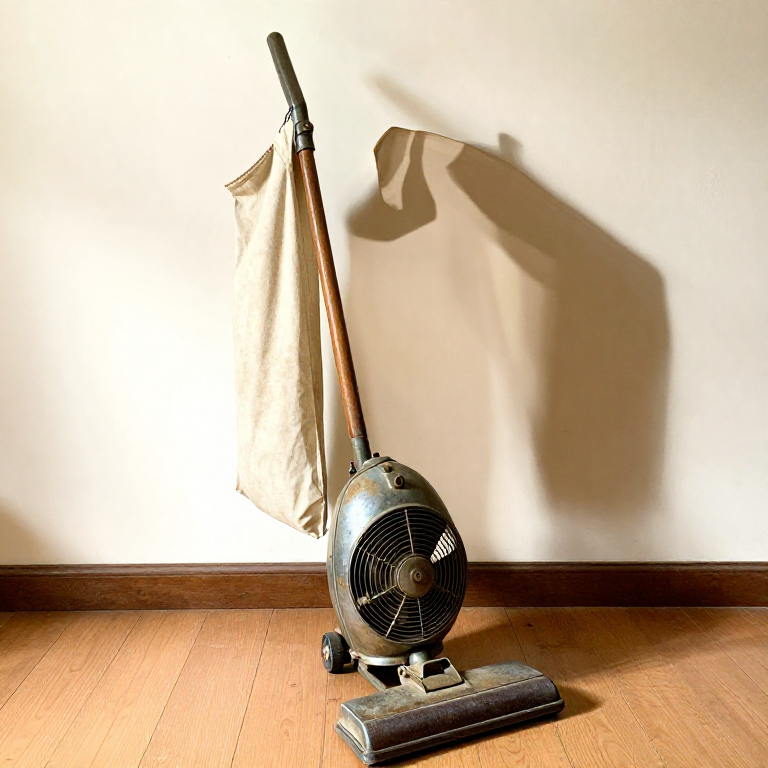


Spangler Vacuum Cleaner
A carpet sweeper pushes dust along. A brush lifts it, throws it forward, and most of it lands again — which is why sweeping a carpet makes the air taste of carpet.
James Spangler's machine removes the dust from the room instead of relocating it. A fan draws air through the carpet, a rotating brush loosens what suction alone cannot lift, and the dust-laden air is blown into a cloth bag that passes air and traps particles. Brush, fan and filter in one upright frame that one person can push.
Spangler was a department-store janitor in Canton, Ohio, whose asthma was aggravated by the dust his own sweeping raised. He built the first one from a soap box, an electric fan motor, a broom handle and a pillowcase. US Patent 889,823, "Carpet Sweeper and Cleaner", granted 2 June 1908 — and he sold it to his cousin's husband, William Hoover.
Instructions
Mains-powered rotating machinery needs guarding
Mains-powered rotating machinery needs guarding
Enclose the fan and the brush before powering anything, earth all metalwork, and never run it with the housing open.
Read US 889,823 and note the three functions
Read US 889,823 and note the three functions
Spangler claims brush, suction fan and dust receptacle combined in one portable frame. Each existed separately; the combination is the patent.
Sweep a carpet and watch the air
Sweep a carpet and watch the air
Brush a carpet in a sunbeam. The dust is airborne, not removed. That visible cloud is the failure Spangler was trying to stop breathing.
Test suction alone on embedded grit
Test suction alone on embedded grit
Work grit into a carpet and try a vacuum nozzle with no brush. Loose surface dust lifts; anything held by the pile stays. Suction alone is not enough.
Build a centrifugal fan, not a propeller
Build a centrifugal fan, not a propeller
Make a bladed impeller in a scroll housing. A centrifugal fan produces the pressure difference you need; an axial propeller moves lots of air at almost no suction.
Materials for this step:
 Mild Steel Sheet1 sheet
Tools needed:
 Metal File
Understand the two competing quantities
Understand the two competing quantities
Suction (pressure drop) lifts particles; airflow (volume) carries them to the bag. A machine with all pressure and no flow picks dust up and drops it in the hose.
Make a narrow floor nozzle
Make a narrow floor nozzle
Build a wide but thin intake slot. Narrowing the gap raises air velocity at the carpet, and velocity is what drags particles free.
Fit a rotating brush across the intake
Fit a rotating brush across the intake
Mount a bristled roller in the nozzle mouth. It agitates the pile and flicks embedded grit into the airstream where suction can take it.
Materials for this step:
 Hardwood Dowel Rods 1/4"1 piece
Drive the brush from the fan motor by belt
Drive the brush from the fan motor by belt
Run a belt from the motor shaft to the brush roller. One motor, two jobs — and the belt is a deliberate weak link that slips rather than stalling the motor.
Set the brush to just touch the pile
Set the brush to just touch the pile
Adjust the height so bristles graze the carpet. Pressed hard it wears the carpet and stalls the belt; too high and it does nothing at all.
Tools needed:
 Measuring Ruler
Put the bag on the OUTLET, not the inlet
Put the bag on the OUTLET, not the inlet
Blow the dirty air into the bag. Spangler's pillowcase was on the exhaust — the fan pushes air through the fabric, which passes air and holds dust.
Materials for this step:
 Cotton Muslin Cloth1 meter
Accept that the fan handles the dust
Accept that the fan handles the dust
In this layout debris passes through the impeller, so blades must be robust. Later machines filter before the fan instead, which protects the motor and costs suction.
Weigh what you collect
Weigh what you collect
Weigh the bag before and after cleaning a measured area. That mass is the only honest measure of the machine — noise and airflow are not.
Run it again with a half-full bag
Run it again with a half-full bag
Repeat the weighing test. Performance falls sharply as the bag loads, because the filter itself becomes the largest restriction in the system.
Compendium — a janitor with asthma
Compendium — a janitor with asthma
The patent. US 889,823, "Carpet Sweeper and Cleaner", granted 2 June 1908 to James Murray Spangler of Canton, Ohio. Spangler was a janitor in a department store and suffered from asthma that the dust of sweeping made worse. His prototype used a tin soap box for the fan housing, an electric fan motor, a broom handle for a grip and a pillowcase for the dust bag. He formed a company, could not raise capital, and sold the patent in 1908 to his cousin's husband, William H. Hoover, a leather-goods manufacturer — who kept Spangler on as superintendent and paid him a royalty. Hoover's name went on the machine; "to hoover" became a verb in British English for a device invented by a man almost nobody can name.
Suction and agitation are not interchangeable. Airflow through a carpet can only lift particles it can accelerate, and dust bound in pile fibres is held by friction and static forces that a practical pressure drop will not overcome. A rotating brush supplies mechanical agitation, breaking that grip and throwing particles into the airstream. This is why suction-only cleaners perform well on hard floors and poorly on carpet, and why the beater bar remains standard equipment more than a century later. Two mechanisms, one job.
Pressure versus flow. A vacuum cleaner needs both a pressure drop, to pull particles off the surface, and a volumetric flow rate, to carry them to the bag — and a fan trades one against the other. Sealed suction with no flow leaves debris sitting in the hose; high flow with little pressure passes over the dirt entirely. Manufacturers quote "air watts" precisely because neither number alone describes the machine. The centrifugal impeller in a scroll housing is chosen for this reason: it develops usable pressure, which an axial propeller does not.
Earlier machines existed and were unusable. Hubert Cecil Booth's 1901 British "Puffing Billy" was a genuine powered vacuum cleaner, but it was a horse-drawn petrol-engined unit parked in the street with hoses fed through the windows of the house. Ives McGaffey's 1869 "Whirlwind" was hand-cranked and required one hand to crank while the other pushed. Spangler's contribution was not suction — it was putting brush, fan, bag and motor into one frame light enough for one person to push around a room, which is the difference between a demonstration and a product.
Materials
3- 1 sheetPlaceholder
- 1 piecePlaceholder
- 1 meterPlaceholder
Related Blueprints
These blueprints share knowledge with this one — techniques, materials, or principles that connect them in the learning graph.

CC0 Public Domain
This blueprint is released under CC0. You are free to copy, modify, distribute, and use this work for any purpose, without asking permission.
Support the Maker by purchasing products through their Blueprint where they earn a Maker Commission set by Vendors, or create a new iteration of this Blueprint and include it as a connection in your own Blueprint to share revenue.