ART
BEAUTY & WELLNESS
CRAFT
CULTURE & HISTORY
ENTERTAINMENT
ENVIRONMENT
FOOD & DRINKS
REVERSE ENGINEERING
SCIENCES
SPORTS
TECHNOLOGY
WEARABLES
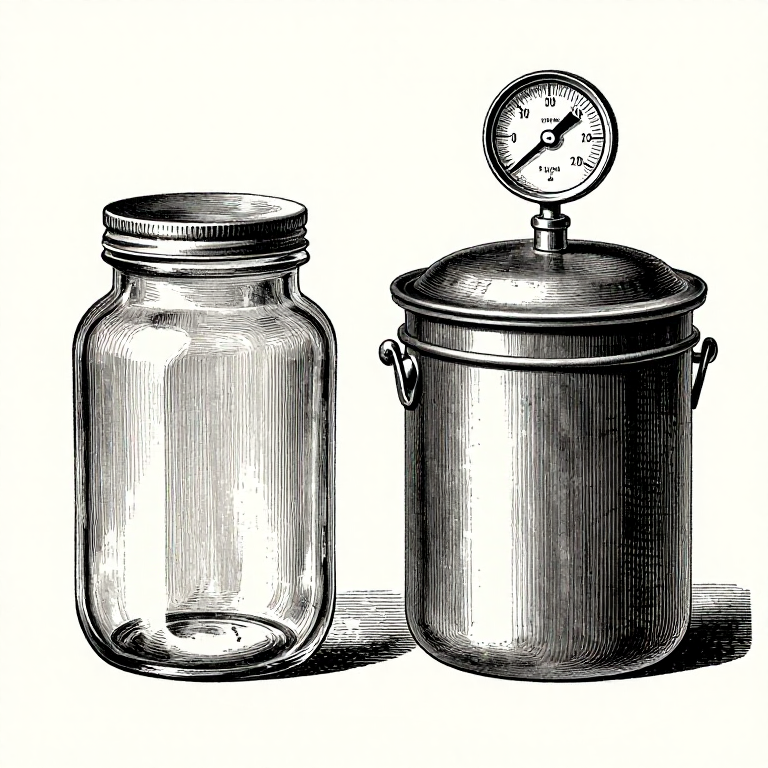


The Acid Line: Why Canning Splits at pH 4.6
A sealed jar is an oxygen-free container held at room temperature for months. That is an excellent preservation method and it is also the ideal habitat for *Clostridium botulinum*, whose spores survive boiling and whose toxin is among the most potent substances known.
One number decides which of those it will be. Below **pH 4.6** the organism cannot grow at all, and boiling water is sufficient. Above it, the spores themselves must be destroyed, and that requires a pressure canner — no amount of extra time at boiling point substitutes.
This rung is that line: which foods fall on which side, why the temperature matters more than the time, and what altitude does to the numbers. It is hazard-gated because getting the side wrong is the classic fatal error in home preserving.
Advanced
3 hours
Instructions
1
1
Which side is a food on, and how to be sure
Which side is a food on, and how to be sure
**High acid, pH 4.6 or below** — most fruit, jams and jellies, pickles in vinegar, properly acidified tomatoes, sauerkraut and other fully fermented vegetables. A boiling water bath is the correct and sufficient method.
**Low acid, above pH 4.6** — all vegetables, all meat, fish and poultry, soups, stocks, beans, corn, most plain tomatoes. A pressure canner is the only safe method. There is no water-bath recipe for these that is safe, whatever its age or its source.
**Measure, do not assume.** A food-grade pH meter calibrated with buffer solutions is the reliable tool; strips are indicative but hard to read against a coloured food. Measure the finished product at room temperature, not the ingredients.
**Tomatoes deserve their own warning.** They sit within a tenth of a unit of the line, and modern varieties are bred less acidic than old ones. This is why every current recipe adds bottled lemon juice or citric acid to canned tomatoes, and why a family recipe from a century ago can be unsafe with today's fruit. Use bottled lemon juice rather than fresh — its acidity is standardised and fresh fruit varies.
Materials for this step:
 Citric Acid1 piece
 Canning Jars (Mason)6 pieces
Tools needed:
 Food-Grade pH Meter
 pH Strips
2
2
The numbers behind the split
The numbers behind the split
Loading Jupyter Notebook...
Tools needed:
 Desktop Computer
3
3
Acidifying deliberately, and where fermentation fits
Acidifying deliberately, and where fermentation fits
A low-acid food can be moved across the line on purpose, and then treated as a high-acid one. Three routes:
**Vinegar.** Pickling uses vinegar of a known strength, normally 5% acetic acid. The ratio of vinegar to water in a published pickle recipe is a safety calculation, not a flavour preference — diluting it further is exactly the change that makes a pickle unsafe.
**Bottled lemon juice or citric acid.** The standard addition for tomatoes. Bottled, because its acidity is standardised.
**Fermentation.** Lactic acid bacteria convert sugars to lactic acid and take a vegetable down to pH 3.4 or so on their own. That is how sauerkraut, kimchi and many pickles were made before vinegar was cheap, and it is genuinely safe — but only once the fermentation has actually finished. A half-fermented vegetable is a low-acid food.
In every case: **measure the finished pH.** A recipe predicts it; a meter confirms it. The one is worth having for exactly this.
Materials for this step:
Citric Acid1 piece Lactic Acid (food-grade)1 piece
 Salt1 pieceCanning Jars (Mason)6 pieces
Tools needed:
Food-Grade pH Meter Digital Kitchen Scale
 Large Pot (lower, for water bath)
4
4
Warning signs, and the rule that overrides everything
Warning signs, and the rule that overrides everything
**Botulism toxin has no taste, no smell and no appearance.** A jar containing it can look, smell and taste perfectly normal. That is the fact that makes this different from ordinary spoilage, and it is why the procedure has to be right rather than checked at the end.
Signs that a jar is definitely bad — none of which are required for it to be dangerous:
* a lid that has lost its seal, or bulges, or springs back when pressed
* liquid spurting out on opening
* rising bubbles, cloudiness, or an unexpected colour
* any mould, on the surface or under the lid
* a smell that is not the smell of the food
**If a low-acid jar is doubtful in any way, do not taste it.** Tasting is the single most dangerous thing a person does with a suspect jar. Dispose of it sealed, and wash anything it touched.
**Boiling low-acid home-canned food for 10 minutes before eating destroys the toxin** even though it does not destroy the spores, and it is a recommended precaution for home-canned vegetables. It is a second line of defence and it does not make an incorrectly processed jar safe.
Follow a tested recipe from a current source, with current processing times. This is the one area of cooking where improvising has killed people.
Materials for this step:
Canning Jars (Mason)6 piecesTools needed:
Food-Grade pH Meter Pressure Cooker
Materials
4- 1 piecePlaceholder
- 6 piecesPlaceholder
- 1 piecePlaceholder
- 1 piecePlaceholder
Tools Required
6- Placeholder
- Placeholder
- Placeholder
- Placeholder
- Placeholder
- Placeholder
Related Blueprints
These blueprints share knowledge with this one — techniques, materials, or principles that connect them in the learning graph.




CC0 Public Domain
This blueprint is released under CC0. You are free to copy, modify, distribute, and use this work for any purpose, without asking permission.
Support the Maker by purchasing products through their Blueprint where they earn a Maker Commission set by Vendors, or create a new iteration of this Blueprint and include it as a connection in your own Blueprint to share revenue.