ART
BEAUTY & WELLNESS
CRAFT
CULTURE & HISTORY
ENTERTAINMENT
ENVIRONMENT
FOOD & DRINKS
REVERSE ENGINEERING
SCIENCES
SPORTS
TECHNOLOGY
WEARABLES
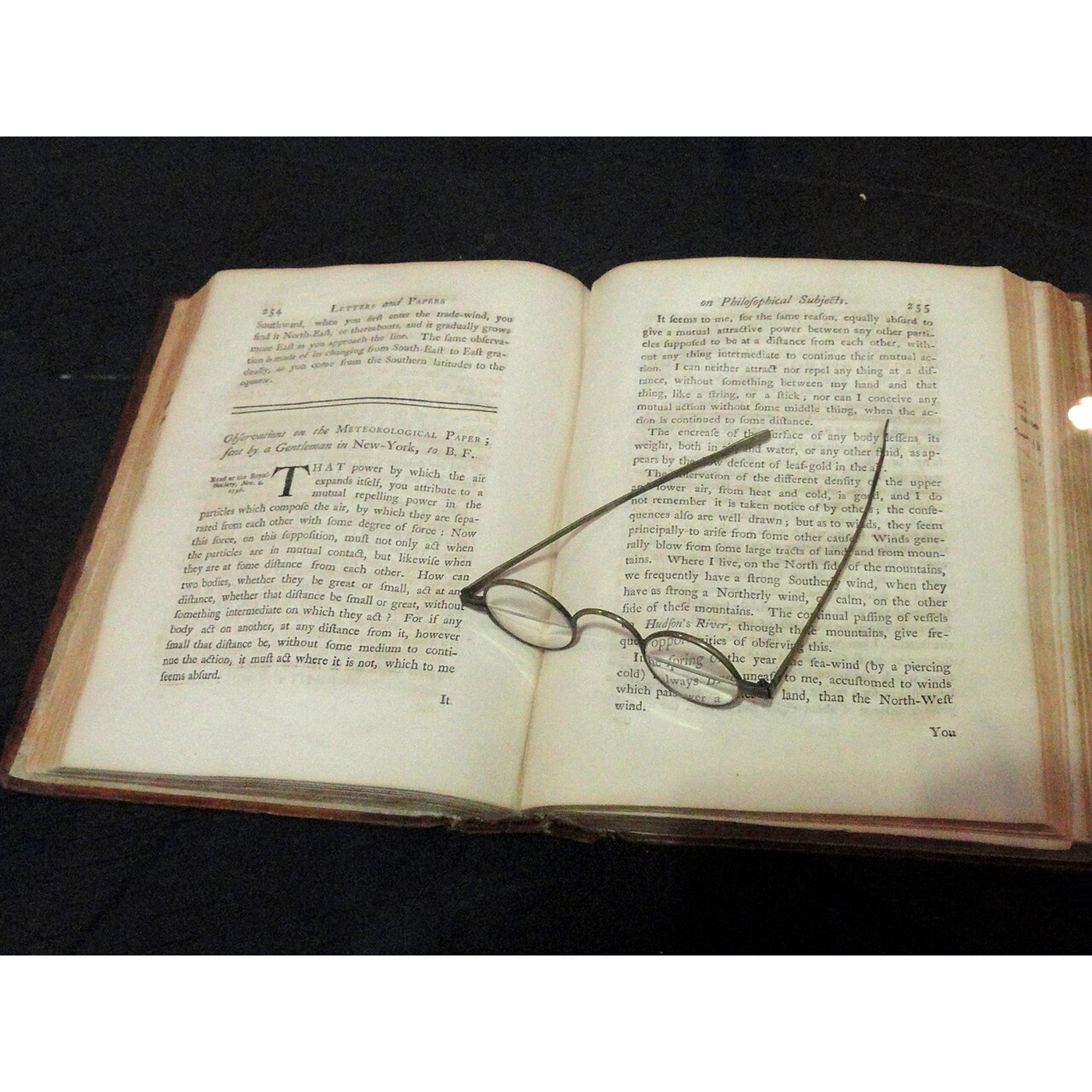


The Bifocal Lens: Two Pairs of Spectacles Cut in Half
With age the eye loses its power to focus near. Someone who already wears glasses for distance then needs a second pair for reading, and must swap them every time they look from the page to a face across the table.
Benjamin Franklin had his optician cut the lenses of his distance and reading spectacles in half and mount the halves together in one frame, distance on top and reading below. In a letter to George Whatley of 23 May 1785 he described these "double spectacles" and how useful he found them at dinner in France, where he could see both his food and the faces of those he talked to. He patented none of his inventions.
This rung works out why a reading addition is needed and how big, explains the image jump at a segment's edge, and builds a bench bifocal from two lenses and a camera.
Beginner
About 2 hours
Instructions
1
1
Accommodation, the reading add and image jump
Accommodation, the reading add and image jump
Loading Jupyter Notebook...
2
2
The single lens it splits
The single lens it splits
A bifocal is two spectacle lenses in one frame. The embedded blueprint covers the single convex and concave lenses it is made from.
3
3
Build a bench bifocal
Build a bench bifocal
Stand a digital camera on a table with its focus locked at infinity: that is the aged eye, which can no longer focus near. Put a newspaper page 40 cm in front of it and a poster across the room behind.
From a convex lens set pick a weak lens for 'distance' — about +0.5 D (f = 2 m) — and for 'reading' a lens 2.5 D stronger than that, about +3.0 D (f ≈ 33 cm): the 2.5 D difference is the reading add for 40 cm. Cut a card frame, mount the weak lens in the top half of the window and the strong one in the bottom half, each masked with tape so only its half shows: Franklin's split.
Photograph through the top half: the distant poster is sharp, the page blurred. Lower the frame and shoot through the bottom half: the page is sharp. Move the frame slowly across the dividing line and watch whether the scene jumps.
Materials for this step:
 Convex Lens Set1 piece
 Corrugated Cardboard Sheets1 piece
Tools needed:
 Digital Camera
 Steel Ruler
 Tape Measure
4
4
Bifocals that are hard to use
Bifocals that are hard to use
Common complaints with bifocals, and their usual causes.
Flow
Loading...
5
5
History and honest limits
History and honest limits
**Benjamin Franklin** described his "double spectacles" in a letter to **George Whatley** dated 23 May 1785. Fused and one-piece bifocals, in which the reading segment is melted into or ground from the main lens, replaced the split lens in the nineteenth and twentieth centuries, and progressive lenses later blended the zones together.
**Honest limits.** Hofstetter's formulas describe averages; an individual's amplitude varies widely, and prescribing is for an optometrist. The bench bifocal shows the principle with a camera, not a prescription for anyone's eyes.
Materials
2- 1 piecePlaceholder
- 1 piecePlaceholder
Tools Required
3- Placeholder
- Placeholder
- Tape Measure3% commissionMagento Legacy Storeships internationallyPlaceholder
Related Blueprints
These blueprints share knowledge with this one — techniques, materials, or principles that connect them in the learning graph.
CC0 Public Domain
This blueprint is released under CC0. You are free to copy, modify, distribute, and use this work for any purpose, without asking permission.
Support the Maker by purchasing products through their Blueprint where they earn a Maker Commission set by Vendors, or create a new iteration of this Blueprint and include it as a connection in your own Blueprint to share revenue.