ART
BEAUTY & WELLNESS
CRAFT
CULTURE & HISTORY
ENTERTAINMENT
ENVIRONMENT
FOOD & DRINKS
REVERSE ENGINEERING
SCIENCES
SPORTS
TECHNOLOGY
WEARABLES



The Counter Lever Cork Extractor: A Spring Sets the Screw, a Tap on the Lever Draws the Cork
Behind a busy counter, every cork drawn by hand takes both hands and a strong pull, and then has to be picked off the corkscrew.
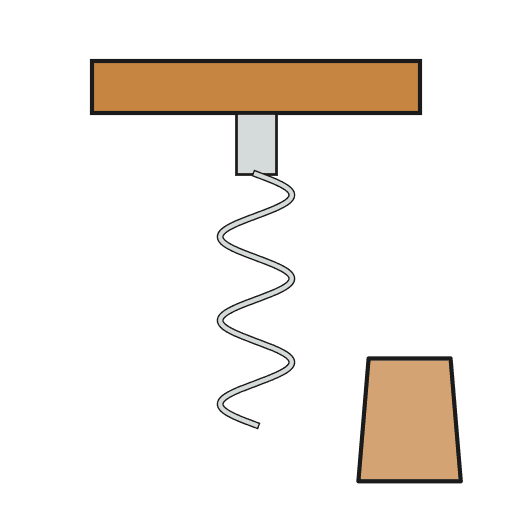
Joseph P. Miers and John Groendyke of Lebanon, New Jersey, received US 41,385, dated 26 January 1864, for a machine that stands on the counter: a frame with a cross-bar that holds the bottle down, a carriage sliding in the frame's grooved uprights, a shaft turning in the carriage with a corkscrew on its end, a spring that presses them down, and a hand-lever whose forked end lifts the carriage. A few turns set the screw, "a slight pressure or tap of the hand on the lever F causes the cork to fly out", and blades on the shank split each cork when the next one pushes it up, so it drops off by itself.
This rung works out the lift of the lever against the spring, with a work check, then builds the machine in hardwood and steel and draws a run of corks.
Advanced
About 8 hours
Instructions
1
1
Lever against spring
Lever against spring
Loading Jupyter Notebook...
2
2
A frame corkscrew before it
A frame corkscrew before it
The embedded blueprint stands a frame on the bottle and lifts the cork with the screw itself. Miers and Groendyke fix the frame to the counter and lift with a lever.
3
3
Read US 41,385
Read US 41,385
"D is the corkscrew, which is rigidly attached to or made solid with the shaft C, and the stem or shank of this corkscrew terminates in two or more cutting-blades, E, intended to split the corks after they have been removed from the bottle, and to cause them to drop off from the corkscrew spontaneously and without the aid of the operator. F is a hand-lever, which is pivoted to one of the uprights a, and the forked end of which straddles the shaft C and bears on the under side of the carriage B."
"The operation is as follows: The bottle from which the cork is to be removed is adjusted under the cross-bar b, and the shaft C and the carriage are raised to the position shown in Fig. 1. The point of the corkscrew being depressed by the action of the spring d will readily enter the cork as soon as a rotary motion is imparted to the shaft C. A few revolutions of this shaft are sufficient to give to the corkscrew a firm hold in the cork, and a slight pressure or tap of the hand on the lever F causes the cork to fly out, the bottle being retained by the cross-bar b. The next cork to be removed forces the first up against the cutting-blades E, so that the same is split and caused to drop off spontaneously and without the aid of the operator."
4
4
Build the machine and draw a run of corks
Build the machine and draw a run of corks
**Frame.** Screw two 45 cm hardwood uprights to a hardwood base 8 cm apart and join their tops with a cross piece. Glue hardwood strips inside the uprights' upper half as grooves for the carriage. Fix a cross-bar between them at the height of a bottle's lip, with a hole the cork passes through but the neck does not.
**Carriage and shaft.** Cut a hardwood block that slides in the grooves and drill it for a 10 mm steel rod. Pass the rod through the top piece and the carriage, and fix a nut and washer on each side of the carriage so the rod turns in it but cannot slide through it. Bend or fix a flat-bar crank at the rod's top. Fit a compression spring round the rod between the top piece and the carriage.
**Corkscrew and blades.** Wind 2 mm steel wire round the rod's lower end as a helix and silver-solder it on. Silver-solder two small flat-bar blades across the shank just above it and file their upper edges sharp.
**Lever.** Cut a 40 cm hardwood lever, fork one end round the rod under the carriage, and pivot it on a bolt through one upright.
**Test.** Cork several bottles of water with the corking kit. Stand one under the cross-bar, lift the carriage with the lever and let the spring set the screw on the cork, turn the crank a few times, then tap the lever. Draw the next cork and see the first split on the blades and drop off.
Materials for this step:
 Hardwood Board2 pieces
 Hardwood Block1 piece
 Wood Screws12 pieces
 Wood Glue1 piece
 Mild Steel Rod0.6 meter
 Hex Nut2 pieces
 Flat Washer2 pieces
 Compression Spring Assortment1 piece
 Steel Wire0.4 meter
 Silver Solder Set (Easy/Medium/Hard)1 piece
 Flux1 piece
 Mild Steel Flat Bar0.2 meter
 Hex Bolt Assortment1 piece
 Glass Bottle (Clear)4 pieces
 Corks4 pieces
 Water3 liters
Tools needed:
 Hand Saw
 Chisel Set - Wood
 Cordless Drill
 Drill Bit Set
 Screwdriver Set
 Clamps
 Hacksaw
 Files (Hand File)
 Bench Vise
 Propane Torch
 Adjustable Wrench
 Wine Bottle Corking Kit
 Clear Safety Glasses
 Leather Work Gloves
5
5
A machine that jams, slips or will not throw the cork
A machine that jams, slips or will not throw the cork
Counter lever cork extractor troubleshooting.
Flow
Loading...
6
6
History and honest limits
History and honest limits
**Joseph P. Miers and John Groendyke** of Lebanon, Hunterdon County, New Jersey, received US 41,385, dated 26 January 1864. Their frame A of wood or other material was fastened to the counter, and they allowed a weight in place of the spring, or its place changed. Their claims cover the hand-lever with the corkscrew on the sliding rotary spring-shaft, the sliding carriage with the shaft, corkscrew and lever, and the cutting blades with the corkscrew.
**Honest limits.** Hardwood, a steel rod and a wound wire helix stand in for their machine's parts, and the sizes are not theirs. The notebook ignores friction and the cork's own grip; its forces, lengths and spring are examples. Your run of corks is the result.
Materials
16- 2 piecesPlaceholder
- 1 piecePlaceholder
- 12 piecesPlaceholder
- 1 piecePlaceholder
- 0.6 meterPlaceholder
- 2 piecesPlaceholder
- 2 piecesPlaceholder
- Placeholder
- 0.4 meterPlaceholder
- 1 piecePlaceholder
- 1 piecePlaceholder
- 0.2 meterPlaceholder
- 1 piecePlaceholder
- 4 piecesPlaceholder
- 4 piecesPlaceholder
- 3 litersPlaceholder
Tools Required
14- Placeholder
- Placeholder
- Cordless Drill3% commissionMagento Legacy Storeships internationallyPlaceholder
- Placeholder
- Placeholder
- Placeholder
- Placeholder
- Placeholder
- Placeholder
- Placeholder
- Placeholder
- Placeholder
- Placeholder
- Placeholder
This blueprint makes
Related Blueprints
These blueprints share knowledge with this one — techniques, materials, or principles that connect them in the learning graph.



CC0 Public Domain
This blueprint is released under CC0. You are free to copy, modify, distribute, and use this work for any purpose, without asking permission.
Support the Maker by purchasing products through their Blueprint where they earn a Maker Commission set by Vendors, or create a new iteration of this Blueprint and include it as a connection in your own Blueprint to share revenue.