ART
BEAUTY & WELLNESS
CRAFT
CULTURE & HISTORY
ENTERTAINMENT
ENVIRONMENT
FOOD & DRINKS
REVERSE ENGINEERING
SCIENCES
SPORTS
TECHNOLOGY
WEARABLES


The Double-Hook Label Standard: A Label That Cannot Turn Edgewise
A metal label hung on a stick by one hole turns in the wind, shows the reader its edge, and sooner or later blows off.
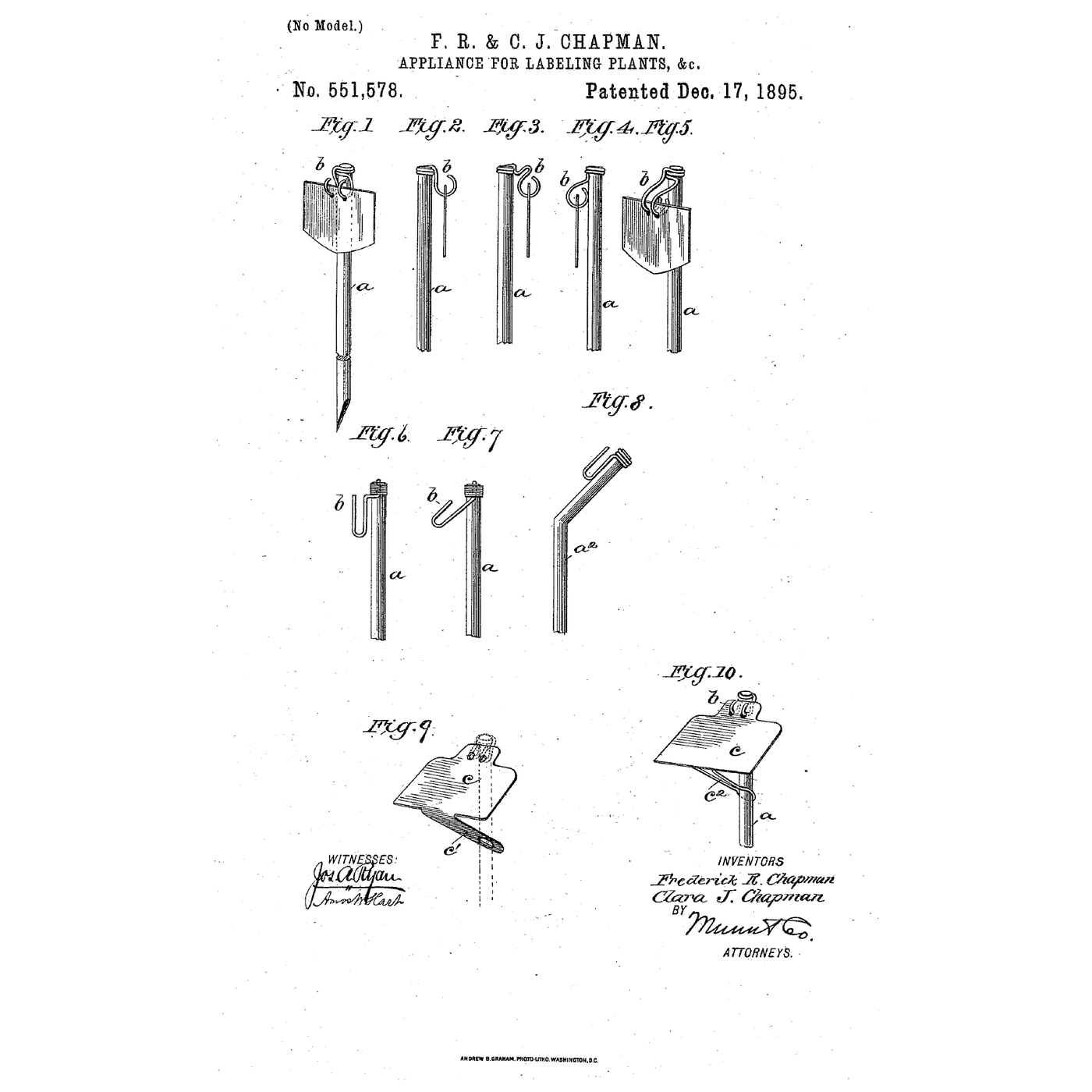
Frederick Revans Chapman and Clara Jane Chapman of Dunedin, New Zealand, received US 551,578, dated 17 December 1895, for an appliance for labelling plants: a standard with "a double or multiple hook capable of carrying any suitable label", made from "the ends of a flexible wire" coiled round the standard's head. "The label, owing to the hook being double, is held with its face always in one direction, since it cannot turn edgewise."
This rung works out how far wind swings a label on one hook, then makes a steel standard with a double wire hook and compares it with a single hook in front of a fan.
Beginner
About 2 hours
Instructions
1
1
Wind push against label weight
Wind push against label weight
Loading Jupyter Notebook...
2
2
Bending and twisting the wire
Bending and twisting the wire
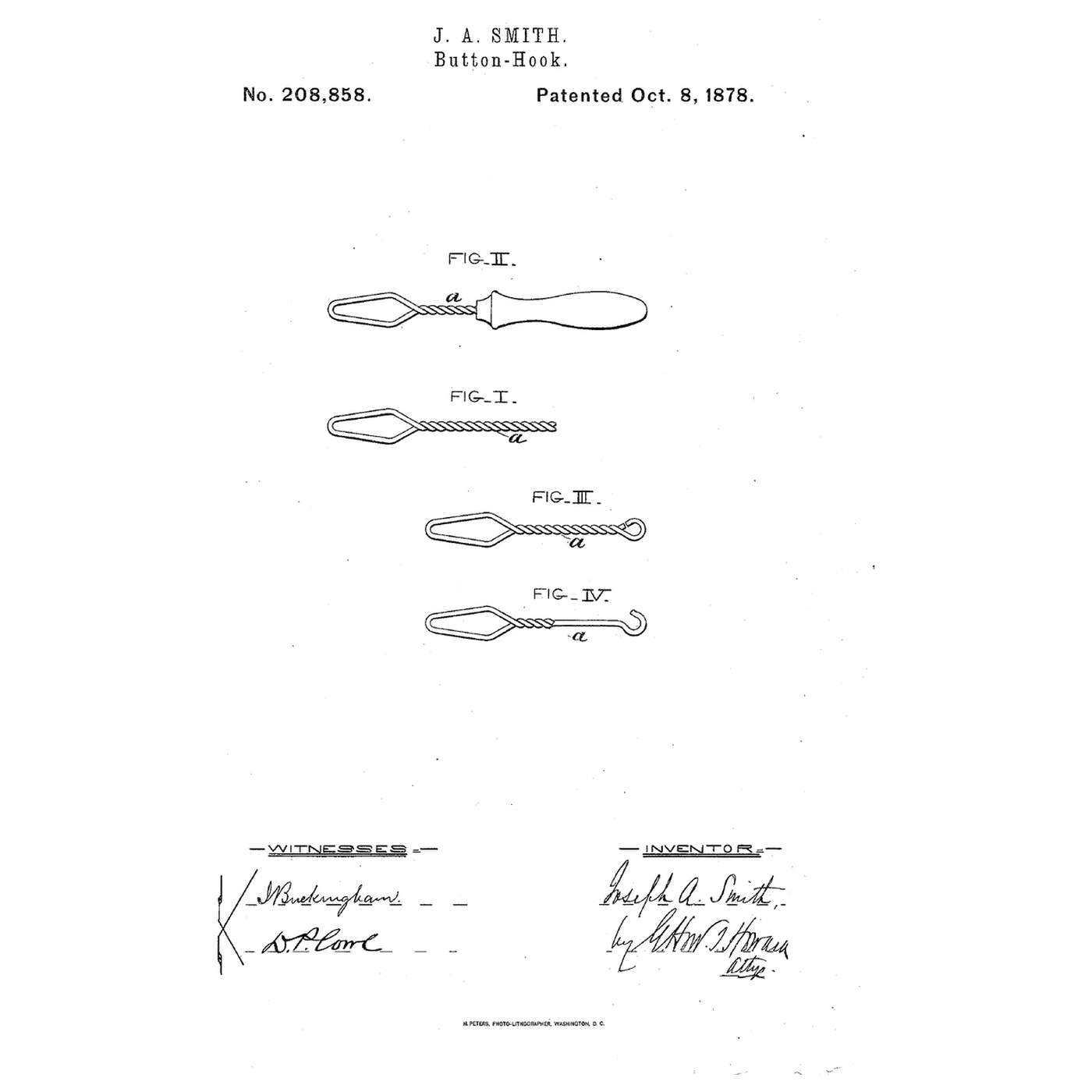
The embedded blueprint bends and twists one wire into a tool. The Chapmans' double hook is made the same way, from one wire wound round the head of the standard.
3
3
Read US 551,578
Read US 551,578
"The double hook b is composed of two hooks, (see Figs. 1 to 5, inclusive,) formed of the ends of a flexible wire which is secured at the head of or in any suitable position upon the standard a".
"When it is desired to use a permanent label, as for trees in botanical gardens, the curved ends of the hooks may be bent over and carried in farther toward the standard or rod a, so as to close the hooks and render the label incapable of being removed save by means of pliers."
4
4
Make two standards and test them in wind
Make two standards and test them in wind
**Standards.** Cut two 40 cm lengths of 6 mm mild steel rod and file one end of each to a point.
**Hooks.** Cut 30 cm of 1.6 mm galvanised steel wire. With the flat-nose pliers, wind its middle three times tightly round one rod 5 mm below the top so the two ends stand out on either side. Bend each end up and back over into a hook with the round-nose pliers, the hooks 25 mm apart. Make the second standard the same, then cut one hook off it with the cutting pliers.
**Labels.** Cut two plates 80 × 50 mm from aluminium sheet with the tin snips, file the corners round and drill two 3 mm holes 25 mm apart near the top edge. Write the plant's name on each with the marker.
**Test.** Push both standards into a pot of soil 1 m in front of the box fan and hang a label on each. At each fan setting read the wind speed at the labels with the anemometer, and measure each label's swing from hanging straight with the protractor. Compare with the notebook. Then press the recurved hook ends down toward the rod with your thumb and check the label can no longer be lifted off.
Materials for this step:
 Mild Steel Rod0.8 meter
 Galvanised Steel Wire0.6 meter
 Aluminium Sheet1 piece
 Garden Soil3 liters
Tools needed:
 Hacksaw
 Files (Hand File)
 Flat-Nose Pliers
 Round-nose Pliers
 Diagonal Cutting Pliers
 Tin Snips
 Cordless Drill
 Drill Bit Set
 Permanent Marker
 Ruler
Ruler Flower Pot
 Box Fan (Variable Speed)
 Handheld Anemometer
 Protractor
 Leather Work Gloves
 Clear Safety Glasses
5
5
A label that swings, turns or blows off
A label that swings, turns or blows off
Double-hook label standard troubleshooting.
Flow
Loading...
6
6
History and honest limits
History and honest limits
**Frederick Revans Chapman and Clara Jane Chapman** of Dunedin, New Zealand, filed US 551,578 on 8 April 1895; it is dated 17 December 1895. Their standard could be branched at the foot, clipped to a pot's edge or bent at an obtuse angle, and their own label had a brace bent from the plate so the standard held it "at an angle of about forty-five degrees". The double hook took "labels of metal or other substance, such as are now in use", "especially light zinc labels".
**Honest limits.** Aluminium stands in for zinc, and the wire is wound, not soldered. The notebook assumes the wind stays square to the label's face, so its swing is an upper bound; the sizes and wind speeds are examples. Your fan readings are the result.
Materials
4- 0.8 meterPlaceholder
- 0.6 meterPlaceholder
- 1 piecePlaceholder
- 3 litersPlaceholder
Tools Required
16- Placeholder
- Placeholder
- Placeholder
- Placeholder
- Placeholder
- Placeholder
- Cordless Drill3% commissionMagento Legacy Storeships internationallyPlaceholder
- Placeholder
- Placeholder
- Placeholder
- Placeholder
- Placeholder
- Placeholder
- Placeholder
- Placeholder
- Placeholder
Related Blueprints
These blueprints share knowledge with this one — techniques, materials, or principles that connect them in the learning graph.




CC0 Public Domain
This blueprint is released under CC0. You are free to copy, modify, distribute, and use this work for any purpose, without asking permission.
Support the Maker by purchasing products through their Blueprint where they earn a Maker Commission set by Vendors, or create a new iteration of this Blueprint and include it as a connection in your own Blueprint to share revenue.