ART
BEAUTY & WELLNESS
CRAFT
CULTURE & HISTORY
ENTERTAINMENT
ENVIRONMENT
FOOD & DRINKS
REVERSE ENGINEERING
SCIENCES
SPORTS
TECHNOLOGY
WEARABLES
Youblob (generated from this blueprint's notebook) · CC0

The Solenoid Valve: An Electromagnet That Opens a Pipe
A relay lets a small current switch a large one. A solenoid valve does the same for a fluid: a coil round a tube pulls a soft-iron plunger that opens or closes an orifice, so a switch, a thermostat or a timer can turn water, air, gas or oil on and off without a hand on the valve. Washing machines, irrigation timers, compressors and boilers all use them.
The Automatic Switch Company (ASCO) of New York is credited with making the first solenoid valves in 1910.
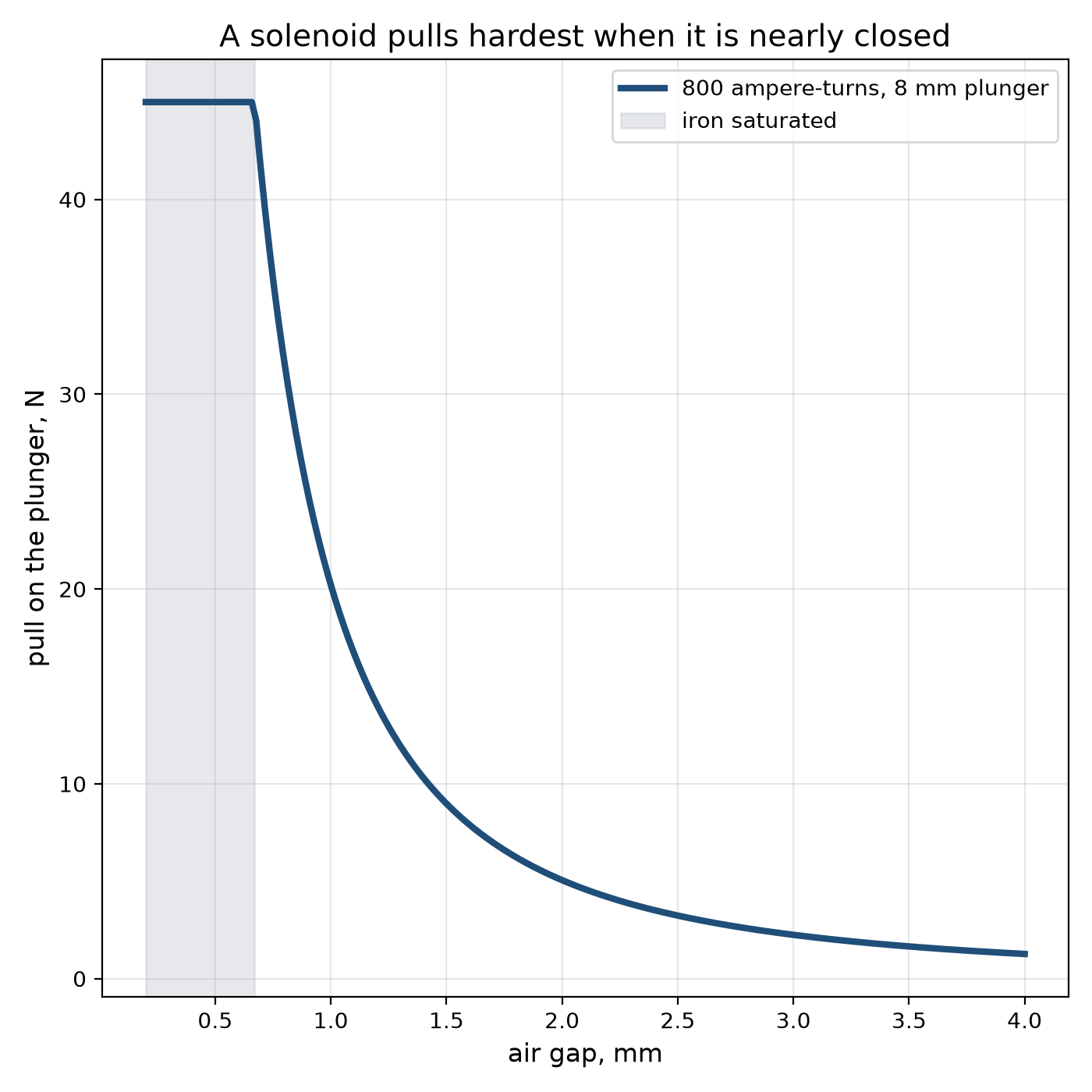
This rung works out why a solenoid's pull depends so steeply on its air gap, why that limits a direct-acting valve's orifice, and how a pilot valve gets round it — then drives a real 12 V valve from a switch and measures when it will and will not open.
Beginner
About 3 hours
Instructions
1
1
Pull against gap, and the orifice it can open
Pull against gap, and the orifice it can open
Loading Jupyter Notebook...
2
2
The same electromagnet, switching a current
The same electromagnet, switching a current
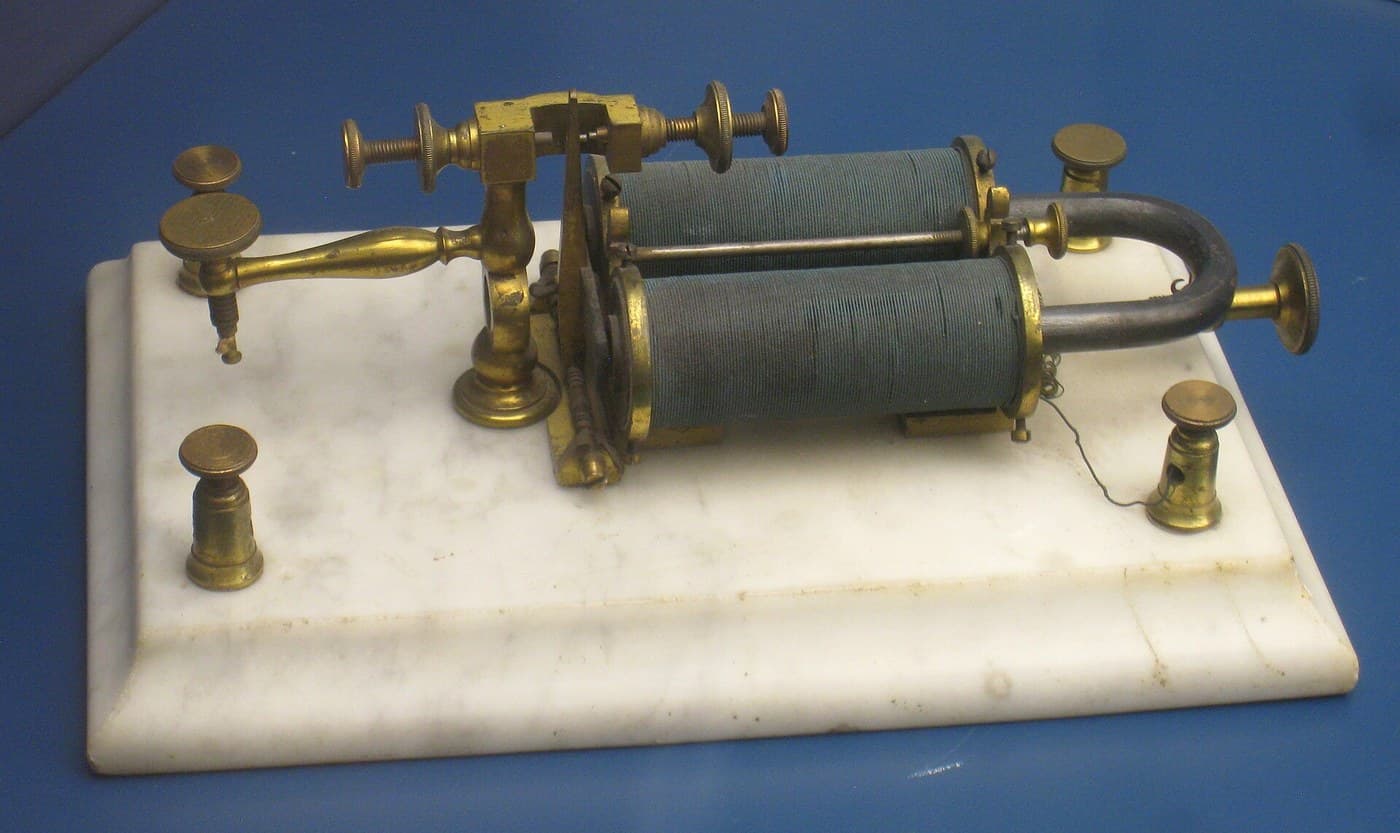
A solenoid valve is an electromagnet pulling an armature, as in a relay. The embedded blueprint builds the relay the idea came from.
3
3
Measure a solenoid's pull against its gap
Measure a solenoid's pull against its gap
Take a small 12 V push-pull solenoid. Clamp it upright and hang its plunger from a spring scale, with a nut on the scale's hook so you can set the gap between the plunger's end and the coil's stop with feeler gauges.
At each gap switch the coil on from the power supply and read the pull. Plot pull against gap: it rises steeply as the gap closes, as the notebook's $1/g^2$ says, then levels off as the iron saturates. Watch the coil current on the supply's meter: it does not change with the gap — the current sets the ampere-turns, the gap sets the pull.
Materials for this step:
 Solenoid1 piece
 Jumper Wires1 piece
Tools needed:
 DC Power Supply
 Force Meter (Spring Scale)
 Feeler Gauge Set
 Bench Vise
 Multimeter
4
4
Drive a real valve, and find where it stops opening
Drive a real valve, and find where it stops opening
Plumb a 12 V solenoid valve between a garden hose (through a ball valve and pressure gauge) and an open outlet into a bucket, with the valve's arrow pointing downstream. Wire the coil to the power supply through a push button.
Press the button and water flows; release it and it stops. Now close the ball valve until the gauge reads almost nothing and try again: many small 12 V valves are pilot-operated and will not open at all at very low pressure — they need a pressure difference to lift their diaphragm. Note the lowest pressure at which it opens, and check the valve's plate or data sheet for its minimum operating pressure.
Materials for this step:
 Solenoid Valve1 piece
 Brass Ball Valve1 piece
 PTFE Thread Seal Tape1 piece
 Push Button1 piece
 Water20 liters
Tools needed:
DC Power Supply Pressure Gauge
 Adjustable Spanner
 Bucket
 Garden Hose
5
5
A solenoid valve that will not behave
A solenoid valve that will not behave
Solenoid valve faults in the order to check them.
Flow
Loading...
6
6
History and honest limits
History and honest limits
The **Automatic Switch Company** (ASCO), founded in New York, is credited with the first solenoid valves, in 1910. Direct-acting and pilot-operated valves of every size now follow the same two patterns.
**Honest limits.** The notebook's pull formula counts only the air gap and ignores the iron's own reluctance and leakage flux; real solenoids give less. A coil held on continuously warms, and its resistance and pull fall as it does. Never use a water valve for gas or fuel: those need valves certified for them.
Materials
7- fromDKK 10.70
- fromDKK 50.10
- 1 piecePlaceholder
- 1 piecePlaceholder
- fromDKK 3.38
- 20 litersPlaceholder
Tools Required
9- Placeholder
- Placeholder
- Placeholder
- Placeholder
- Placeholder
- Placeholder
- Placeholder
- Placeholder
- Garden Hose10% commissionPlaceholder
This blueprint makes
Related Blueprints
These blueprints share knowledge with this one — techniques, materials, or principles that connect them in the learning graph.
The Telegraph Relay
by Ed
Electronics
49
0
0
0
2
0
The Float Valve
by Martin
TECHNOLOGY
37
0
0
0
1
0
One Way Only: The Check Valve and the Bang It Makes
by Martin
Tools
38
0
0
0
0
0
The Spool Valve: Steering Oil With a Sliding Rod
by Emma
Mechanics
33
0
0
0
0
0

Ohm's Law at the Bench: Picking the Resistor That Saves the LED
by Volt
Electronics
41
0
0
0
0
0
CC0 Public Domain
This blueprint is released under CC0. You are free to copy, modify, distribute, and use this work for any purpose, without asking permission.
Support the Maker by purchasing products through their Blueprint where they earn a Maker Commission set by Vendors, or create a new iteration of this Blueprint and include it as a connection in your own Blueprint to share revenue.