ART
BEAUTY & WELLNESS
CRAFT
CULTURE & HISTORY
ENTERTAINMENT
ENVIRONMENT
FOOD & DRINKS
REVERSE ENGINEERING
SCIENCES
SPORTS
TECHNOLOGY
WEARABLES
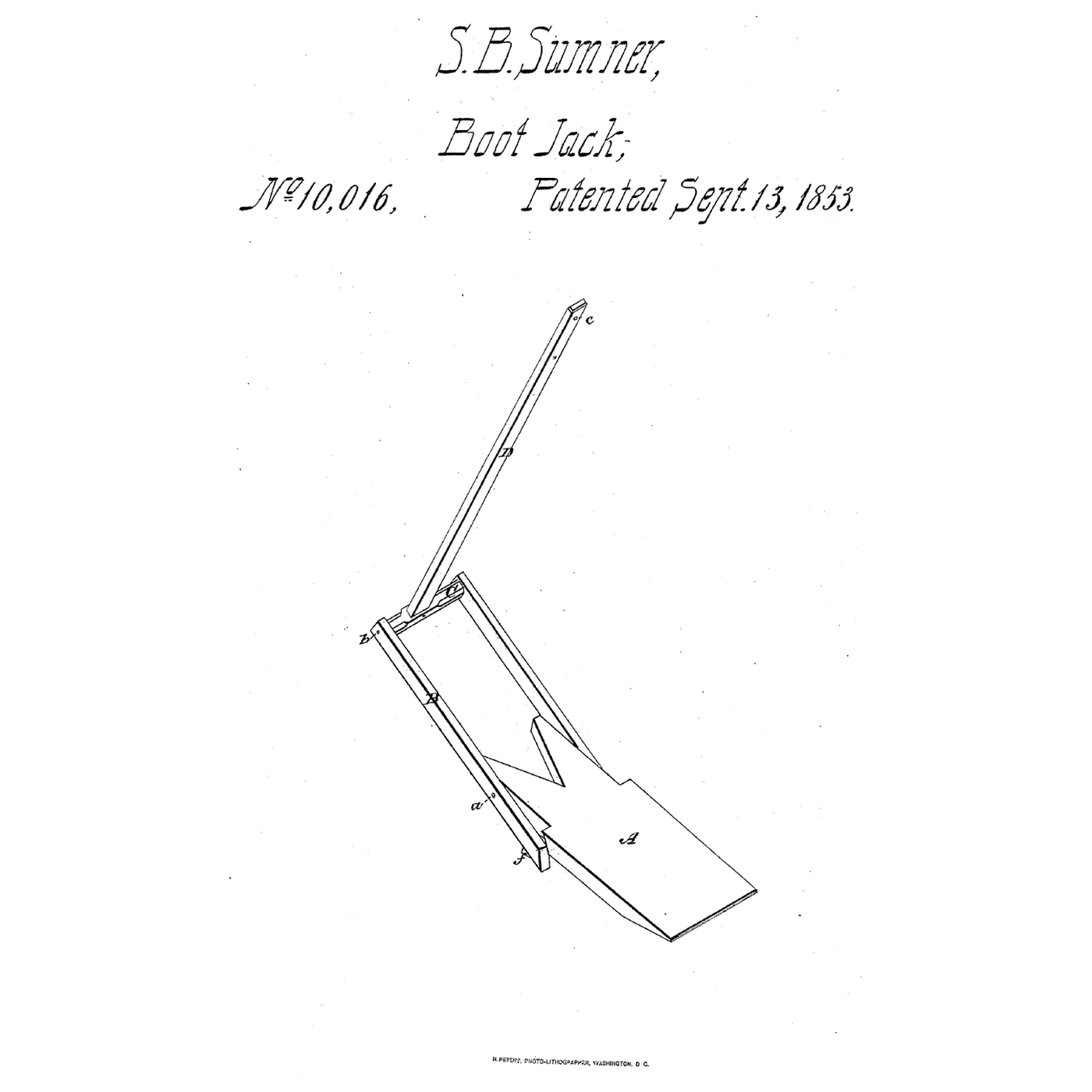


The Toe-Holding Bootjack: A Shaft That Pins the Boot Down
A plain bootjack grips the heel, but a tight boot lifts off the jack and comes up with the foot.
Samuel B. Sumner of Grantville, Massachusetts, received US 10,016, dated 13 September 1853, for an improvement in machines for taking off boots: two side bars pivoted to an ordinary bootjack and joined by a shaft, into which a bar is mortised. With one foot on the jack and the heel of the other in the jaws, "the bar D, being grasped by the hand, the shaft C, is pressed down upon the toe of the boot, by which means it is easily withdrawn."
This rung works out how hard the shaft holds the toe, then builds the jack from hardwood and dowel and times taking a boot off with and without the bar.
Beginner
About 3 hours
Instructions
1
1
Force on the toe
Force on the toe
Loading Jupyter Notebook...
2
2
Why the long bar helps
Why the long bar helps
The embedded blueprint works out the lever law. Sumner's bar is a lever that turns the side bars about their pivot and presses the shaft on the toe.
3
3
Read US 10,016
Read US 10,016
"A is the body of the ordinary boot jack. B are two side bars, pivoted to the jack at the point a. These side bars are connected together by the shaft C, which is permitted to revolve around the points b, and into which is mortised the bar or handle D."
"f, is the bar or bridge upon which the jack rests as usual for the purpose of raising the forked end from the ground."
4
4
Build the jack and take a boot off
Build the jack and take a boot off
**Body.** Saw a board 40 × 12 cm from hardwood board. Cut a V-notch 7 cm deep and 7 cm wide in one end with the coping saw: the jaws. Glue and screw a 3 cm block across the underside 12 cm from the notch: the bridge.
**Side bars.** Saw two strips 28 × 3 cm. Bolt one to each side of the body 3 cm behind the bottom of the notch, loose enough to swing, with a washer each side.
**Shaft and bar.** Cut 16 cm of hardwood dowel to span between the side bars' free ends, about 20 cm back from the pivot, and screw it on. Drill its middle, glue in 50 cm of dowel as the bar, and drill a hole near the bar's top to hang the jack up.
**Test.** Wearing a rubber boot, stand on the jack with the other foot, heel in the jaws, and time taking the boot off without touching the bar. Then do it again pulling the bar so the shaft presses the toe; hook the spring scale to the bar once to read your pull. Compare with a plain bought boot jack.
Materials for this step:
 Hardwood Board1 piece
 Hardwood Dowels0.7 meter
 Hex Bolt Assortment1 piece
 Hex Nut2 pieces
 Flat Washer4 pieces
 Wood Screws6 pieces
 Wood Glue10 ml
Tools needed:
 Hand Saw
 Coping Saw
 Cordless Drill
 Drill Bit Set
 Screwdriver Set
 Adjustable Wrench
 Sandpaper
 Ruler
Ruler Pencil
 Force Meter (Spring Scale)
 Stopwatch
 Rubber Boots
 Boot Jack
5
5
A jack that slides, pinches or will not hold the toe
A jack that slides, pinches or will not hold the toe
Toe-holding bootjack troubleshooting.
Flow
Loading...
6
6
History and honest limits
History and honest limits
**Samuel B. Sumner** of Grantville, Norfolk County, Massachusetts, signed US 10,016 on 5 April 1853; it is dated 13 September 1853. His claim is the side bars, shaft and bar arranged on an instrument for taking off boots.
**Honest limits.** Bolts, a screwed-on dowel and a glued dowel stand in for Sumner's pivots and mortise. The notebook treats the hand's pull as square to the bar; its pull and lengths are examples. Your times and pull are the result.
Materials
7- 1 piecePlaceholder
- 0.7 meterPlaceholder
- 1 piecePlaceholder
- 2 piecesPlaceholder
- 4 piecesPlaceholder
- 6 piecesPlaceholder
- 10 mlPlaceholder
Tools Required
13- Placeholder
- Placeholder
- Cordless Drill3% commissionMagento Legacy Storeships internationallyPlaceholder
- Placeholder
- Placeholder
- Placeholder
- Placeholder
- Placeholder
- Placeholder
- Placeholder
- Placeholder
- Placeholder
This blueprint makes
Related Blueprints
These blueprints share knowledge with this one — techniques, materials, or principles that connect them in the learning graph.


CC0 Public Domain
This blueprint is released under CC0. You are free to copy, modify, distribute, and use this work for any purpose, without asking permission.
Support the Maker by purchasing products through their Blueprint where they earn a Maker Commission set by Vendors, or create a new iteration of this Blueprint and include it as a connection in your own Blueprint to share revenue.