ART
BEAUTY & WELLNESS
CRAFT
CULTURE & HISTORY
ENTERTAINMENT
ENVIRONMENT
FOOD & DRINKS
REVERSE ENGINEERING
SCIENCES
SPORTS
TECHNOLOGY
WEARABLES



The Two-Fulcrum Nut Cracker: A Pick Kept in the Handle
One cracker cannot suit both a small pecan and a big walnut, and the pick that goes with it is always lost on the table.
Herbert Story of Kearney, New Jersey, received US 417,951, dated 24 December 1889, for a combined nut cracker and picker "useful and convenient" and "neat in appearance and at a small cost": the jaws pivot on a variable fulcrum with one place for small nuts and one for larger nuts, and one handle is a tube in which the nut pick is kept, screwed in, until it is wanted. He wrote plainly: "I do not claim, broadly, a combined nut cracker and picker, as such implements, are not new".
This rung works out squeeze and handle spread for two fulcrum holes, then builds the cracker from flat bar with a brass-tube handle and cracks pecans and walnuts in each hole.
Intermediate
About 3 hours
Instructions
1
1
Squeeze and handle spread
Squeeze and handle spread
Loading Jupyter Notebook...
2
2
A pivot that does the work
A pivot that does the work
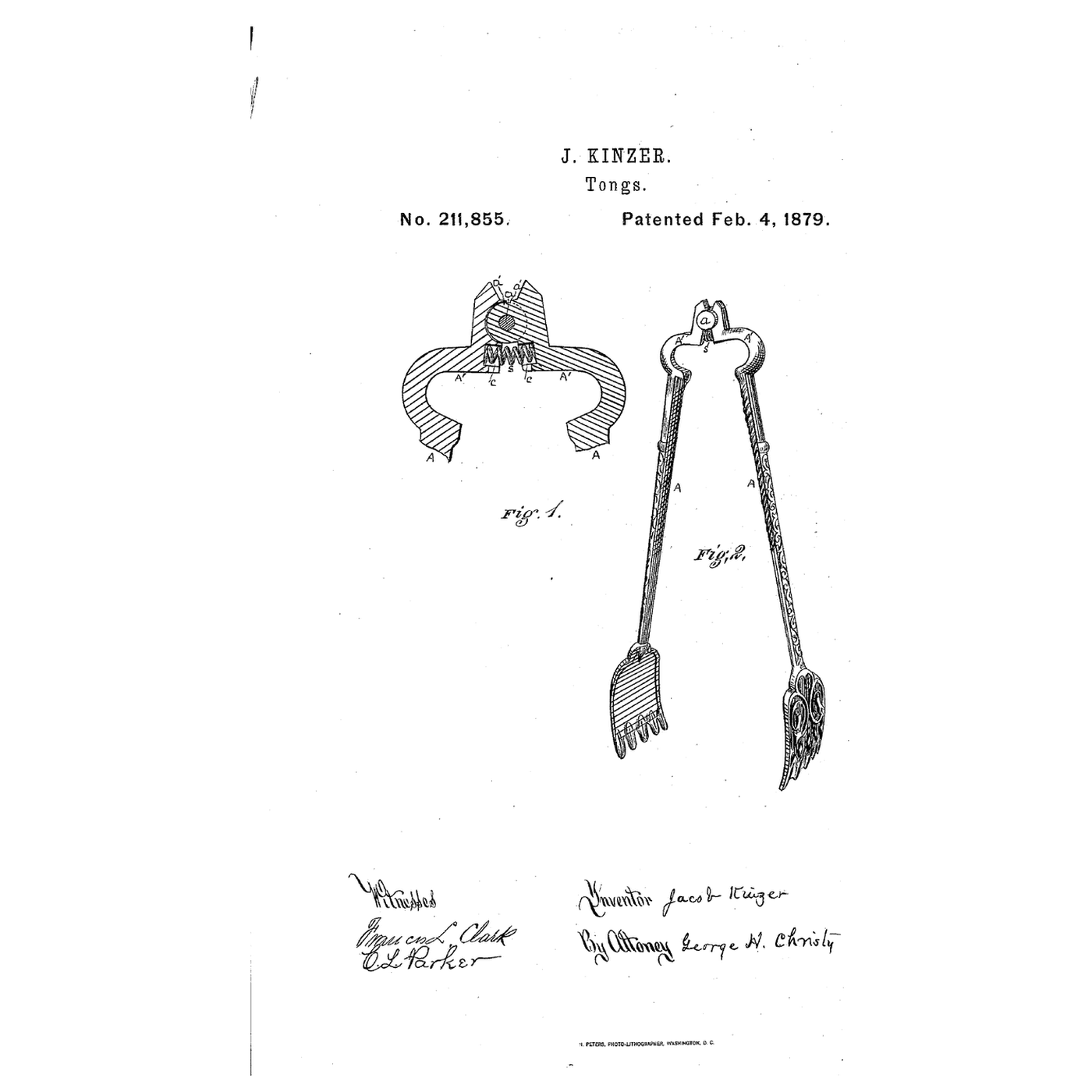
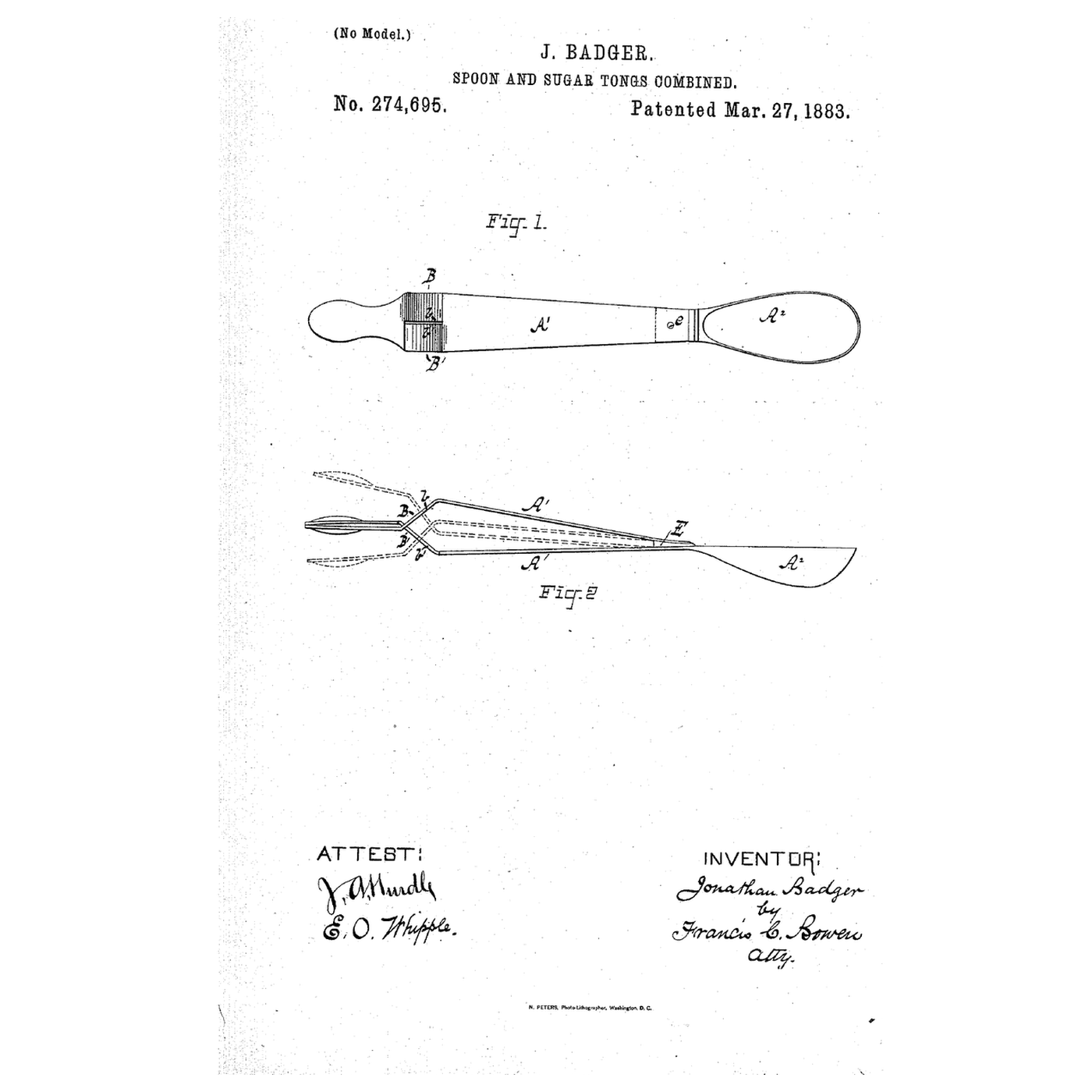
The embedded blueprint builds pivoted tongs with a spring by the pivot. Story's cracker gives the pivot two places to go.
3
3
Read US 417,951
Read US 417,951
"In said drawings, a a represent the two jaws of a nut-cracker with handles a′ a′, and pivoted at a² to a variable fulcrum b, one portion of said fulcrum b′ being arranged for small nuts and the other portion b² for larger nuts."
"When the nut-cracker only is to be employed, the nut-pick is allowed to remain in the handle, secured by the screw f, where it is out of the way and in no manner interferes with the use of the cracker".
4
4
Build the cracker and crack both sizes
Build the cracker and crack both sizes
**Bars.** Cut two 20 cm lengths of 20 × 5 mm mild steel flat bar. File a shallow V across the inside face of each near one end: the jaws. Clamp the two bars together and drill two 6.5 mm holes through both, 20 mm and 35 mm from the middle of the jaws.
**Pick handle.** Cut 12 cm of 3/8" brass tube and epoxy it along the outside of one handle, open at the end, as the socket for a nut pick. Let it cure.
**Pivot.** Bolt the bars through the near hole with an M6 bolt and two nuts locked against each other.
**Test.** Crack five pecans and five walnuts; measure the handle spread at the crack with the ruler. Move the bolt to the far hole and do the same. Compare with the notebook and with your own grip. Keep the nut pick in the tube between uses.
Materials for this step:
 Mild Steel Flat Bar0.4 meter
 Hex Bolt Assortment1 piece
 Hex Nut2 pieces
 Brass Tube 3/8" OD0.12 meter
 Epoxy Resin5 ml
 Walnut10 pieces
 Pecan10 pieces
Tools needed:
 Hacksaw
 Bench Vise
 Files (Hand File)
 Cordless Drill
 Drill Bit Set
 Adjustable Wrench
 Ruler
Ruler Digital Caliper 6-Inch
 Nut Pick
 Clear Safety Glasses
5
5
A cracker that will not open wide enough or slips
A cracker that will not open wide enough or slips
Two-fulcrum nut cracker troubleshooting.
Flow
Loading...
6
6
History and honest limits
History and honest limits
**Herbert Story** of Kearney, Hudson County, New Jersey, signed US 417,951 on 15 September 1888, filed it on 12 November 1888, and received it dated 24 December 1889. His solid handle carried a projection to match the socket on the other, "thus giving to the handle a uniform finish", and the pick screwed into the tubular handle.
**Honest limits.** Two drilled holes stand in for Story's fulcrum piece, and a push-fit brass tube for his threaded socket. The notebook assumes handles and jaws close together; its squeeze, lengths and nut sizes are examples. Your spreads and cracks are the result.
Materials
7- 0.4 meterPlaceholder
- 1 piecePlaceholder
- 2 piecesPlaceholder
- 0.12 meterPlaceholder
- 5 mlPlaceholder
- 10 piecesPlaceholder
- 10 piecesPlaceholder
Tools Required
10- Placeholder
- Placeholder
- Placeholder
- Cordless Drill3% commissionMagento Legacy Storeships internationallyPlaceholder
- Placeholder
- Placeholder
- Placeholder
- Placeholder
- Placeholder
- Placeholder
This blueprint makes

Related Blueprints
These blueprints share knowledge with this one — techniques, materials, or principles that connect them in the learning graph.



CC0 Public Domain
This blueprint is released under CC0. You are free to copy, modify, distribute, and use this work for any purpose, without asking permission.
Support the Maker by purchasing products through their Blueprint where they earn a Maker Commission set by Vendors, or create a new iteration of this Blueprint and include it as a connection in your own Blueprint to share revenue.