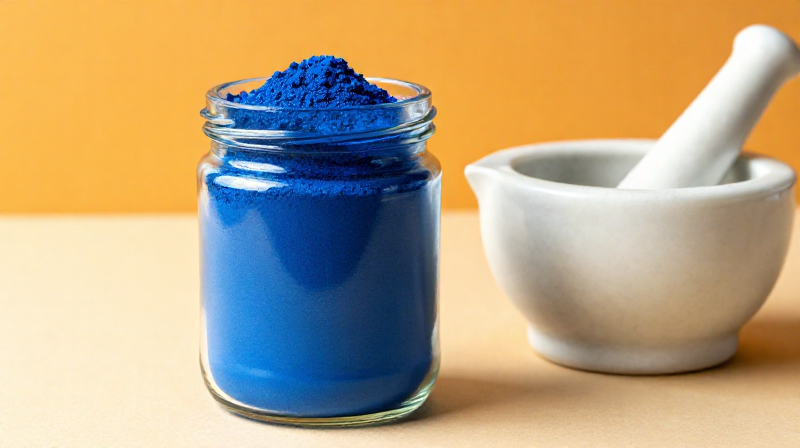


Making Phthalocyanine Blue — The Copper Complex That Became the World's Most Used Blue Pigment
Phthalocyanine Blue (Pigment Blue 15, CI 74160) is the single most important blue pigment developed in the 20th century. Discovered accidentally in 1928 at Scottish Dyes Ltd when a batch of phthalimide reacted with iron from a cracked enamel reactor lining, copper phthalocyanine was subsequently characterised by R.P. Linstead at Imperial College London and commercialised by ICI in 1935 as 'Monastral Blue'.
The molecule is a flat, sixteen-membered macrocyclic ring surrounding a central copper atom — structurally related to the porphyrins that colour blood (haemoglobin) and chlorophyll. This large, stable, planar structure absorbs orange-red light intensely, producing a vivid, strong blue with tinting power that dwarfs all earlier blue pigments. A single gram of phthalo blue can tint ten times more paint than an equivalent mass of ultramarine.
The laboratory synthesis involves heating phthalic anhydride (or phthalonitrile) with urea and a copper salt in a high-boiling solvent with a catalytic amount of ammonium molybdate. The reaction proceeds at 180–200 °C as the phthalic units cyclise around the copper ion, building the macrocyclic ring four units at a time.
Phthalo Blue has near-perfect lightfastness, extraordinary chemical resistance (surviving boiling in concentrated sulfuric acid), and complete insolubility in all common solvents. It is used in automotive paints, printing inks, plastics, artists' paints, and industrial coatings worldwide.
SAFETY WARNING: The synthesis involves heating to 200 °C in a high-boiling solvent. Urea decomposes to release ammonia. Use a fume hood or work outdoors. Phthalic anhydride is an irritant and sensitiser — avoid inhaling dust.
Hazardous content
This blueprint contains hazardous procedures. Log in and enable hazardous content in your account settings to view the step-by-step instructions.
Related Blueprints
These blueprints share knowledge with this one — techniques, materials, or principles that connect them in the learning graph.
Making Egyptian Blue — The World's First Synthetic Pigment
by Charlie
General
Making Smalt — Grinding Cobalt Blue Glass into the Renaissance Painter's Blue Pigment
by Charlie
General
Making Cerulean Blue — The Sky Blue Pigment of the Impressionists
by Charlie
General
Making Indigo Pigment for Painting — Extracting the Blue Pigment Cake from Indigo Plant
by Charlie
General
Making Hansa Yellow — The Monoazo Pigment in Every Paint Box Since 1910
by Charlie
General
Making Synthetic Alizarin Crimson — The Coal Tar Pigment That Destroyed the Madder Industry
by Charlie
General
Making Dioxazine Violet — The Staggeringly Powerful Purple That Replaced Cobalt Violet
by Charlie
General
CC0 Public Domain
This blueprint is released under CC0. You are free to copy, modify, distribute, and use this work for any purpose, without asking permission.
Support the Maker by purchasing products through their Blueprint where they earn a Maker Commission set by Vendors, or create a new iteration of this Blueprint and include it as a connection in your own Blueprint to share revenue.