Colaboración
ARTE
BELLEZA Y BIENESTAR
ARTESANÍA
CULTURA E HISTORIA
ENTRETENIMIENTO
MEDIO AMBIENTE
COMIDA Y BEBIDAS
INGENIERÍA INVERSA
CIENCIAS
DEPORTES
TECNOLOGÍA
TECNOLOGÍA VESTIBLE
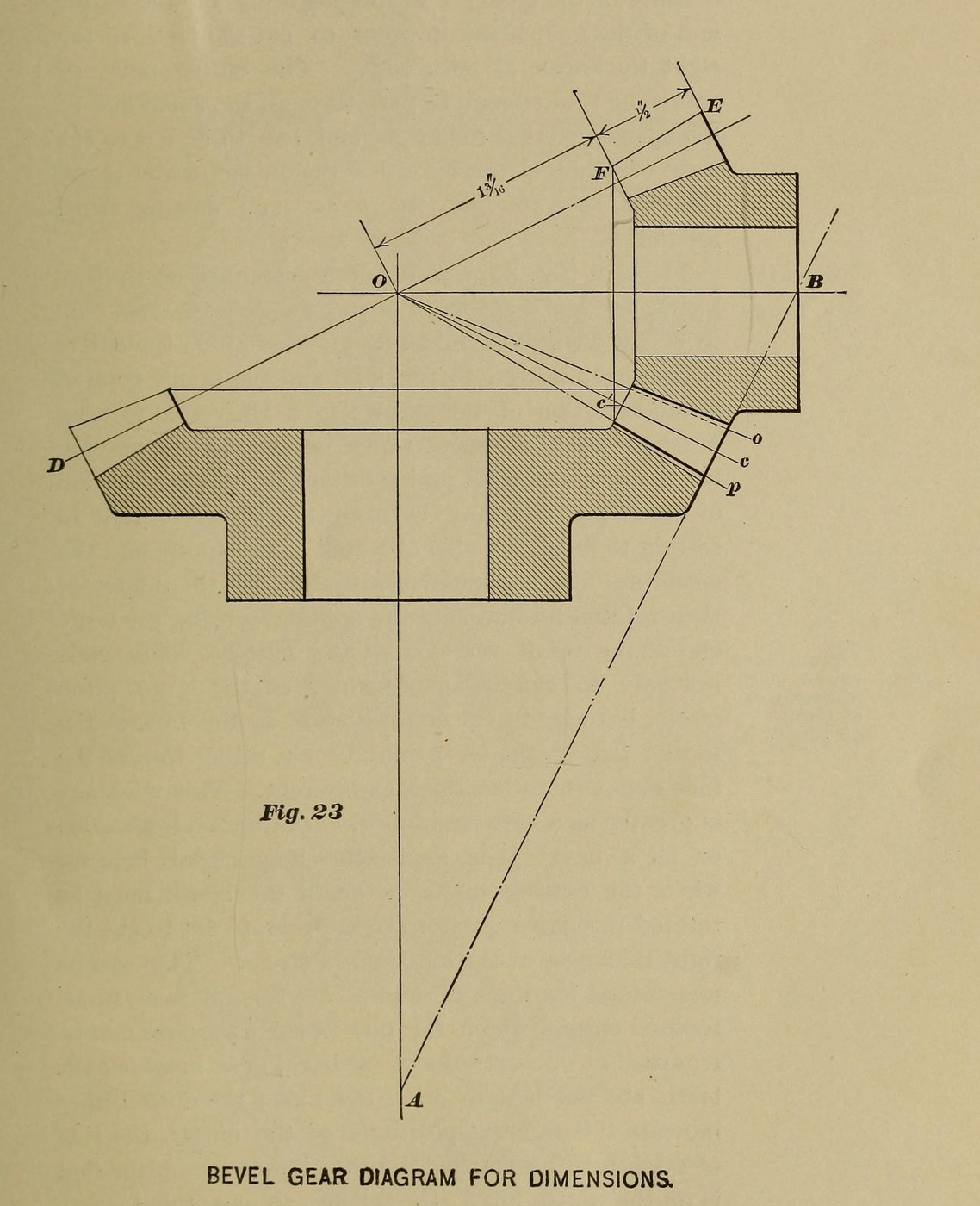


Bevel Pinion: 12 Teeth, 8 Pitch, for a 24-Tooth Gear (Brown & Sharpe 1911)
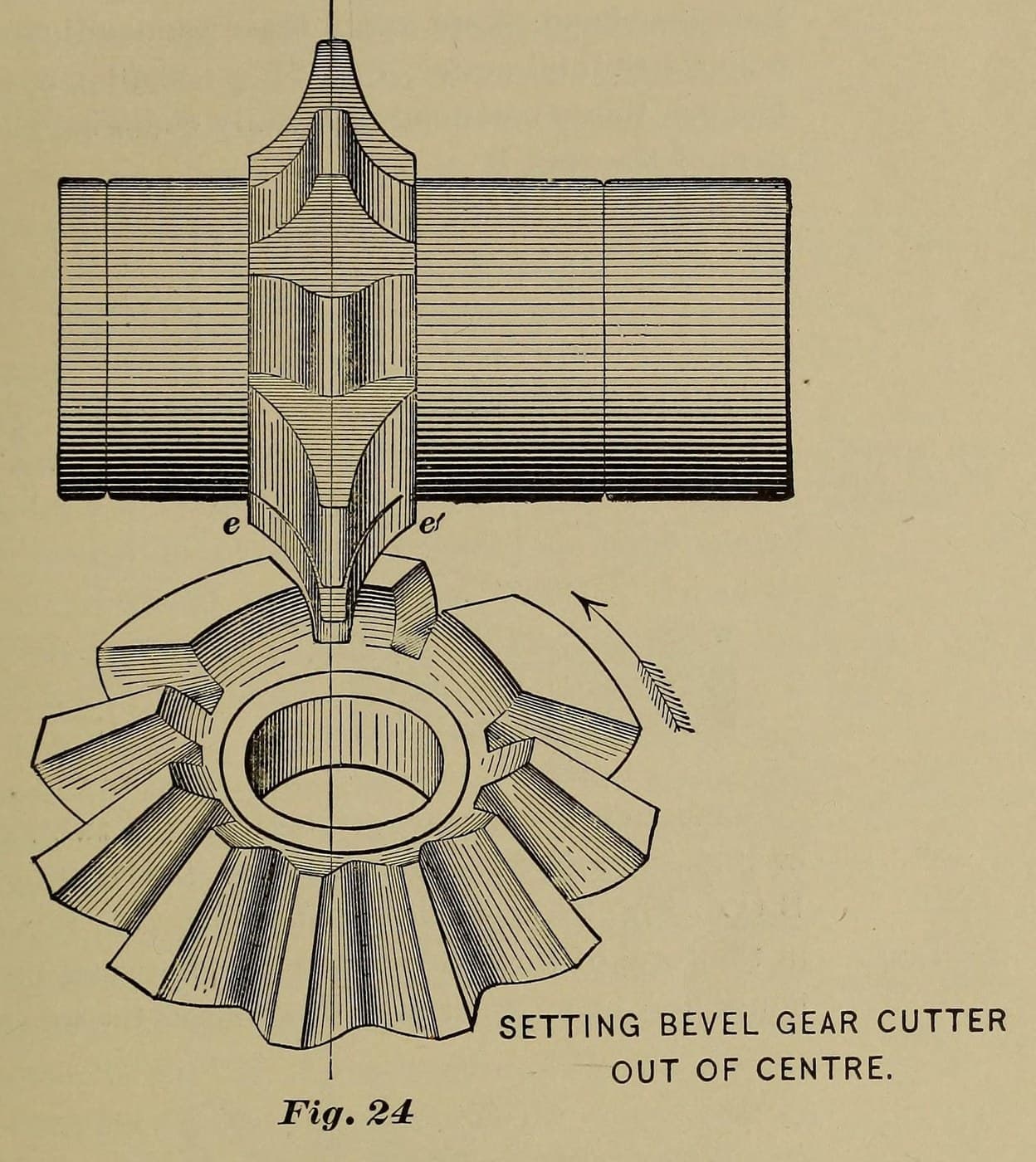
Brown & Sharpe's own worked example: the small gear of a 12 and 24 tooth bevel pair, 8 pitch, shafts at right angles, cut with the No. 8 cutter they send to anyone who orders one for this pinion. The method is the same as for mitre gears: set off centre, cut each side, file the small ends.
Source: Brown & Sharpe, Practical Treatise on Gearing (1911), Fig. 23 example, Part I ch. IX–X, Part II ch. III and the set-over table p. 58. The blank sizes are our arithmetic with their rules; the steel and bore are ours. Picture: their Fig. 23.
Avanzado
1 day
Instrucciones
1
1
Work out and turn the blank
Work out and turn the blank
Pitch diameter 12 ÷ 8 = 1.500 in. Angle of edge 26° 34′ and angle of face 59° 11′ (Brown & Sharpe's figures for every 12 and 24 tooth pair). Diameter increment = cos 26° 34′ × 0.250 = 0.224 in, so turn the steel blank to 1.72 in outside diameter. Face ½ in long. Try both angles with a protractor against the end of the hub.
Materiales para este paso:
 Barra de acero dulce1 length for one blank
Herramientas necesarias:
 Torno de metal
 Herramienta de corte para torno
 Transportador de ángulos
 Micrómetro
2
2
Choose the cutter
Choose the cutter
Twice the back cone radius × 8 comes to about 13, so a No. 8, 8-pitch bevel gear cutter. Measure its thickness Tc at the pitch line, 0.145 in from its tip.
Herramientas necesarias:
 Fresa para engranajes cónicos
 Calibre vernier para dientes de engranaje
3
3
Set the head at 22° 18′
Set the head at 22° 18′
Apex distance = sec 26° 34′ × 1.5 = 1.677 in. Angle increment: tan = sin 26° 34′ ÷ 6, giving 4° 16′. Set the dividing head to the cutting angle 26° 34′ − 4° 16′ = 22° 18′ and index 12 spaces. Depth at the large end 0.270 in.
Herramientas necesarias:
 Fresadora
 Cabezal divisorFresa para engranajes cónicos
4
4
Set over and cut one side
Set over and cut one side
Apex distance ÷ face = 3.35; we take the nearest column, 3¼, where a No. 8 cutter has the factor .286. Set-over = Tc ÷ 2 − .286 ÷ 8 = Tc ÷ 2 − 0.036 in. Set off centre by that amount, take up backlash, and cut round all 12 spaces.
Herramientas necesarias:
FresadoraCabezal divisorFresa para engranajes cónicos5
5
Set over the other way and trim
Set over the other way and trim
Set over the same amount the other side, line the cutter up with the space at the small end, take a trial cut, and rotate toward the cutter until the tooth is 0.196 in thick at the large end and 0.138 in at the small end. Check with the gear tooth vernier, then cut round.
Herramientas necesarias:
FresadoraCabezal divisorFresa para engranajes cónicosCalibre vernier para dientes de engranaje6
6
File the small ends
File the small ends
File the teeth rounder at the small ends, where the cutter could not, without filing them thinner at the pitch line. The cutting angle is under 30°, so the spaces may come out narrower at the face than the cutter suggests; Brown & Sharpe's own shop used a No. 6 cutter here instead.
Herramientas necesarias:
 Lima fina
Materiales
1- 1 length for one blankMarcador de posición
Herramientas requeridas
9- Marcador de posición
- Marcador de posición
- Marcador de posición
- Marcador de posición
- Marcador de posición
- Marcador de posición
- Marcador de posición
- Marcador de posición
- Marcador de posición
Este plano hace

Blueprints relacionados
Estos blueprints comparten conocimiento — técnicas, materiales o principios
CC0 Dominio público
Este Blueprint se publica bajo CC0. Eres libre de copiar, modificar, distribuir y usar este trabajo para cualquier propósito, sin pedir permiso.
Apoya al Maker comprando productos a través de su Blueprint, donde gana una Comisión del Maker establecida por los vendedores, o crea una nueva iteración de este Blueprint e inclúyela como conexión en tu propio Blueprint para compartir ingresos.