Colaboración
ARTE
BELLEZA Y BIENESTAR
ARTESANÍA
CULTURA E HISTORIA
ENTRETENIMIENTO
MEDIO AMBIENTE
COMIDA Y BEBIDAS
INGENIERÍA INVERSA
CIENCIAS
DEPORTES
TECNOLOGÍA
TECNOLOGÍA VESTIBLE
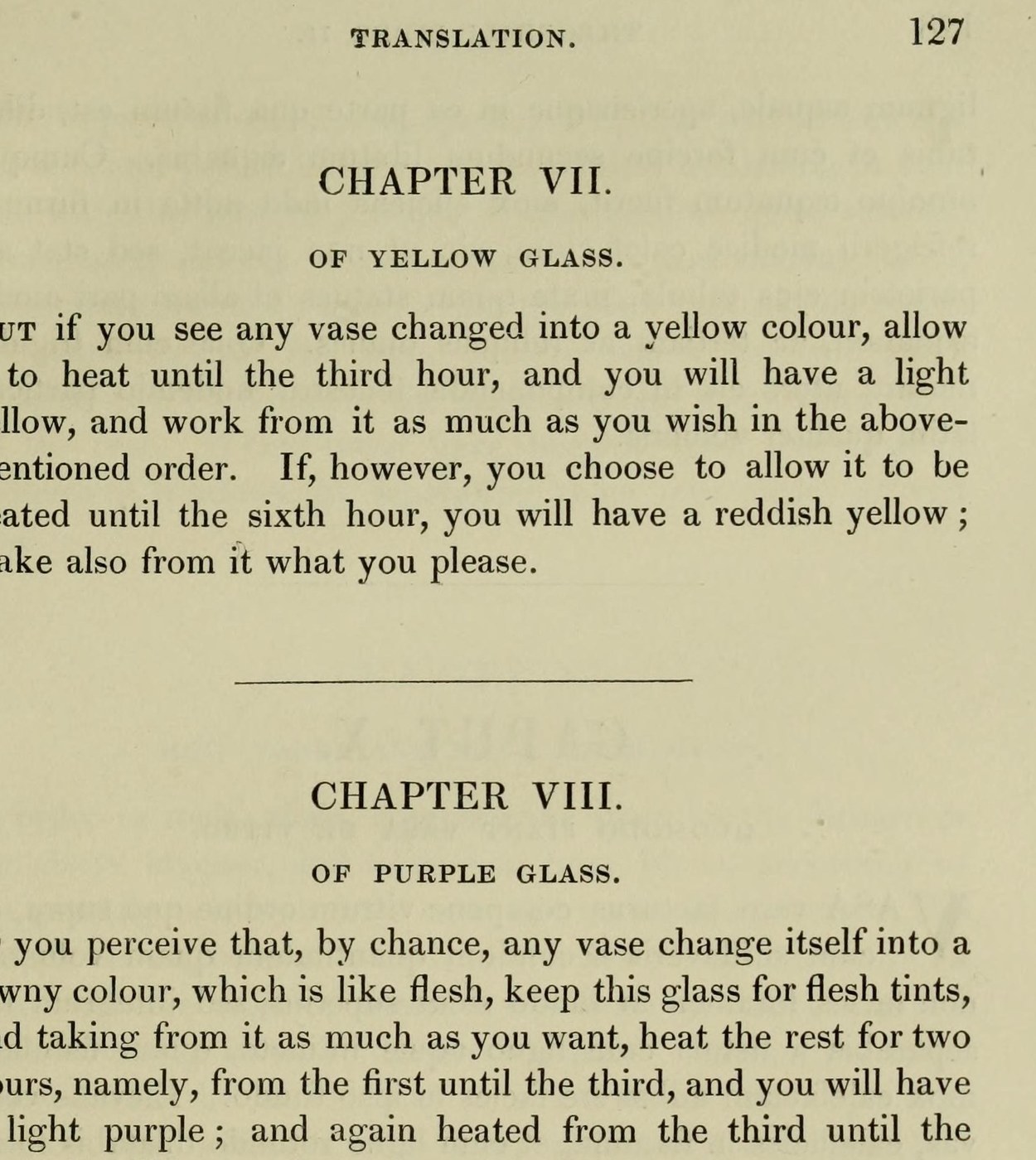


Coloured Glass Sheets: Beech-Ash Glass Blown into Cylinders and Flattened (Theophilus, tr. Hendrie 1847)
Window glass as the monk Theophilus taught it around 1100: two parts beech ash to one of clean sand, fritted for a night and a day, melted overnight in clay pots, blown into long bladders, opened into cylinders, split and flattened in a second oven, and cooled standing upright.
White glass comes first. A pot that turns yellow gives light yellow if heated to the third hour and reddish yellow by the sixth; a pot that turns flesh-coloured gives light purple after two more hours and red purple by the sixth.
Source: Theophilus, De Diversis Artibus, Book II, tr. R. Hendrie (1847), pp. 119-129. Picture: p. 127.
Avanzado
2-3 days
Instrucciones
1
1
Make the beech ash
Make the beech ash
Cut beech-wood logs and dry them. Burn them together in a clean spot and collect the ashes, taking care that no earth gets mixed in.
Materiales para este paso:
 Troncos de madera dura (roble, arce, haya)1 beech
Herramientas necesarias:
 Paleta de albañil
2
2
Frit the ash and sand
Frit the ash and sand
Mix two parts of ash with one part of sand washed free of earth and stones. Heat it on the upper hearth of the furnace for a night and a day, stirring it with an iron trowel as it warms so that it does not melt into a lump.
Materiales para este paso:
 Arena de cuarzo1 1 part to 2 of ash
Herramientas necesarias:
 Horno de vidrio capaz de alcanzar 1100 grados CelsiusPaleta de albañil
3
3
Make the pots and melt
Make the pots and melt
Grind dry white clay, wet it, beat it hard with wood and make pots wide at the top and narrow below, with a small lip curved inward. Set the dry pots in the glowing furnace, fill them in the evening with the hot frit and feed dry wood all night until the glass is fully melted.
Herramientas necesarias:
 Caolín en polvoHorno de vidrio capaz de alcanzar 1100 grados Celsius
 Tenazas de fraguaPaleta de albañil
4
4
Blow the cylinders
Blow the cylinders
In the morning gather glass on the iron pipe (two yards long, a thumb thick), blow a little, tap it on a flat stone so it hangs evenly, and blow it into a long bladder. Melt open the far end in the flame and widen it with a piece of wood, break it off the pipe with a wet piece of wood, open the other end the same way, and let a boy carry the cylinder on a stick to the warm cooling oven. This first glass is pure and white.
Herramientas necesarias:
 Caña de soplador de vidrioHorno de vidrio capaz de alcanzar 1100 grados Celsius
 Horno de recocido
5
5
Bring out the colours
Bring out the colours
If a pot turns yellow, heat it to the third hour for light yellow or to the sixth for reddish yellow. If a pot turns tawny like flesh, keep some for flesh tints; heat the rest from the first to the third hour for light purple, from the third to the sixth for a red purple. Blow cylinders from each as before.
Herramientas necesarias:
Horno de vidrio capaz de alcanzar 1100 grados CelsiusCaña de soplador de vidrio6
6
Split and flatten
Split and flatten
When all are made and cooled, fire the flattening oven. Split each cylinder along one side with a hot iron, lay it on the glowing hearth, and when it softens open it with the pincers and a smooth piece of wood and flatten it. Stand the sheets upright against the wall of the warm cooling oven, one next to another. When cold, cut them into pieces for windows.
Herramientas necesarias:
Horno de vidrio capaz de alcanzar 1100 grados CelsiusTenazas de fraguaHorno de recocidoMateriales
2- Marcador de posición
- 1 1 part to 2 of ashMarcador de posición
Herramientas requeridas
6- Marcador de posición
- Marcador de posición
- Marcador de posición
- Marcador de posición
- Marcador de posición
- Marcador de posición
Este plano hace

CC0 Dominio público
Este Blueprint se publica bajo CC0. Eres libre de copiar, modificar, distribuir y usar este trabajo para cualquier propósito, sin pedir permiso.
Apoya al Maker comprando productos a través de su Blueprint, donde gana una Comisión del Maker establecida por los vendedores, o crea una nueva iteración de este Blueprint e inclúyela como conexión en tu propio Blueprint para compartir ingresos.